

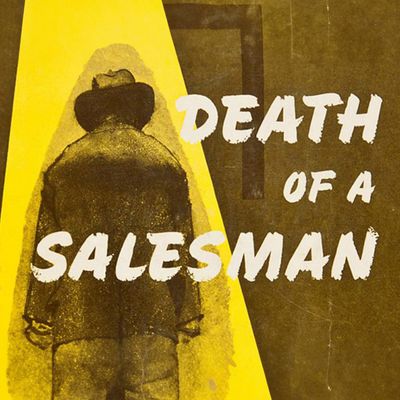
In this episode, Jeff & Richie sit down and discuss the 2022 Broadway revival of Arthur Miller's "Death of a Salesman". The acclaimed West End production makes its way to the Hudson Theatre and is starring Wendell Pierce and Sharon D Clarke... Read More
From the show: Half Hour with Jeff & Richie (Post-Show Broadway Discussions and Interviews)
Featured Shows
About
In this episode, Jeff & Richie sit down and discuss the 2022 Broadway revival of Arthur Miller's "Death of a Salesman". The acclaimed West End production makes its way to the Hudson Theatre and is starring Wendell Pierce and Sharon D Clarke. Tune in and hear Jeff & Richie's thoughts on the overall production, how a new twist on this show works in today's theatre, and a deep dive into Arthur Miller's works.
(Show was seen on Monday, September 26th, 2022)
If you liked this episode, don't forget to subscribe to this podcast and leave us a review.
Share your thoughts with us on this episode below:
On Instagram: @halfhourpodcast
On TikTok: @halfhourpodcast
On our website: www.twoworldsentertainmentllc.com
Transcript
This transcript was automatically generated and might contain errors.
[0:08] Richie Grasso: Hello, and welcome to Half Hour, an entertainment podcast through Two Worlds Entertainment.
[0:12] Jeff Malone: I'm Jeff.
[0:13] Richie Grasso: And I'm Richie. Here to bring you the casual conversations on the shows and films and concerts and music that we see and observe throughout our careers.
[0:21] Just a heads up that this conversation will feature spoilers.
[0:24] So make sure you're checking out the piece that we're discussing or not. It's completely up to you, but we are going to have spoilers on what we're talking about today.
[0:32] So you have been warned if you want to see this live in person first before listening on with the podcast.
[0:38] Today we are talking about the 2022 Broadway revival of Arthur Miller's's Death of a Salesman playing at the Hudson Theater on Broadway in New York City.
[0:46] This production stars Wendell Pierce and Sharon D. Clarke, along with Andre DeShields, and it is directed by Miranda Cromwell.
[0:55] This was a really successful revival in London that is now here, a long-awaited return of this show.
[1:02] We see, I believe this is the fourth or fifth revival of the piece on Broadway.
[1:07] It's I think it's been on Broadway four or five times.
[1:10] So yeah, it's quite often done.
[1:12] This is only the first time that I've seen it.
[1:14] Yeah.
[1:15] And we've all so many people have studied it, you know, throughout their studies as students.
[1:22] It's definitely something to study.
[1:23] I've read it in high school.
[1:24] Yeah.
[1:24] And this is the Young Vic Theatre production from London that's here.
[1:28] This production was originally directed by Marion Elliott and Miranda Cromwell at the Young Vic Theatre in London and subsequently at the Piccadilly Theater in London in 2019.
[1:36] So this was a pre-COVID piece that's now here in New York.
[1:40] And Wendell Pierce and Sharon D. Clarke did do this over there as well, which is really cool.
[1:48] Death of a Salesman, a heavy piece.
[1:50] It is arguably considered one of the greatest, one of the greatest plays of the 20th century.
[1:56] It of American theater.
[1:58] Arthur Miller's writing The A View from the Bridge, Death of a Salesman, All My Sons, and The Crucible, meaning his four major pieces, along with many, many other things.
[2:09] What do we think of this?
[2:11] We I will say this was about the Lohman family, it was an all-black family, the Lohman family being seen on Broadway for the first time like that.
[2:19] And that definitely adds to a lot of different elements of this piece and the themes.
[2:23] It's heavy, it was over three hours long.
[2:26] So we were dealing with a really long, heavy piece here.
[2:30] What were your overall general thoughts of this play and this production of it?
[2:34] Overall thoughts for me is that the show, I think that it just worked.
[2:41] You know, seeing this. I've read the play, I haven't seen any productions of it, but seeing this and seeing this with an all-black family, seeing the story in that light and that viewpoint, it was it just worked, but it was also different to see, and how they were able to kind of make this work.
[2:59] And that kind of goes for like any family, you know, during that time in America and being a salesman.
[3:05] So I think, you know, it's really cool when you can take a piece and relate it to multiple families of different backgrounds, etc.
[3:15] So yeah, I thought it just, you know, it was good.
[3:18] I think what's so interesting is when you see a play that so many people have read and so many people know, and you take a dynamic element of it and you just take a different, you don't change the script.
[3:30] There's nothing really changed. You didn't change the time period, and you were reminded that what were black families going through at this time of American history?
[3:38] We're talking about the late 40s into the 50s, so the wars are kind of ending a little bit.
[3:42] We're coming to the baby boomer time of Americana being this verge of the 1950s, being this boom of economy and boom of success and the American dream and raising families and living.
[3:55] And then you realize, no, it wasn't that great for so many people, right?
[4:00] There's this amazing blurb in the playbill by Armin De Thomas titled Death of a Salesman at Home with Willie Lohmann and it speaks about black communities coming up from the South and migrating to northern cities for looking for a better pay and successful work and successful jobs.
[4:18] And we learned that in the 1920s and 30s, where the Lohman family is in Bedford Stuyvesant neighborhood of Brooklyn, that neighborhood was experienced a large influx of black Americans to, as I'm quoting here due to the migration and the introduction of the A train that connected Harlem to Brooklyn.
[4:33] And eventually Crown Heights and Bedford Stuyvesant became predominantly black.
[4:37] So how do we not see a piece like this when you're seeing a black family in Bed Stuy in Brooklyn living?
[4:44] And there's so many things going on with this.
[4:46] I'm so many people know the plot of this, so I'm gonna, we're not gonna talk too too much about the plot of this because so many people have read this, but I do want to talk about this production in specific and what's working and what's going on here.
[4:58] First of all, I will say I was really really blown away by Wendell Pierce's whole portrayal of Willie Lohmann.
[5:07] Yeah, it was so commanding.
[5:09] I read a few things where people were like, oh, he was angry a lot, he yelled a lot, it was a little abrasive a lot.
[5:15] Some people had said that in just commentary that I read and heard about.
[5:18] And I said, I didn't think so at all.
[5:19] I thought he totally hit the mark where he needed to.
[5:22] This is such a tragedy piece of a struggle of a man who is just dealing with all of the hard heartaches of life.
[5:31] And you're seeing so you have to carry that whole piece on your shoulders.
[5:35] You're on the stage the majority of the piece.
[5:37] I thought he was really, really amazing in the role.
[5:40] Yeah, I agree.
[5:41] I really, really do.
[5:43] I thought Sharon D. Clarke was also really great in the role.
[5:45] For me, I feel like she warmed up to it.
[5:48] In the beginning, it was a little stiff, a little quiet.
[5:51] She seemed a little, and I think the character is stiff.
[5:54] She's clearly holding in that she knows that her husband's trying to kill himself, and so she's trying to deal with her sons being back in the house and her husband, and so she I but I think she really kind of then opens up as the piece goes.
[6:06] So if that's done on purpose, then good for her, because she's really showing the arc of the character.
[6:11] And I really enjoyed her more in the second act as she really kind of opened up more as the character.
[6:17] Yeah, I think kind of both of them were great together, and I thought that they had great chemistry.
[6:23] Yes, great chemistry together, and even with their two sons, you know, them as a whole family dynamic really worked well together.
[6:31] And I always like there's a lot, there's so much hidden message in this.
[6:35] Whenever I see, I find Tennessee Williams and Arthur Miller's, their pieces just have so many hidden messages and themes.
[6:41] There's something I wanted to talk a little bit about some of the themes of the piece here.
[6:45] Yeah, Willie, the name Willie, will he will he die?
[6:53] Will he kill himself?
[6:54] Will he be successful?
[6:56] Will he?
[6:56] They never call him William.
[6:58] Yeah, there's a theory that's not my idea.
[7:01] This is something that's been around the history for the many years of this piece.
[7:04] I've just throwing it out there to get your opinion on something like that.
[7:07] Lohman, low man, yeah.
[7:11] There, I mean, when you automatically look at this man's name, and actually, I believe that Arthur Miller's denied, there's there's somewhere in the history that Arthur Miller's denied that Lohman was purposely done as low man, but critics have said, Oh, well, you named this guy.
[7:26] Will he Lohman?
[7:28] I mean, is there theory behind that?
[7:29] What do you think of just his name in general when you hear something like that?
[7:32] I feel like that would make sense if all four of the characters had something similar.
[7:38] Yeah.
[7:39] So like Linda Lohman, it's just Linda Lohman.
[7:43] Right.
[7:44] So I mean, it kind of works.
[7:47] It's a good interpretation by someone to come up with that theory.
[7:52] And like happy, he's happy.
[7:55] Yeah, he's just happy-go-lucky, right?
[7:57] And then Riff or Biff.
[8:00] Rev.
[8:01] Biff is kind of like his father, but like Biff.
[8:05] What do you, you know, you're it gets it?
[8:06] I say riff because it's like you're gonna get in like the riff.
[8:09] Yeah, yeah, yeah.
[8:10] So with those, maybe it's just the man, the men in the story that would contribute to that by name.
[8:18] Maybe, yeah.
[8:19] But and I just find that to be interesting, and that and the struggle of this man, and I and I always also find the mystery of the theme of Willie Lohmann also is like, what is where is he going?
[8:30] Yeah, he's going out of town.
[8:32] They never specifically he's names the cities he goes to, but we know that he's having an affair, he had an affair.
[8:38] Infidelity is a theme throughout this piece.
[8:41] As and what and and and having that affair, but also being a mediocre salesman is he he can't accept that he doesn't make the sales that he wishes he could.
[8:52] He's been doing this job for 30-something years.
[8:54] Long ago, his brother offered him a job in Alaska, he didn't go.
[8:58] There's this steadiness of what's and it's what's reality versus what's illusion.
[9:05] The illusion of what is reality for Willie Lohmann and what is illusion.
[9:10] And he dips into the memory scenes of his past as the happier times of his life.
[9:16] Yeah.
[9:16] And the reality is he can't pay his bills.
[9:18] The reality is his sons won't are not getting their lives together.
[9:22] The reality is that he is not as successful as he wants to be when he sees others around him being successful.
[9:28] But they were the happier times that they could flash back to, but were they?
[9:34] I think that's the point of the flashback is he was making something out of nothing.
[9:42] It seemed like he was happy when his son was successful in football.
[9:46] And there was this like, you're gonna play football, you're gonna go to college and play football.
[9:50] The American dream to go be a football player.
[9:53] And to see a black family in Brooklyn talking about their sons having the dream like this, and then their sons not finding their way.
[10:00] And then when they go into these office scenes and you see white actors cast in these roles and the racism that is existing there that I never really thought I'd seen racism in a production of Death of a Salesman, and I see this now.
[10:12] I'm like, wow, it's astonishing to see that nothing has changed, but a director's vision of this can really, really just take a whole nother look at this piece.
[10:29] Because the tragedy is now just a different layer.
[10:31] Yeah.
[10:32] Well, that's like an interesting topic, kind of, because this was directed, and this concept was it came up from someone.
[10:41] They read this play and they said, Oh, this would work with a black family.
[10:46] And what they're feeling in the workplace at that time is very different than what a white man was feeling in the workplace at that time, right?
[10:54] Right.
[10:54] So as the death of the salesman as we originally know it, what was it?
[11:00] A poor white family.
[11:02] So that was just class status, right?
[11:04] It had nothing really to do with race.
[11:06] Right.
[11:07] And now this is both.
[11:08] It is such an amazing thing that we can, you know, when you look at history and you look at these playwrights who wrote about these family living room dramas and things of the 30s and the 40s and the 50s and the 60s, we can't forget what were Hispanic families and Asian families and black families dealing with at the same time.
[11:26] And we can tell this tragedy piece from a different lens, and it can still work in that way.
[11:53] And there's that theory of is he gonna kill himself?
[11:56] If you don't know the piece, you really don't kind of know if he's actually going to.
[12:00] He's kind of getting manic and the pipe, the gas pipe and the gas line, that's a whole thing, and driving the car and killing himself.
[12:08] It's this tragedy theme.
[12:10] There's that line that Sharon D. Clarke has when she says, Your father is trying to kill himself.
[12:17] That is so shocking if you've never read this play before and you hear that because you're seeing, oh, Sahab family, this is tough.
[12:23] They're going through hardships, and then you hear that, like, whoa, now we're really in serious town.
[12:27] And the sons turn around and say, What mom?
[12:29] What are you talking about?
[12:30] And she's holding on to that.
[12:33] There's so much going on there.
[12:34] I just find that a lot of these themes really all intertwine.
[12:37] And I love the dipping into the memory.
[12:40] The brother, Andre DeShields playing the brother is this ghostly figure that comes in and out.
[12:45] He has these cryptic, mysterious lines about the diamonds in the jungle and Africa and his life.
[12:51] And what does that mean?
[12:53] He it's almost like you could have come with me, Willie.
[12:55] I could have showed you a better life.
[12:57] We could have had a journey.
[12:58] We could have made more money, but you stayed here.
[13:01] The decisions you make, and the brother almost like the ghost of Christmas past, kind of in Christmas Carol, or Scrooge and Marley kind of haunting him.
[13:10] It's that my brother's coming back to haunt me.
[13:12] But what's interesting about that character was it's Ben.
[13:17] Ben, yeah.
[13:19] It's like we don't really know why Ben is dead.
[13:24] So we see something that Willie has like looked up to or looked for guidance in life, but Ben is still dead.
[13:33] And I think that's an interesting point.
[13:35] What did he die from?
[13:36] Because they can't be that different in age.
[13:39] Right.
[13:40] So did something along the same lines happen?
[13:44] Yeah.
[13:45] Did Ben have all of the answers really?
[13:47] Because it seemed like when he would come, Linda would be annoyed that he was there.
[13:54] Kind of tainting Willie's opinion.
[13:57] Or, you know, Willie would be like, I gotta get out.
[13:59] We gotta go to Alaska, we gotta go here, we gotta go.
[14:02] But what was Ben chasing that ended up ultimately in his death?
[14:07] Yeah.
[14:08] And at the very end, and then there's also something there when right before Willie Lohman goes to the car to kill himself at the end, Ben comes to him one more time.
[14:18] Yeah.
[14:18] And is saying that I went into the jungle at 17 and I left at 21.
[14:22] I'm paraphrasing something like that.
[14:23] And that it's diamonds in the jungle, something like that.
[14:26] It was so you could interpret that in so many ways.
[14:28] And it was almost like he had to hear his brother again to kind of make this horrible decision for his life.
[14:34] And it just astonishing.
[14:37] The piece is just so tragic and so sad.
[14:41] And how how does something how does a piece like this, when you're watching it from your own lens make you feel?
[14:49] It makes me feel really sad for the struggle that so many people have had to go through in their life or are still going through in their life.
[14:55] There was something so sad, and the audience reacted to this.
[14:59] Jeff Malone: There was a tragedy, and he would say to his son, you do not pick something up when you know he was trying to teach his son like you're gonna fight for $15,000, not $10,000.
[15:08] Richie Grasso: When someone drops something in that room, you don't pick it up, they'll pick it up.
[15:12] Jeff Malone: But the father picks it up. Then the father gives the advice that he couldn't give to himself or use in his own life, and there he is picking up the lighter, and then I found to be so chilling, and this must have been a directorial moment, I guess lighting the cigarette for the boss. It wasn't just picking it up, it was let me pick it up and let me serve you, and you're not helping me, but I will still the blatant racial tones there was so sad, and uh and the audience really reacted to that.
[15:40] Richie Grasso: I did I did hear that, you know. Um Yeah, I think for me, I think I put a lens on here. How do I see something like this in my own life and the different lives around me? And I thought one of the biggest takeaways for me was that I think this was more with Biff, but like, what is the story that we're creating and presenting to the world that's false? And are we all living a big lie? But also, what are we working for? You know, what is the point of creating a career and a job and doing something that you either like or don't like? And I think there's so much hidden in that because I think when he looks at his father, he says, This man tried to create a career, was creating a career, and it all came crashing down from one night.
[16:40] Jeff Malone: The point that Biff goes and sees his father in Boston to find him having an affair. And we don't know at that point because guess what? He was just told by that woman, oh, you're gonna get up to the sales front now, you know, now that he was sleeping, and also how many other people was he doing that with? How many other um affairs was he having to get to the front? Because in the beginning, you kind of hear him say, Oh, I had all the clients, and then they were gone. And I think the same thing happened with Biff because it was like he had everything going for him, and one thing changed. He got a bad grade, he failed the class, and he couldn't, and then he went and saw his father having an affair. And after that, he feel he he really realized that everything was a lie.
[17:29] Richie Grasso: And the father and the son, and the older son Biff, and the dynamic between the two of them and the love they have for each other, but the hatred they have for each other's life. Your life should have been this, and your life should have been this. And the younger son's like, but I'm gonna get married, I'm gonna figure it out. He even says that at the funeral again. Mom, I'll be fine. You know, and the brother's a whole nother lane with that.
[17:51] Jeff Malone: Yes, there is because that son has he has the womanizer side of his life, he has the fun and fantasy free side of his life. You see that. Well, I think there's a whole another line lane with his character because Happy is the name, yep. Um Willie idolized and did everything for Biff and couldn't care less about Happy. And Happy just wanted his father's approval. Biff already had his father's approval, he didn't need to earn it, and Happy just wanted it and was never given it.
[18:23] Richie Grasso: Yeah. You ever feel that way?
[18:25] Jeff Malone: Yes. It's really astonishing. So there's a family dynamic there that's very the whole dynamic's tragic. They all love the mother.
[18:31] Richie Grasso: Yeah, the mother is the bedrock of the home. And let's actually go to the home a little bit.
[18:39] Jeff Malone: Yeah. Um, because I want to start also talking about this production element as well. We had some many um mysteriously moving set pieces, things hanging. It was a house that was frayed, that was broken apart, that came together when it needed to, and broke apart when it needed to. I found the house to be another character, and I found the house to really mirror what was going on in the family. There was not, I I'm such a person with the scenery where I I sometimes like literal, and I like and when it's something like this, there was a lot of pantomiming of props, and there was like no bed when they were sitting on a bed, or you know, it was limited. I understand we didn't need all that to clutter the piece.
[19:16] Richie Grasso: Um, that's where we're always so opposite.
[19:18] Jeff Malone: Yeah, I think. Because I love a stripped minimal show sometimes. Where it's like, you don't really need to see a house. You know that the house is there.
[19:27] Richie Grasso: Yeah. I like this idea of creating a vision here. What does this house really look like? Does and I think anyone sitting in that theater would say, Are they in a house? Are they in a building? Are they in an apartment? It's are they, you know. I like how the windows and doors would appear when needed and disappear. It didn't provide a clutter in front of the acting moment.
[19:47] Jeff Malone: Yeah. To me, there was something about everything hanging above them that was like, oh, at any point something could fall. The fragility of the home was mirrored in the fragility of the family. At any point, someone's gonna kill themselves, or someone's gonna leave, or someone's going to be sad or angry. And when you looked, I'm like, oh, yeah, at any point that table could fall. They're hanging on literal ropes and threads. And they came down when they needed to, and they went up. And I noticed everything was up, but when he died, and the mother at the end said, I paid the final mortgage on the house, the house is paid off. Look, it's done, and you're not here. It was a little bit of like a you can't take it with you.
[20:26] Richie Grasso: Yeah. But then the whole house came, everything settled down. The roof, too, a pitched roof appeared at the very end. Which we didn't see.
[20:33] Jeff Malone: Never saw until the very end. The roof, it was almost like the roof is done. And did you notice there's so and from a scenic designer's perspective? When you read in the script, we have to fix this, we have to fix that. Everything in their life, it almost was like, is the American dream to just have a big house that you constantly have to spend 30 years fixing until you pay your mortgage off? Because it was the refrigerator, it was the belt. Oh, we have to pay for this, the heater, the roof. Did they fix the roof, right? Yeah, the roof's fine, it's not leaking, right? The stoop, let's fix the stoop. They would say, Look at this stoop, how proud our father was of this stoop. Right. There was such pride that he had in the home.
And then there was multiple lines, like, Well, no one's here. I I'm working and I'm working and I'm paying off this home, and no one's here now. And it does go. I think that's such a commentary on American culture and American dream. People who think the big house is the American dream. And you spend your whole life paying for it. And then look, he literally didn't even live to see the day where he 100% owned it. And the whole house came down on her. And it was almost like she was left with, there's the table, there's the home, there's the everything is here, and I'm here alone. And if for a set design, it was pretty brilliant to do that at the end.
[21:46] Richie Grasso: I think it was really nice. It was nice to do that with the set. And it's also interesting to see what does Biff do in those final moments. Because he's walking through the home.
[21:55] Jeff Malone: Yeah. But he never leaves the home.
[21:59] Richie Grasso: No, I know. He continues to walk backwards. And one of the things that Willie says in the show is, oh, I want Biff to take this home. And does he end up doing it? Yeah. Never know. Yeah. You know, does he end up being a salesman? We'll never know. What does Biff end up doing? And does he take on a lot of the characteristics of his father now? Or does he go and live the life he wants to live? And it they all are at a crossroads. It's all I always find the line very interesting too when Linda at the end says, Where is everybody at this funeral? She has I'm paraphrasing, but I find that to be so chilling. She said, Why are we the only ones here? Yeah, he always talked about, I have clients in Boston and Hartford and all I go 30 years. And it's like, who was there for him at the death? It was his family and those neighbors.
[22:51] Jeff Malone: Yeah. Um, but that was it.
[22:54] Richie Grasso: Yeah. And that was, I think the mother realized the sadness of that, too. Well, I think that's the point too of showing the relationships that you create in your outside life outside of your home are not always going to be there. Maybe there would some, but they're not always going to be there. And also talking about design too, the lighting was beautiful. It was so mysterious, flashing things, people appearing, the mysteriousness of the flashbacks. There was a lot of great moments in the lighting. And the music was nice. I will say what was a little interesting for me is there were so many different genres of music in the piece. And I would love to know from the sound designer or the music composer's perspective why. If you remember, the beginning of the piece started with pop music.
[23:39] Jeff Malone: Yeah. We then went to like 40s jazz ballad standards, and then we ended with like gospel. We went to multiple places. Maybe that was showing the diversity of black music of different time periods. Maybe. But I also think it's a little bit uh a teeter of this story is timeless. So yes, it takes place in the 1940s. Yes. And written in the late 40s, yeah. But does this apply to the year 2022?
[24:11] Richie Grasso: Yeah.
[24:12] Jeff Malone: Yeah. And because of that, taking this weave of music throughout the show puts you in that sense, like, oh, this could really be happening today. And I think that's kind of intention.
[24:23] Richie Grasso: It could be. There is a part of me though that says, sink me into something for three hours. If I'm gonna sink into a piece about the 1980s, sink me into the 1980s for three hours.
[24:35] Jeff Malone: That's just some kind of how I feel sometimes.
[24:37] Richie Grasso: This is a little bit different.
[24:38] Jeff Malone: Yes, this is not really about the 1940s. This is about a family and the American family values, the American dream, career, etc. And because of that, I think we are still seeing, you know, this family in multiple aspects of it, multiple years of this. And that and that kind of leads me to the question I wanted to ask you, which is why is Death of a Salesman always done? Why is it timeless? And why is it a piece that is always done all the time? Every few years we see this.
[25:13] Richie Grasso: Well, I was kind of thinking I was kind of just going there, but yeah, right. I think um it's a timeless show. And I see this and I see the show, and I say, This applies to me. This applies to you, this applies to everyone in that theater. And that's why we still see shows that are written like this years after years after years. You know, that's why I think for me, yeah.
[25:37] Jeff Malone: Yeah, it is timeless and it is it is just shocking. It chills you to see this, and I think it's important to see a piece like this. And what would the next Broadway production 20 years from now be like? You know, because you're gonna just keep seeing it, right? You know, so yeah.
[25:55] Richie Grasso: Oh my gosh, we're out of time. We're talking about this amazing piece. Let's wrap this up a little bit here. Thoughts, thoughts, concluding thoughts. I think I want to ask you a question first before final thoughts. But um, we've now seen four of Arthur Miller's's um big plays. We've seen All My Sons, A View from the Bridge, The Crucible, and now Death of a Salesman all on Broadway. We've seen them together. So I guess now I would love to know out of those four, which is your favorite.
[26:23] Jeff Malone: Oh, that's a tough to call to make. I know this one the best, so I would say maybe Death of a Salesman. It's pretty close with A View from the Bridge. Um, I was in a production of The Crucible long ago, and I like The Crucible. Um, and I like All My Sons. To me, there's more rooted sense of relation to the struggles of what people are going through in a piece like A View from the Bridge and a piece like Death of a Salesman. I know those two the best, and they're kind of neck and neck for me. And but yeah, it is amazing that we've seen all four on Broadway in the last 10 or 15, about 10 years.
[26:54] Richie Grasso: No, 10 years, yeah.
[26:55] Jeff Malone: Yeah. So what about you? What would you say is your favorite?
[26:57] Richie Grasso: I kind of agree with you. I think it's a neck and neck between A View from the Bridge and Death of a Salesman. I like both of them because one story is about you know immigration and making it in this world to have that American dream. And I think this kind of picks up where that leaves off. And now we're talking about having the American dream and craving and wanting it for people that already live here. So I think they're both, you know, there's so many chilling moments in both of those shows, and they both still apply to our lives today. And All My Sons had some wonderful moments like that too. The Crucible is a little different because that's basically how the McCarthyism era of the Americana reflected in the witch hunts.
And that would that's a cool way to look at a piece too. Just a little different than this, but he wrote different pieces like that. That's okay. Uh, but yes, to con my overall thoughts, this is wonderful. This is a really chilling moving production. I strongly recommend people go out to see it. I think Miranda Cromwell's direction of it is amazing, but I do think that Wendell Pierce and Sharon D Clarke really carry this piece. They really do, especially what Wendell's doing in some of those flashback scenes is amazing. I really hope it gets some Tony nominations out of it. I know it's a limited run, so make sure you go check it out. I believe January 8th or 15th, it's running until so make sure you try to go check that out. But definitely, really moving piece. I'm glad we got to see it and discuss it.
[28:20] Jeff Malone: Yeah, I really enjoyed the piece as well. I think it's a little long. It's definitely a little long. So go in with that. I will I do wish sometimes with these old pieces. I know maybe they can't with the estate, you know, trim things down. If they could take 15 or 20 minutes off of it, I think that could really, you know, sometimes that the second act goes on like that. There's sometimes just dialogue that's unnecessary.
[28:39] Richie Grasso: Yeah, yeah. We sometimes we understand what's going on without needing it to be 30 minutes of a scene, maybe a 20 minute version of it. You know, I understand that you don't want to touch the piece in its original form, but yeah, but it's definitely a great piece to see. And we're seeing this in previews right now, so they're just gonna keep growing up. Hopefully it'll with this show and get better and better as well. So I think you know it was great already.
[29:02] Jeff Malone: So definitely go and check it out.
[29:03] Richie Grasso: Yeah, and let us know what you thought.
[29:05] Jeff Malone: Yes, please. I was gonna say that follow us at half hour podcast on Instagram, TikTok, Facebook, Twitter. Comment, engage with us, let us know what you thought. If you're seeing this, if you want to have conversations about the film, is a film version of this or past productions you've seen or the play. What do you think? Check it out. It'll be really, really great. So thank you all for listening. We have lots more shows coming up this season. Some pop music. Uh, this was really great that we got to check this out. And like I said, Arthur Miller's's Death of a Salesman is playing at the Hudson Theater in New York City on Broadway for a limited time until January of 2023. Uh all right, here we go. Signing off for now. Uh, thanks for listening. I'm Richie.
[29:40] Jeff Malone: And I'm Jeff. Saying ta-ta.
[29:44] Richie Grasso: Bye.
© Broadway Podcast Network, All Rights Reserved