

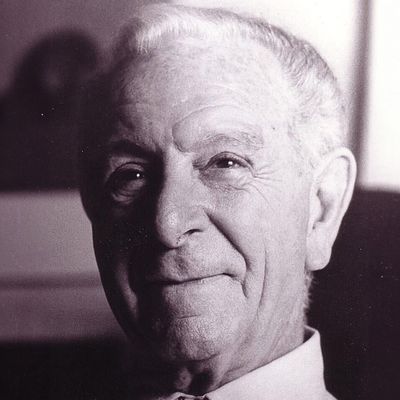
The third of a four-part program featuring Broadway composer Burton Lane, known for such celebrated shows as FINIAN’S RAINBOW and ON A CLEAR DAY YOU CAN SEE FOREVER, along with songs for over thirty films including ROYAL WEDDING and BABES IN ARMS... Read More
From the show: Anything Goes
Guests
About
The third of a four-part program featuring Broadway composer Burton Lane, known for such celebrated shows as FINIAN’S RAINBOW and ON A CLEAR DAY YOU CAN SEE FOREVER, along with songs for over thirty films including ROYAL WEDDING and BABES IN ARMS. Lane recounts his early songwriting efforts in Hollywood with Frank Loesser and Harold Adamson, Broadway collaborations with E.Y. “Yip” Harburg and Alan Jay Lerner, writing songs for Fred Astaire, and discovering a young Judy Garland.
Featured songs: “Overture from ON A CLEAR DAY YOU CAN SEE FOREVER,” “Look To The Rainbow,” “When The Idle Poor Become The Idle Rich,” “Old Devil Moon,” “Where Have I Seen Your Face Before?” “Too Late Now,” “You’re All The World To Me,” and “How Could You Believe Me When I Said I Loved You When You Know I’ve Been A Liar All My Life?”
Originally produced and broadcast in 1981. For more information go to AnythingGoesPL.com or BPN.FM/Anything Goes. Theme music arranged by Bruce Coughlin. Associate producer Jeff Lunden. Anything Goes – Backstage with Broadway’s Best – is produced and hosted by Paul Lazarus.
Transcript
This transcript was automatically generated and might contain errors.
[0:00] Paul Lazarus: Hi, this is Paul Lazarus. In the 1980s, I produced and hosted a radio series called Anything Goes, a celebration of the American musical theater. Now, the Broadway Podcast Network is bringing back these shows. Today, the third part of a four-part look at the career of legendary Broadway composer, Burton Lane. Lane is best known for his remarkable scores for Finian's Rainbow and On a Clear Day You Can See Forever. This program was originally broadcast in 1981.
[1:05] ♪ Musical number: "Overture from On a Clear Day You Can See Forever" — performed by Burton Lane ♪
[2:28] Paul Lazarus: Good afternoon and welcome to Anything Goes. Today's program is the conclusion of a two-part tribute to composer Burton Lane. Last week, we looked at the earlier part of Mr. Lane's career, his film scores to Dancing Lady, Babes on Broadway, and Dancing on a Dime, and his early contributions to Broadway musical theater, Three's a Crowd and Hold On to Your Hats. I'm your host, Paul Lazarus. I hope you'll join Anything Goes for the next hour and a half as we listen to a prerecorded interview with Burton Lane and songs from his scores to Finian's Rainbow, On a Clear Day You Can See Forever, Carmelina, his film scores to Royal Wedding and Give a Girl a Break, and rare recordings of Mr. Lane himself.
[3:44] Paul Lazarus: We now come in 1947 to a small show like the small Irving Berlin White Christmas, Finian's Rainbow, which is a masterwork in the musical theater. There's just no getting around it, and if you had written that alone, you would deserve to be on this program. That's in my opinion anyway. It's a great show. You know that the movie was just on? I just saw it. It's terrible. Oh, God. Who's that director? He should be shot. Well, it's Coppola. It's Francis Ford Coppola. He didn't understand the show at all. That was the second picture he ever directed. It's a shame, because he didn't understand the show at all. He didn't understand anything. Boy, what a shame. I'll bet if he did it today, it'd be a different film.
How did Finian's Rainbow evolve? How did that all get started? Yip and Fred Sadie, who worked with Yip on the book, had done a first draft, and then Yip brought it to my attention, and his first thoughts were that I should split the score with Earl Robinson. Yip had written some songs with Earl Robinson, who had written Ballad for Americans, and Yip was in his American folk period at that point, and he had written a song with Earl Robinson called The Free and Equal Blues, and he wanted to use that as a finale of the first act. And when he brought me this idea of Finian's, I was bowled over. I thought it was simply wonderful. I thought the premise was wonderful. I thought what it had to say was wonderful, the characters were marvelous, and I didn't think I would be able to do it.
I said, you know, you should go for George Gershwin, not me. I don't have enough training and enough... I've never done anything as challenging as this, you know, and I don't think I'm up to it. I had that feeling, and plus I had a feeling that the second act wasn't very good. I had reservations about how they were treating the second act. So between Yip's reluctance to change the second act and my original fears, about three months went by before I said yes, and Yip did change the second act, but I say this because I know you'll get to another story later on about Flahouli, which Yip was very stubborn about making changes where he was involved in the book. Lyrical changes were no problem, but book changes were impossible.
Anyway, we started to work on the show, and within a short time, Yip saw that there would be a total clash of styles if I were to do half the score in Earl Robinson, because although Earl was very capable of doing the kind of things that he did best, they were not theatrical. There's a big difference. There is a big difference, and I had a vision of what I wanted to hear, and it had to sound as if it were true folk music, but still belong to the stage, and apparently that was accomplished, but it's very hard to describe this, because I love folk music, but there's a certain kind of folk music that doesn't belong on this, you can't use dramatically.
[7:32] Paul Lazarus: Right, otherwise it just sits there.
[7:34] Burton Lane: It just lays there, you see, it doesn't have any real tension or excitement.
[7:39] Burton Lane: In Glacomora, where we come from, there's an old legend. You'll never grow old, and you'll never grow poor, if you look to the rainbow beyond the next moor.
[7:52] Burton Lane: Lovely legend. I wonder who thought it up.
[7:55] Burton Lane: My father. On the day I was born, said my father, said he, I've an elegant legacy waiting for ye.
[8:15] Burton Lane: There's a rhyme for your lip, and a song for your heart, to sing it whenever the world falls apart.
[8:31] ♪ Musical number: "Look To The Rainbow" — performed by Burton Lane ♪
[10:32] Burton Lane: Basically, it evolved from Yip Harburg and Fred Sadie's original book idea. I think it was Yip's original idea. I think it started with Yip, and then Freddie worked with him on it. Fred, very talented fellow. But Yip was a guy who came up with very brilliant ideas, original ideas of concepts and so forth that I'm sure started with him.
[11:01] Burton Lane: Also, Yip's social outlook was more in that direction than Freddy's. So that Yip was able to satirize the things that had to be satirized. But always with a sense of humor.
[11:22] ♪ Musical number: "When The Idle Poor Become The Idle Rich" — performed by Ella Logan, Donald Richards, and the Lin-Marie Singers ♪
[14:39] Paul Lazarus: You're listening to Anything Goes with the completion of a two-part tribute to composer Burton Lane. You heard two songs from his score, Finian's Rainbow, written in collaboration with Yip Harburg. Ella Logan, Donald Richards with the Lin-Marie Singers performed "Look to the Rainbow" and "When the Idle Poor Become the Idle Rich." Now back to a pre-recorded interview with composer Burton Lane. It'd be interesting to get your perspective on Yip Harburg at this point, now that he is really gone and just the long association you had with him.
[15:14] Burton Lane: Well, I have a lot of mixed up feelings about Yip because there was sort of a father-son relationship and there were a lot of wonderful things and feelings we had for each other. There were also a lot of frictions that developed along the way. But that is the nature of a father-son relationship, too, isn't it?
[15:40] Paul Lazarus: I suppose so. One of the great tragedies, I think, was that people who could have written Finian's Rainbow didn't do ten shows together.
[15:54] Burton Lane: That was obviously going to be one of my questions. I imagine people have to wonder why two writers who were able to do that kind of work didn't do a lot more. And I'm wondering, too, as I look back, you see. And this is where the frictions would come in. Was it... I mean, what I'm sensing you're saying is that you would have liked to have written more with Yip and it didn't happen.
[16:22] Burton Lane: Oh, there was no question. But Yip had very strong feelings about the kind of things he wanted to work on. And although I was not against working on the kind of things he wanted to work on, I couldn't accept that to the exclusion of everything else. And although I brought him many... Yip felt he was, very frankly, Yip felt he would be wasting his time if he didn't do a show which had social significance. Well, I loved social significance. I loved what Finian had to say. I never had any qualms or fears that it would be the wrong thing to do. I always was... Finian broke new ground on many fronts. And the fact that we did a fairy tale, a fantasy, a social satire, all combined in one, was a very daring thing to do.
And I was aware of this. Except I loved it. And Yip loved it and Freddie loved it. And if you love something enough and you do a good job, it's going to come off. But Yip wanted to turn everything into a social significant show. And I said, you know, it doesn't work for everything. And where it works, we'll do it. And where it doesn't work, let's keep busy doing things because there are enough things to do that we like.
[17:51] Burton Lane: But Yip never wanted to be teamed. He wanted to be like the eagle and me. He wanted to be free. And he wanted to keep himself available for anything that might come his way. And that, I think, was a basic error because even if he had decided to work with Harold Arlen, Harold is a giant. I would say was a giant. I mean, he hasn't been writing in years. But Harold was an exceptional composer. You know, he was just way above everybody. Both of you are. And I just think that, you know, where you can be a team, you have continuity of meeting, of working. You just turn out because it's there to be turned out. And it's so collaborative to begin with.
[18:43] Paul Lazarus: Right. And it's very frustrating to be a lone composer or a lone lyric writer where you're not settled in with somebody.
[18:54] Burton Lane: So there were a lot of things about Yip that were wonderful. Certainly a major talent, a tremendous creative man. But there were other aspects that were difficult. Many people said that if you really knew Yip, and I, of course, only knew him peripherally, he... I mean, we're talking about, you know, maybe all the bad sides. There's certainly so many wonderful sides to the man. I think I've shown that on my other programs. I think it's worthwhile to look at other... The person has a whole human being. We're talking about a human being. And, you know, nobody is all one thing.
[19:31] Paul Lazarus: Right. People are complicated.
[19:35] Burton Lane: Yip was, when he passed away, just about to be 85 years old. So there were a lot of years of where people were molded into whatever they became.
[19:48] Paul Lazarus: Absolutely. And Yip had a childhood. You know, Yip was a man who never believed he had what he had. And therefore he was always on the make to be recognized.
[20:01] Burton Lane: Right. When he had his recognition. He never believed he had it. And I can tell you stories about... that are kind of poignant and sad. I'll tell you one time, when he was at my house, we were working on Finian's. We were working in California. And as is a custom, when you're working, you work in your kibbutz. We were sitting across the living room from one another, and Yip kind of looked past me, musing. And he said, someday I'd like to build a house. I'd like to build a house that's in a valley, surrounded by mountains. And when you look out, you see the ocean. And I looked at him and I said, Yip, you just built that house. You just moved into it. You're living there. And his eyes lowered to meet mine. And he said, oh, yeah.
[21:01] Burton Lane: Now, you know, that's a very, that's a very meaningful tale, I'm telling you. I'm telling you, I couldn't make this up. And the, the meaning of it didn't hit me until much later. Because Yip had a drive, a drive to be recognized that made him, inadvertently, without meaning to, to hurt people. And cause a lot of pain. And he didn't have to be that way because he had what he was after.
[21:45] Paul Lazarus: Yes.
[21:47] Burton Lane: He once said to me, talking about Madeleine Lee, who's married to Jack Gilford.
[22:01] Burton Lane: She is simply marvelous. She is so wonderful. She gets reservations for me. I'm always treated beautifully. I said, well, what does she do? He says, well, she calls up Sardi's when I want to go to Sardi's and I go down there and there's a marvelous table waiting for me. I said, well, that's simply wonderful. And then one night I was met with Madeline Lee. And I said, what do you do? She said, I just called up and said I want a table for Yip Harburg. Mr. Mahoney, the moon has disappeared. That's the valley legend, Shan. They who meet on an April night are forever lost in love. If there's moonlight all about and there's no moon above. I look at you and suddenly something in your eyes I see soon begins bewitching me.
[23:06] ♪ Musical number: "Old Devil Moon" — performed by Burton Lane ♪
[25:35] Burton Lane: Just when I think I am free as a dove, old devil moon deep in your eyes blinds me with love. Can we, since we're really on the subject of Yip, can we just talk about this last song that you wrote? Because I do want to play that. It's called Where Have I Seen Your Face Before. It's Yip and His Best. And you wrote it about three years ago? About three years ago. I don't know. It might be a little more than that or a little less. Yip and I would see each other occasionally, socially, not a lot really. And one time we were together and he had this lovely title. And I was moved by it and wrote this melody and then he wrote this gorgeous lyric. And it had been our hope, that kind of dream you have, the way Yip used to always look for rainbows, that we'd end up finding a show together and that we would use it.
We have a couple of songs like that that we were hoping to find a spot for. And of course we didn't. And now that Yip is gone, I just recently played it for Chappell's Music, a publishing firm I'm with. And we're going to see what we can do. It's a kind of a song, well when I played it for Chappell's they said, you know, this sounds like a standard. Sounds like a song that's inevitably, it's inevitable that it will become a standard song. It's a gorgeous, gorgeous song.
[27:37] Burton Lane: On April 7th at the Schubert Theatre, a day before what would have been Yip Harburg's 85th birthday, a celebration was held in tribute of the life work of Yip Harburg, less than a month after he tragically passed away in a car accident. And when Burton Lane came to the podium to present his thoughts about his long-time collaborator, he chose to sing the last song that they had written together. I love writing songs with Yip. My tunes always sounded better dressed in his lyrics. A few years ago, Yip told me a title he had and it touched me. And then I wrote a melody and apparently it touched him because he wrote one of the most beautiful lyrics that I think will touch you. This was the last song we wrote together.
[28:44] ♪ Musical number: "Where Have I Seen Your Face Before" — performed by Burton Lane ♪
[31:45] Burton Lane: Composer Burton Lane at the piano, singing the last song that he wrote with his long-time collaborator Yip Harburg on April 7th at the Schubert Theater on the occasion of the Memorial Tribute to Mr. Harburg.
[32:21] Burton Lane: You've been listening to part three of a four-part series devoted to talented Broadway composer Burton Lane. Associate producer Jeff London, Anything Goes! Backstage with Broadway's Best is produced and hosted by Paul Lazarus. For more information, visit anythinggoespl.com. If you enjoyed this episode, be sure to rate and follow us. Thanks for listening.
© Broadway Podcast Network, All Rights Reserved