

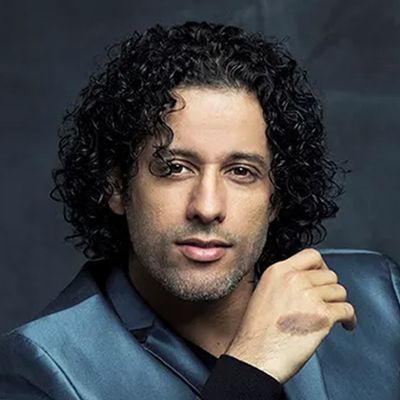
Luis Salgado is a Musical Theatre Director, Choreographer, and Performer with a heart for Philanthropy. 🔥 Through his art he has always had the Latinx banner, lifting up the work of our people in every single production he has been in... Read More
From the show: Backstage Talk
Guests
Featured Shows




About
Luis Salgado is a Musical Theatre Director, Choreographer, and Performer with a heart for Philanthropy. 🔥
Through his art he has always had the Latinx banner, lifting up the work of our people in every single production he has been in. ✨
As the founder of R.Evolución Latina, he is inspiring the young Latinx future of our industry. 👏🏻
This episode is also available in Spanish! 🌎
Please visit his Instagram to see what he's been working on!
If you want to know more about our host, please visit his website! Feel free to reach out with feedback or if you want to be part of Backstage Talk!
Follow us on Social Media:
Transcript
This transcript was automatically generated and might contain errors.
[0:00] Martín Acuña: Hi everyone, I am Martín Acuña and you are listening to Backstage Talk.
[0:16] Martín Acuña: Jonathan Larson asked how can you make someone take off and fly in one of his songs from Tick Tick Boom? And I, for the past two years, have learned one way to do it, through the power of community. Welcome to the Latinx in Musical Theatre Special for Season 3 of Backstage Talk, where we will be featuring artists from across all positions in musical theatre, from several Latin American countries and different Latin heritages. I am proud to showcase my Latinx family. I hope you enjoy.
[0:51] Martín Acuña: Hello everyone, welcome back to another episode of Backstage Talk. Today's guest is Luis Salgado. He is a Puerto Rican performer, director, and choreographer that has been on Broadway, film, television, and stages all around the world. He also has a passion for social work, which led him to start Revolución Latina, an organization that activates individual and collective human growth through artistic experiences for transformation and social change. Luis, I am honored to have you here. Welcome to Backstage Talk.
[1:25] Luis Salgado: Thank you so much. I am honored to be here with you and to have this in both of our languages, right? We're exemplifying what an American looks like. We can do it all. Let's go.
[1:38] Martín Acuña: Yes. First thing I want to know is what made you choose the thespian path in life, and if you can give us a quick, brief dive into your journey in musical theatre.
[1:48] Luis Salgado: Definitely. I think musical theatre is so wonderful, but I discovered musical theatre through the layers of each discipline. I am a dancer first. I come from a dance background, and it changed my life to dance. But after dancing, I wanted to express further, so I started speaking, right? I started speaking not through the vehicle of a play necessarily, but through the vehicle of poetry or utilizing a lyric to then tell a story in a scene form. And eventually with that, I realized, oh, I'm going to try to have some notes in my body and get in tune with something. And so I started singing, and that all led to the passion for musical theatre. I think, you know, that public school encounter was everything.
But as I grew and I went to college to study acting and further my dance education in outside dance schools and eventually again recorded a couple of songs in different musicals in Puerto Rico, I realized there's growth to be had. Came to New York, fell in love with musicals.
[2:54] Martín Acuña: I love it. I love it. So I want to ask a little bit about your approach to directing and choreographing in musical theatre. So where do you start and what's your process like?
[3:04] Luis Salgado: Yeah, you know, it depends on the material, and I think I can summarize two techniques. If I'm looking at choreography as the first idea, sometimes I just let the music touch me and go into the studio and allow my body to move and get all that resonance in the space. And then I sit down with that material and I study the lyrics and the book. And then I'm like, OK, what of this serves the story we're about to tell? Another time is the opposite, which is technically what I mostly want to do or need to do. But because I'm a dancer first, I need to let that out. And so then it's just a more intellectual process where you study the lyrics, right, and you study the book and you figure out what is needed, what is essential to go from one conflict to the next.
And then you get up and dance in service of those things. So I use both techniques and they serve me greatly because at the end of the day, what we need to do is spark creation. And so one of the things that's the most important to me is not having just one rule, something that is just dictating what journey to take, but allowing the exploration process to guide me into the most creative journey for the show that I'm doing.
[4:21] Martín Acuña: I love it. So what would be a piece of advice that you would tell a younger version of yourself?
[4:27] Luis Salgado: I think to not be afraid, precisely even that final example that I mentioned, you know, it takes guts to say, I'm going to find a different approach. And people might look at you weird or that first day of rehearsal, you try something different than what's expected. People say, what are we doing? And so you need to have grace and you need to have playfulness and you need to have a daring spirit in you to be an artist, to be a creative. And so I think to the people listening and to myself, to the younger version of myself, I will say, do not be afraid to explore, do not be afraid to mess things up and make them muddy and dirty, and then learn from that. You know, I'm actually in the middle of a process now, and I have a collaborator who's very structured.
And so every time that I'm proposing an idea, she's sort of, yeah, but it needs to be like this. And it's like, it doesn't need to be anyhow, you know, it just needs to become a splash of painting in the wall. And then we can step back and say, all right, are we fun? Are we having fun? Now, what does it need to be with all the colors and layers we have? Otherwise, you're just limiting process. So do not be afraid, would be my message.
[5:38] Martín Acuña: I love it. So let's switch to the big topic of our conversation, that it's Latins in musical theater. You've had the chance to work with a lot of Latin people, and you have been a leader in the industry and specifically on Broadway of this Latin representation and visibility. So what is for you visibility and representation?
[6:06] Luis Salgado: I think visibility and representation is making space and being consciously aware of the need for that space. You know, I think there's a layer, which is us having this conversation and creating awareness through conversation and dialogue for sure. But where I find myself now, the stage that I think I'm the most present at the moment is about making space in this dialogue with producers, in this dialogue with new creations or with how we do things. And so, for instance, with the same production in Sonoma, California that I'm developing and I'm creating, I am working towards making space for this wonderful student of mine, actually a Colombian artist. Her name is Mariana Herrera from Cali, Colombia.
She's been a student of mine since she was nine. And in this paints and layers that I'm throwing at the wall, I realized that maybe she is my lead character, that her story and her truth in my life might be the connecting tissue of the story that I want to tell. And so I'd speak to the producers about her. And can we bring her from Colombia to be a part of this show? And so making space for her is then giving hope for visibility and representation to other Latin American artists who say, wow, one day my story could also be inspiration of a new journey. The same with my creative team, Juan Pablo Lozano from Peru and Antonio Villachez from Peru. I'm trying to bring them to collaborate with me so that I can give space for new voices as I'm creating, you know, choreographical styles.
They both contribute something very unique and different as I tell musical theater form stories, but I can use their expertise of the backgrounds they bring from Peru. And so for me, that is the main thing is creating space. You know, in Gala, I'm working right now, a production of On Your Feet. And it was very hard to find a projection designer or a lighting designer that is local in this area and that has a Latin background and that understands that musical theater form are either they're busy, employed by places like the Kennedy Center, or they're far away and it's too expensive to bring us when we're trying to bring a cast of 24, mostly from, you know, a hybrid of New York and Washington DC.
So how do we create space? Well, then my creative team includes Brian Menjivar from Salvador or Valeria Coso, Italian and Spaniard, or Miriam Godry, which is, you know, friends in South Africa. And they're together with me in the creation process. So they represent or I bring Maho Ferruccio from Bogota, Colombia, she will be our PSM. And I met her doing Yes Colombia with Missy. And she's incredible and capable. And I put my foot down saying we need to try and give an opportunity to this Latina female PSM that I know she can run our room in the most professional way. And so she's coming from Bogota as an exchange experience. And of course, being supported by Gala Theater in every possible way to be our leader, our fierce leaders in the production stage management area, you know, and we that's the dialogue. Yes, we must talk about it. But we must open those doors for those opportunities to take place.
[9:31] Martín Acuña: I love that the way we can increase Latin visibility and representation on Broadway is through opening those spaces. So I want to go back a little bit to the shows that you're working on and ask you, what is the most important part of creating these Latin characters in musical theater?
[9:43] Luis Salgado: I think, like, I think one thing is creating the Latin characters. And that's so important on that same topic of representation and visibility. But looking at from the scope of director and choreographer, how I'm working mostly now, it's not only about the characters, it's not only about the character that stands on stage, but it's also how we create the work, you know, somebody like Jaime Lozano, creating and composing lyrics or music, get to have a point of view in the story that doesn't have to be Latina, but can still be under the scope of the quote unquote immigrant story, perhaps, because that's his truth. And so the music carries that even when it's not a Latina character expressing it.
So that's as important right now with Salgado Productions. I have, I've been doing for a few years now, the development of female directors to be empowered through the Salgado Productions house. And so for instance, now in May, I'm doing this production of short plays. Those short plays are created by young American playwrights. But they will be told through the eyes of these three different female directors. One of them is Marina, who is from Brazil. We have Florencia, who is from Mexico. We have Claudia, who is from Cuba. So their take and their approach to how they tell the story will be very different than if it was an American white, let's say, director, because it would have been, you know what I mean? So it gives a scope of growth and evolution and perspective to the place that is very unique and different. And I'm really, really excited about, again, creating space in those ways.
[11:26] Martín Acuña: I love it. Luis, last question before we wrap up. Which are your top five favorite musical theater shows?
[11:35] Luis Salgado: That's a tough one. I will say that Aida, it's one of the top ones because it helped me and inspired me to move to New York. I say Moving Out because it's a fantastic piece of theater that was told through dance. And being such a lover and a passionate dancer and dance creator, that show, I went to see it nine times. It literally changed my mind and my heart and my way of thinking about musical theater. I will say Wicked, because Wicked, I think also, you know, it challenged all the odds. It was a production that not a lot of people believed in when it started coming out into the Broadway market. And there were a lot of people who said no to it. So it proved that the audience has a say. And even in a time where Twitter and Facebook wasn't the thing, it was MySpace, it was really word of mouth, what started making Wicked the success that it became.
I think that that is really, really, really important. I think In the Heights, of course, because it gave a scope and a perspective to the Latina representation in a successful manner. So I take my hat off to Lin-Manuel and Kiera Alegria-Hudes and Alex Lacamoire and everybody that made that show what it became. And to finish, I think the hybrid of experimental theater coming to Broadway, you know, shows like Peter and the Star Catcher, The Curious Incident, Hadestown, that kind of experimental theater vibe, downtown theater vibe, coming to the Broadway market and having a space commercially. I am extremely fascinated because I've been making that type of theater everywhere I go. And to see it successfully presented on the Broadway field inspires, you know, the journey that I've been taking as a creative. So I'm thrilled about those shows.
[13:31] Martín Acuña: I love it. Luis, thank you so much for coming over here to Backstage Talk to this Latinx in Musical Theater special. I am honored to feature your voice. I wish you all the success that I know is down in your path and from the bottom of my heart and all the way from here from Bogota, Colombia, all my love and hugs for you.
[13:58] Luis Salgado: Thank you so much for joining me. All my love and hugs for you back. And we hold hands and we walk together the journey and the path of making dreams come true and representing who we are with our voices, with our accents. So I take my hat off to you, Martín. Thank you for having me here with you in this amazing program and for, you know, guiding me into a morning of inspiration. Now I run out to rehearsal with your input, with you creating this emotions and this journey and these reminders of everything that is important in my purpose in life. So thank you for your work.
[14:32] Martín Acuña: Thanks everyone for listening to this new episode of Backstage Talk. Remember to follow us on Facebook and Instagram at Backstage Talk Podcast.
© Broadway Podcast Network, All Rights Reserved