

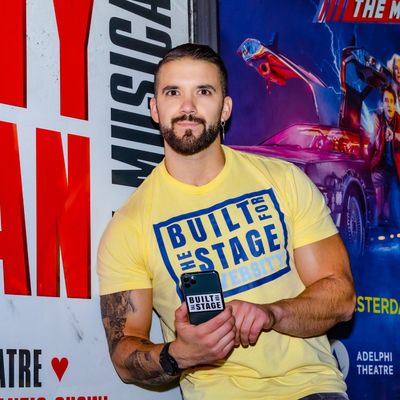
Founder and Fitness Coach to the theater community Joe Rosko joins Behind the Awards to chat about his journey with Fitness and Performing. Joe shares Fitness tips and also give some of his favorite performance in the most recent seasons... Read More
From the show: Behind the Awards with Eila Mell & Bruce Gotlieb
Guests
Featured Shows

About
Founder and Fitness Coach to the theater community Joe Rosko joins Behind the Awards to chat about his journey with Fitness and Performing. Joe shares Fitness tips and also give some of his favorite performance in the most recent seasons.
Also in this episode - Celia Keenan-Bolger’s 2025 Isabelle Stevenson Tony Award and her start of the Gavin Creel Fellowship with the help of Sara Bareilles, Catherine Brunell and in partnership with The American Theater Wing.
https://americantheatrewing.org/program/the-gavin-creel-fellowships/
Joe Rosko began his professional career as a trainer and actor at the exact same time in 2007. Since then, it has been his mission to build a bridge between the worlds of fitness and theatre. Rosko believed that actors were truly professional athletes but didn’t feel as though the theatre community was equipped with the proper resources to train like said athletes. This realization led to the creation of “Built for the Stage.” Over the years, BFTS has had clients represented in over fifty Broadway shows, as well as stages on the West End in London, Australia, and other countries around the world. Rosko prides himself in having the unique abilities to continue a performer’s fitness progress while in the midst of being in or out of a show. All professional athletes train a certain way while in season or out of season, and with actors it’s no different. Actors are athletes, and thus, they should train like one. @builtforthestage
Make sure to check out Eila's book, "The Tony Awards", and all her other amazing books: https://amzn.to/43WMu5Y.
Connect with Eila and Bruce:
Transcript
This transcript was automatically generated and might contain errors.
[0:00] Celia Keenan-Bolger: We are living through big, challenging times, where any act of resistance or kindness or engagement can feel insufficient. In honoring me, you're sending a message that the work of community care matters. The writer Clarissa Pinkola-Estes says ours is not the task of fixing the entire world all at once, but of stretching out to mend the part of the world that is within our reach. And the truth is, every single one of us, you here, you at home, we can all engage with this work. We can look inside of our communities for what needs doing, find some friends, and try to make our corner of the world a little bit better. My dear friend, Gavin Creel, who is my co-conspirator and champion in this work.
I am one among many helpers in this community, and I am constantly amazed by our ability to show up and answer the call. This award feels like spiritual encouragement for me to keep caring and directing our collective energy towards helping the most vulnerable among us, so that we can shine our mighty, compassionate light and make this world a better place. Thank you.
[1:39] Eila Mell: Hello, and welcome to Behind the Awards. I'm Eila. I am here with my buddy, Bruce, as always. Hello there.
[1:50] Bruce Gotlieb: Hello. How are we doing today?
[1:52] Eila Mell: I am so good. I'm very excited to be talking to you, as always.
[1:57] Bruce Gotlieb: Of course. Of course. We just played the clip from this year's Tony's, Celia Keenan-Bolger winning her Isabelle Stevenson Tony Award for her advocacy, her...
[2:07] Eila Mell: All the great work she does for the community. I mean, I think that that is the biggest honor, that Isabelle Stevenson Award.
[2:14] Bruce Gotlieb: I think she even touches on it, if not this speech, she's touched about it throughout the lead-up to the Tony's, just the list of people who have gotten it before her, and she feels such pride in joining that community.
[2:29] Eila Mell: She fits right in, because we know Celia. She was a guest on our show, and she's wonderful. She's such a good person, and so talented, but the talent...
[2:40] Bruce Gotlieb: Her spirit, and her heart. Her desire to give back.
[2:44] Eila Mell: Right. That's the most important thing. Absolutely. So, I mean, huge congratulations to Celia. They couldn't have chosen someone better for that.
[2:52] Bruce Gotlieb: Yeah, and one of the cool things that she introduced in her speech that a lot of people I know herself, Audra, have been saying how Gavin Creel had breathed some of these inspirations into their lives. So she shared that the American Theatre Wing will now be in partnership with Celia, Keenan-Bolger, Sara Bareilles, Catherine Brunel, and a group of Gavin's friends.
[3:16] Eila Mell: They're launching an annual fellowship program in his honor, so they're trying to build a three million dollar endowment to give these fellowships out. Each fellow is going to receive a grant of $25,000, personal mentorship from an industry professional. They get access to wing programs, tickets to shows, Tony Award attendance. You know, there's a list of things that they get, but more importantly, they're going to select five emerging actors beginning their career as theatre makers. And Gavin shared how much he always wished, you know, coming up, how important it was. So they're kind of living that legacy on, and I think it just speaks to, like we said, the type of person she is, and what she's giving back.
[3:59] Bruce Gotlieb: Absolutely. And, you know, people think of the American Theatre Wing as just the Tony Awards, but the Tony Awards are one aspect, but they do so much good for the community, and they really help sustain the community, and build it too. And they nurture so many new artists with grants like this. You know, this isn't their only one, for sure. I mean, you know, this has been going on for decades. So, you know, just kudos to them as well, because it's a wonderful thing. And that, just the money and the mentorship, it's invaluable. You can't imagine how helpful that would be to someone just starting out.
[4:37] Eila Mell: Yeah, we spoke about it a lot this season, I know, you and I, and when we were talking about the Tonys, and talking about the special episodes, how theatre is evolving and growing, and it's so exciting. This also then adds to that layer, because, you know, the torch is going to then get passed down to, you know, more individuals that want to continue to evolve and tell stories. So, you know, it's people that are theatre lovers and Broadway lovers, you know, it's nice to know that there are people invested in making sure that this medium of storytelling continues to live on.
[5:11] Bruce Gotlieb: Yeah, absolutely. And that's the whole point.
[5:15] Eila Mell: Yeah, for sure. I remember when I wrote the Tony book with the Wing, Audra McDonald said, you know, someday someone is going to beat my record, you know, I won't hold the record of the most wins by an actor forever. And, you know, I'll be cheering them on, you know, so it's not, it's just a sense of community that I think is very special to theatre. I don't know that that exists in, you know, other forms of entertainment.
[5:42] Bruce Gotlieb: It's a whole different world. And even, you know, when we spoke to the cast and creatives from Mincemeat, they even said that even theatre in England is different than theatre on Broadway in New York. It's just really a different community and there's no community like it.
[5:55] Eila Mell: Yes. Right. Right. Other actors I've spoken to from England, you know, have said that it's just the fact that all the shows are in such close proximity builds this community that you don't, you're right, you don't have anywhere else.
[6:09] Bruce Gotlieb: So, you know, it's very nice to just acknowledge what they're doing because it means a lot.
[6:14] Eila Mell: Absolutely. And speaking of building community, we have a guest on today that is building community in a different way. They're building community through fitness, through podcasting, through mind journey and keeping their bodies fit, their minds fit.
[6:30] Bruce Gotlieb: Right. So we had Joe Rosko, who is, his podcast and his Instagram account is Built for the Stage. And we did, we did an episode with Joe and we were on his show, he's on our show and he's great. He trains so many actors on Broadway. I mean, we couldn't even venture to guess how many because it's such a huge number.
[6:52] Eila Mell: And if you listen to his podcast, you hear about different actors' journeys and how they continue to push forward in not only in their craft, but in training their body to be physical, because I don't think people really realize that some of these performers, even if they're not dancing, even if they're just doing a play in their physicality, how much training they need to go through to keep their body.
[7:20] Bruce Gotlieb: Giving eight times a week.
[7:21] Eila Mell: Exactly. Right. So, you know, and there's certainly tips that everyone can take for that. And, you know, healthy mind, healthy life, healthy bodies.
[7:30] Bruce Gotlieb: Absolutely. So we'll bring Joe out and follow him.
[7:35] Eila Mell: Yeah. Why are we talking about it? Let him talk about it. He knows more than we do.
[7:39] Bruce Gotlieb: Exactly.
[7:40] Eila Mell: All right. Here's Joe.
[7:43] Bruce Gotlieb: Well, Bruce, we have a special guest. He's like family because he has a show also on the Broadway podcast network built for the stage. Let's welcome Joe Rosko. Hello, Joe.
[7:54] Joe Rosko: Hello. Thanks for having me.
[7:56] Eila Mell: Hey, Joe.
[7:57] Bruce Gotlieb: Hi.
[7:58] Eila Mell: Thank you so much for joining us.
[7:59] Joe Rosko: So we're excited to find out about, I guess, your path, your journey. You have built for the stage, which you have the podcast, obviously, and you're a personal trainer, fitness coach. You've also performed on stage. So you have like, you know, many hats you wear.
[8:14] Joe Rosko: Yeah, definitely.
[8:15] Eila Mell: How did built for the stage start?
[8:17] Joe Rosko: Yeah. So it really is kind of like a reflection of my life story because fitness or sports and theater were always in their separate ways at the forefront of my life. And then once I created built for the stage, that was kind of like my way of putting them together. So age four, I'm playing all the sports. And then a funny story about being in seventh grade, my middle school girlfriend convinces me to audition for Much Ado About Nothing, the school play. And I'm this little, you know, jock boy playing three sports. And I'm like, What am I doing? What is this? So I get cast in the show, and she doesn't. So like a big, big part of like, middle school is that you want to do extracurriculars because you don't have a car or a way of seeing friends or a girlfriend or whatever.
So you're like, Okay, this is my only chance of doing it. So she wasn't even cast. So I'm in this show and wearing tights and makeup. And I'm like, What is this? It's Shakespeare. I don't even know what I'm saying. I have speaking lines. But my choir teacher, Kelly Scourge, sat me down after it was all over and was like, we're doing guys and dolls. You should try it just one more time. I promise it's going to be different. And I tried it and I loved it. Fast forward to graduating high school, I had found out you could major in musical theater. I had no idea. So I started prepping for that. And then I chose instead of sports scholarships, I went to school for musical theater, but I missed the sports side.
So I'm sitting in my dorm on Saturdays and the football games are going on and I can hear the PA system and I'm crying in my dorm room drama, drama, drama. So I try out for the football team and I end up playing football while majoring musical theater and I become a personal trainer because I get really into the training aspect. None of my football players need training because we're obviously already getting trained. So who do I have left but all of my friends in theater. So I start training actors with my cert at 18. I go on my summer stocks. They want to train with me. I graduate. I have more gigs and more friends in the city. I'm just training actors and actors and actors. And then in 2017, it finally came to me.
I'm seeing all these Hollywood trainers being promoted during the surge of the Avengers. Like when it was at its peak of popularity from whatever it was like 2013 to 17. And I'm like, I don't see that for Broadway and Broadway actors. They grow up in theater just really focusing on that. And they're not big into sports or training per se. But once they get submerged in this profession, they really need it because of the physical demands. And that's when I decided like, all right, I'm really going to go all in on being Broadway's trainer and I went online with it via an app in 2017 before it was cool to do it. And yeah, just been at it since.
[11:29] Eila Mell: So people can train with you remotely, right? You don't have to be in person.
[11:34] Joe Rosko: Yeah, it's actually all remote. I have a very select few clients that I'll train in person. It's usually only for like, if a show hires me, like I've been hired for Aladdin or a workshop in London for a musical about Sinatra. But typically it's all in an app. And I have clients on the West End or Australia, Tokyo, Disney, yeah, everywhere.
[12:00] Eila Mell: Is there also another component that because, you know, actors typically perform at night, sometimes they're not even eating dinner till after a show, which can be late. I mean, how do you navigate something like that and still stay fit?
[12:10] Joe Rosko: Yeah, that's that's a big part.
[12:14] Joe Rosko: The specialty of training performers is, you know, I've been there myself and I also know what they're going through as far as balancing not just the training aspect but the nutrition side. So there is a lot of talks about how to get into a rhythm of when the best time is to be eating. It's different for everyone and obviously from either the person or the demands of the show or the role that they're playing. And then this even more so goes into play with my tour clients because while being on tour is wild not just from the show aspect but I'm going to be on a bus for however many hours or we're going to the airport. It's just like take being in a sit-down show in New York on Broadway and put it to a tour and times the demands by, I don't know, a thousand. It's just like non-stop for those tour folks. They deserve a medal.
[13:08] Joe Rosko: And I would think you also don't have the same kind of choices nutrition-wise when you're on tour. Yeah, there's little tricks of the trade that I'll definitely always equip with my clients whether it's finding like certain grocery stores that we know work or tricks of like healthy hotel-friendly meals that you can make if you don't have like a full kitchen or something. Yeah, and you say it on your podcast all the time that, you know, actors are athletes and they are and there's so much required from a lot of these performers even if they're not, you know, doing all the dancing. There's just wear and tear every day, you know, from the schedule that they maintain. Correct me if I'm wrong, I believe you even have people who are performers that are also trainers for you as well?
[13:55] Joe Rosko: Yeah, we have a handful and they'll train under me first and I'll teach them our methodology and what I've kind of come up with these past, I don't know, 17, 18, however many years of me doing this. So that's a great component is that I do have performers that still have skin in the game per se that are training our clients as well. We just had an awesome class last week and we're doing an in-person challenge soon in New York where for four weeks, two times a week, actors will come together and train together with our coaches and they'll also get support on our app as far as other workouts and nutrition goes. Back to your note though about like not everyone that's training has to necessarily be in like a heavy dance track to be going through something physically demanding.
One of my longest clients on Built for the Stage plays Pumbaa in The Lion King and, you know, he doesn't really dance at all but you don't realize he's wearing this, I think it's around 35 to 40 pounds of puppet that is front loaded in front of him. They also have a pretty raked stage there at The Lion King and what that does to your posterior as far as the challenges on your back, it's quite taxing. So just something like that, for example, is a reason that fitness is so important to a performer regardless of their role, if they're dancing or not, you know, their height, weight, whatever, like everyone should be training in some capacity to equip them to be ready to be on the stage.
[15:31] Joe Rosko: It lines up, you know, actors and anyone who's involved in fitness, you know, there's a certain amount of dedication that you have to put in until you see some results. So I can see how the two align for you. Yeah, definitely. It's also cool to help the performers in their journey of they're in a show, they're out of a show, because that's the merry-go-round of theater. And to go to what you highlighted there about it being paralleled with sports, in sports you are in the season, you're out of the season. So in the show, out of the show, it's the same where a big message I still to this day fight tooth and nail to get across to performers is that you shouldn't just be training when you're out of a show, you know, when they book it, and they're busy, or they think they're doing physical things on the stage.
So that's good enough. Professional athletes, when they're in season, they're training just as much than out of season, but it just looks different might be for more durability, maintenance, injury prevention. You know, if you're, we were talking about it on the interview I did with you with, let's say, Boop or Death Becomes Her, they're dancing their faces off. But maybe your choreographer loved the kick on the right. And you're doing, I don't know, 12 kicks on the right, but you're only doing three kicks on the left. And maybe you're lifting a partner to your shoulder three times a show, but it's always to your right shoulder and never to your left or you're bent, you know, I can go on and on about the imbalances that are occurring from doing the same thing over and over and over again, eight times a week, week in and week out.
So when these performers are thinking, Oh, I'm getting all I need on this stage, I'm being totally physical enough, I need to rest, I don't need to work out when really, there's a lot of imbalances going on that they need to be focusing on in the gym to help them stay healthy.
[17:35] Eila Mell: Seems like you're checking a lot of those fitness goals, you know, boxes off from your younger self. Do you ever miss the performance aspect of it?
[17:41] Joe Rosko: Oh, yeah. If you even have time to do it, I mean, you seem pretty busy. Yeah, I try to see my clients and every show that they're in. This year, I think I'm up to after this coming weekend, I'll see three more shows this coming weekend. I'll have seen 18 West End and Broadway shows this year. So I go and see a lot of shows a lot of theater. Um, I have three, you know, the Playbill binders, I saved every Playbill that I've ever from Broadway show I've ever seen and West End show since 18. So I'm looking forward to like, I don't know what I'm old and gray at 70 or 80 to pull out some Playbill from I don't know 2007 and say, Hey, look at this dusty old Playbill. But anyways, yeah, every time I show up, I'm so proud of them.
But at the same time, I'm like, Oh, I miss this. But what I don't miss is the daily grind of the unfamiliar, the unsure Do I have work? When's the next gig? I just waited in line. I sang my 16 bars. And for those 30 seconds, half of my day is gone. You know, like, like round of applause standing out to these performers that are still in the daily grind because I don't know how you could be doing it if you weren't 100% 110% committed to trying to make this happen. It is not for the faint of heart. That's for sure.
[19:12] Eila Mell: Well, let me ask you, how does what you do help people during auditions? And you know, when you're doing that as your job until you book a job?
[19:19] Joe Rosko: Yeah, in regards to fitness? Yeah, how we train? Yeah, exactly. This is when we can be a bit more aggressive as far as how the intensity of the training just because they're not having to do the eight shows a week. What I tend to do just to give a couple of secrets away, what I tend to do is I'll make the intensity ramp up from the start of the week to the end of the week where the end of the week is actually the most intense. The reason being is that typically by midday Thursday, all callbacks or auditioning is done Thursday, Friday, Saturday, Sunday. So if we're gonna be let's say sore or a bit more tired than we are for the week compared to the beginning, that's when we want to really be feeling the brunt of our training. Because the audition side of it won't be as demanding towards the back half of the week.
[20:17] Eila Mell: And how many days a week do your clients typically?
[20:26] Joe Rosko: Yeah, we on average, I would say three, three and a half to four would be your average, but we will do as low as two a week or five a week. Two is very rare. Five is something that a lot will, they'll want to strive to, but it'll usually be four just again, because of the demanding schedule. But for anyone listening, you could train three times a week for 30 to 45 minutes only, and still get all the benefits that you would want and need as far as your fitness and health goes.
[20:58] Eila Mell: How important is nutrition as part of your fitness?
[21:07] Joe Rosko: Yeah, it's everything. It's everything. Whether it's the performance side or the aesthetic side, you can have a Ferrari. And if you're not putting gas in that Ferrari, then the Ferrari is useless. Or if you're putting sludge or mud into that Ferrari, it's not going to run. So it doesn't matter how many sets and reps and what magnificent fitness program you're doing entails, it starts and ends with your nutrition.
[21:32] Eila Mell: So what I'm hearing is everybody can be a Ferrari.
[21:41] Joe Rosko: Everyone can be a Ferrari. It just takes a lot of dedication and mostly consistency. I think fitness, unlike theater, theater takes talent, luck, it takes a bit of everything. There's a lot of factors. But fitness is something where it's very hard, but it's not hard. What you have to do isn't hard. It's just doing it and doing it consistently. And if you do it, if you can get into this rhythm and break through that seal, which takes around two to three weeks of maintaining a new neutral, the results come. It works if you work 99% of the time.
[22:11] Joe Rosko: Our bodies are meant to move. They're really not meant to sit in front of a screen.
[22:14] Eila Mell: Oh yeah. Me with my job and it being remote, besides my one hour or 90 minute session, I'm behind the laptop. So even the hour to 90 minutes, in my opinion, it's not enough physical movement for the day. I'm not saying I need to go out and do something, again, that's very intense, but just walking or standing up. All of us, just this 24 seven is not the way that our human bodies were built for. So if you can't do anything, at least download whatever your current cast recording obsession is and go for a walk around the block or a run.
[22:57] Joe Rosko: Definitely. At least I know the catchy metric is 10,000 steps, just because it's, I don't know, it sounds nice and clean, 10,000, but just at least walk 30 minutes a day at least, and that's going to be better than nothing.
[23:16] Eila Mell: Is it true that you start to burn fat after 20 minutes?
[23:20] Joe Rosko: It depends on what you're doing. If you're just walking at a extremely, it also depends on your goal. There's the thing out there, you can burn five calories for every kiss that you have, silly things like that. So are you going to transform your body after walking 20 minutes every day? No. If you're doing it with an amazing nutrition plan, then you could just because nutrition outweighs any type of fitness or exercise that you could do. The fitness side is really complimentary. And where fitness actually originated in the, I don't know, Spartan era, it's really to prevent injury. It wasn't to look a certain way. It was to be durable, to outlast someone else in battle or in everyday working in the fields, et cetera, et cetera.
[24:16] Eila Mell: This is Joy Woods, and Behind the Awards, we'll be right back.
[24:21] Eila Mell: So from the shows that you've seen this season, which ones are the most physically demanding?
[24:28] Bruce Gotlieb: Let's jump into that. First, it's not from the season, but I do want to hop back to Shucked because you brought it up from the Tongue. Those quote-unquote box jumps that they were doing onto those barrels when they were rolling... Oh, I'll never get over that. That was nuts. That was so impressive. I'm going to look up their name really quickly because they're a gymnast that's in Death Becomes Her. They actually do the body double when she's Warren Yang. His spotlight just on Warren. His tumbling and his physical ability throughout that show is just crazy. I couldn't get over it. So kudos to him. So not movement per se, but I saw Floyd Collins with Jeremy Jordan and his lack of movement because I got to chat with him afterwards.
The brunt he takes from sitting and lying there you would think is silly, but to be in that fixed position, but then also get up and be on the flight rig and doing some of the crawling and climbing he's doing, kudos to him because over time, that's a very challenging physical role. Not on just one show. One show, anyone could do that, no problem. But over and over and over again, forget about it. Amazing job to him. I'd also say though, with control of one body, you also have this season, somebody who you have on your show, Andrew Durant.
[26:00] Joe Rosko: Oh, yeah. Doing Dead Outlaw is just, again, he's in this static position for more than half the show. I still don't know how he does it. Have you seen the challenge that they started where now other people from Broadway shows, they're like, trying to do that?
[26:11] Bruce Gotlieb: Oh, yeah, the actually the Death Becomes Her, they're all in their little like, ensemble outfits, and they're all doing their like, best Frozen picture.
[26:17] Joe Rosko: That's so funny. I saw for the fourth time, it's on a new show, but I saw Aladdin again. And I just have to shout out the Aladdin boys that go through the first song. They're jumping from set piece to set piece and then moving these sets in and out is what I call design chaos, and how more of them don't get injured. I'll never know. The dancers from Buena Vista Social Club, they're giving it the entire show. Did you see this yet? The band, but the dancers, I was also like, some of the cast were singing primarily the entire time with no dancing. But then at the end, during like curtain call, or maybe the final number, they let them dance as well. And they were all phenomenal dancers and just weren't showing it at the moment.
So that was awesome. I would say my last one that I'll highlight, I'm gonna say Sunset Boulevard because I've talked to them. I think it's an underrated requirement of this camera work that they're doing. I think that that takes a toll on anyone. We talked about the front loading of the Pumbaa character, but that on your posterior as well, holding those cameras like that that they do.
[27:42] Bruce Gotlieb: Well, so I have a question. I always wondered this, you know, there are so many times I go to a show and, you know, the many people in the cast look like all they do is spend time in the gym, but that doesn't suit every character that someone might play. So how do you find a balance in keeping actors fit, obviously, but also, you know, I would think that many times they need to have a body that suits more than one type.
[28:04] Joe Rosko: Yeah, I'm so glad you brought it up. And that was like something that I almost got like in trouble for in the beginning with my messaging was that I was trying to have people embrace every body type is out there and letting them know that like, yeah, you're every role to my opinion, like there's going to be some type of look that a casting person is looking for. And to your point, it's not always maybe what the theater industry is known as the cliché ensemble member. So what we built for the stage always talk about is are you capable? And are you durable? If a casting agent in the audition, or a director or choreographer in the rehearsal room says, so and so I need you to do this. Can you do said this?
And can you do it eight times a week without being injured? And can you do it in the body that you're blessed with that they cast you to be in that particular role? So yes, the whole actors are athletes thing. We don't say I don't know, actors are this height, size and blah, blah, blah. No, we say they're athletes. And if let's say you look on a professional football field, there's a defensive end, that's six, five, 280 pounds. And then there's a, let's say a wide receiver, that's 5'8", 165 that are vastly different looking, but their athletic capabilities are equally astronomically impressive. So that's just like my example that I'll pull from there. So I love that you brought that up. And again, focus on being capable and durable. And that's what I think is going to lead to your success in the industry, rather than looking a certain way.
[29:59] Bruce Gotlieb: Yes. So there's this, yeah, like, okay, if there's a room full of 10 people, and they all look different. And this one person is doing above and beyond better than everyone else, then like, that's it, like full stop. Well, whether they look this way or that way, like, it doesn't matter.
[30:19] Joe Rosko: And so fitness is not necessarily bodybuilding. No fitness is the definition is basically how fast and how much of a load can you move from one space to another? I know that's kind of hard to wrap your mind around. But whether it's just your body weight, you know, how fast can we run from here to there? Or how high can we jump from here to there? Or as far as picking something up? How heavy can this thing be? And how far can you move it? Meaning? Could you put it over your head? Could you squat it all the way down and stand it up, etc, etc? Or flexibility? You know, how quickly can you get your body from this position to that? And how far can you like extend it? Are you just reaching down and touching your shins? Are you all the way at the floor? Is your nose touching your knee, you know, we can go on and on that is fitness. It's not my bicep is peak this much and I have this many abs showing and etc, etc.
[31:18] Bruce Gotlieb: And I'm sure that you have clients of all ages too, because I think probably as you age, you need a fitness routine more than when you're young.
[31:24] Joe Rosko: Yeah, I work with anyone from the college level. They're in college at the moment. And then you have a particular client right now. They're either it's either 63 or 64. But anyways, yeah, that's it's, it's like a 40 year gap window that I'm working with right now.
[31:45] Bruce Gotlieb: So how can people become clients if they want to?
[31:49] Joe Rosko: Yeah, usually everyone starts at builtforthestage.com. I have a free trial form, they basically can kind of just see what it's like to work with me and what it's like to work on the app. And then we would chat about their goals. And if we think it's a good fit, then yeah, we would just have them fill out an onboarding questionnaire. And I'd build out their own personal program and a nutrition one if they'd like nutrition's like extremely personalized. So as far as how I approach things, it's not a, you know, one size fits all, like, I chat with them and whatever, not only physically, but psychologically is the best approach. I can help with that as well.
[32:35] Bruce Gotlieb: And then you also have the podcast. So when people go over to your podcast, you're chatting with different industry folks about their navigation of the journey they've selected, right. And most of the times, for an actor or for a performer, there's a lot of ups and downs. Like you mentioned, you're waiting online for hours, you're doing all these things to do something you're passionate and you love about what's been fun for you getting to talk with all these people and explore their...
[33:02] Joe Rosko: Yeah, so it really the podcast started kind of hand in hand with the training people on the app with Built for the Stage. I was working with so many clients. And when I was geeking out on podcasts already, particularly one podcast called How I Built This by Guy Raz on NPR. Speaking of like Audra McDonald, we're talking about the Tony nominees in our interview on my podcast. In my opinion, like unless you're one of those big names, at that point in podcasting or media on Broadway, you weren't really getting a lot of other stories besides those big names. So I, through coaching these people got to know their stories and got to know them. And I'm like, I need to start a podcast, you know, and highlight, I'm having these conversations, I might as well record them and have everyone else hear about them.
So that's really how it started very humble beginnings. Like I didn't know, we were kind of sharing horror stories from before we hit record on some technological things. But like, yeah, I was doing the goofiest stuff to get these episodes down. But bit by bit, I got better and better. And yeah, I didn't want to make it a fitness podcast. I'll parallel to fitness sometimes just because the journey in theater is, is much like one in fitness, where it's never owned, it's rented. And we're always having to maintain or build ourselves up from day to day to stay in the game, per se.
[34:35] Bruce Gotlieb: So yeah, another thing was like, I wanted audience members to be able to relate to the struggles of the guests. We kind of chatted about this again on our interview, where I think it's a misconception of, oh, it's easy for them or oh, they got lucky or Oh, if I was only them. So I think it's helpful for the listeners of our podcast to hear like, oh, this person in their third Broadway show didn't get their first one until I don't know, six, seven years into it. And they made it to final callbacks eight times for different shows and didn't get it. And, you know, kind of your story, Eila, where you're talking about, you know, I think you said eight years before your book was published, like, those are the amazing stories that I was hoping to share.
Because so many of us might quit too early, just because of maybe false comparisons, thinking that it's just not cut out for us, because it's not coming as easily as we think that the others are succeeding, you don't have to be doing the same thing as somebody else in order to get inspiration from.
[36:01] Joe Rosko: Yeah, right, you know, so hearing your conversation with somebody, you know, could spark somebody else's just inspiration or motivation, they could be a teacher, they could be, you know, a doctor, they don't have to be from a fitness background from a theater background, they just, you know, you love or you have passion about what you do, which draws you to, you know, listening to it. And you hope that throughout your day that you can impress upon somebody something, right, that then there's that ripple effect down the road.
[36:15] Bruce Gotlieb: Well, thank you, Joe, so much for joining us. This was great.
[36:19] Joe Rosko: Yeah, check out Joe's podcast Built for the Stage and give him a try. If you're an actor, and you need some kind of fitness routine, he can absolutely help even, you know, just stamina, I think is probably one of the most important things.
[36:25] Bruce Gotlieb: Give him a follow over on Instagram to Built for the Stage. And we'll see everyone next time on Behind the Awards.
© Broadway Podcast Network, All Rights Reserved