

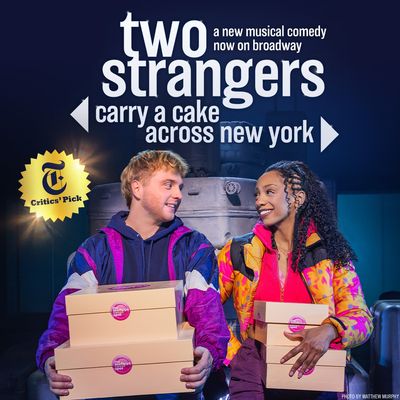
Olivier Award winning and Tony Nominated Actor Sam Tutty joins Behind the Awards to chat about his award winning role in Dear Evan Hansen and this seasons breakout hit Two Strangers Carry a Cake Across New York. Sam shares the creation process from its early days to Boston and New York... Read More
From the show: Behind the Awards with Eila Mell & Bruce Gotlieb
Guests

Featured Shows

About
Olivier Award winning and Tony Nominated Actor Sam Tutty joins Behind the Awards to chat about his award winning role in Dear Evan Hansen and this seasons breakout hit Two Strangers Carry a Cake Across New York. Sam shares the creation process from its early days to Boston and New York.
Also in this episode - Eila & Bruce discuss the increased ticket prices for some Broadway shows.
Sam Tutty is currently starring in Jim Barne and Kit Buchan’s musical Two Strangers (Carry a Cake Across New York). He is best known for his West End debut as Evan in Dear Evan Hansen. During his school years, he appeared in a number of productions including The Wizard of Oz. After compulsory schooling, Tutty trained at Italia Conti Academy of Theatre Arts, later making his off-West End debut as Daniel in Once on this Island. His performance at Southwark Playhouse was widely praised, and a career in the West End looked promising. Tutty was originally cast as the alternate Evan for Dear Evan Hansen, however he was later promoted to the titular character.
His first performance as Evan was on October 9, 2019, ahead of an official opening night on November, 19 2019. In a review for LondonTheatre.co.uk, Mark Shenton said: “Tutty is another discovery, who pulls off the rare trick of projecting adolescent angst and insecurity with paradoxically confident ease. With his strawberry blonde hair and slight physical bearing, he embodies a nerdy character… There's a truthfulness to his acting - and a robust singing voice - that makes him feel utterly authentic and intensely moving.” In 2020, Tutty won an Olivier for Best Actor in a Musical.
Make sure to check out Eila's book, "The Tony Awards", and all her other amazing books: https://amzn.to/43WMu5Y.
Connect with Eila and Bruce:
- Instagram @behind_the_awards
- Eila @eilamell
- Bruce @cominghomewithbruce
Transcript
This transcript was automatically generated and might contain errors.
[0:00] Sam Tutty: Hello, this is Sam Tutty, and you are listening to Behind the Awards.
[0:12] Eila Mell: Hello, and welcome to Behind the Awards. I'm Eila, I'm here with Bruce.
[0:17] Bruce Gotlieb: Hello there.
[0:18] Eila Mell: Hello there. How are you?
[0:20] Bruce Gotlieb: We are in the midst of Tony season. How are you faring?
[0:24] Eila Mell: We are in the midst, I'm faring well. There are still a few shows that if I can get to, I will try to, but I think I've pretty much hit everything that was really on the top of my list.
[0:38] Bruce Gotlieb: Yeah.
[0:39] Eila Mell: There are some that I'm sure I've missed just because of time, and they are no longer playing.
[0:44] Bruce Gotlieb: Right, yes.
[0:45] Eila Mell: One of the factors that also comes into it is, you know, cost.
[0:48] Bruce Gotlieb: Oh my gosh, the other night...
[0:50] Eila Mell: Some shows are expensive.
[0:52] Bruce Gotlieb: Yes.
[0:53] Eila Mell: The other night, I, at the last minute, was looking for a ticket for something, so I went over to Fallen Angels, and I was able to get the last two tickets of the entire run that were available.
[1:06] Bruce Gotlieb: Wow.
[1:07] Eila Mell: So my friend Judy and I, we went, and, you know, we spent more than we wanted to, because we got caught up in the frenzy of wanting to see the show.
[1:14] Bruce Gotlieb: And then afterwards, you know, it was a very good show, but it was really quick.
[1:18] Eila Mell: And then I had such buyer's remorse about spending so much money on a ticket.
[1:22] Bruce Gotlieb: It's like, I don't know.
[1:24] Eila Mell: Yeah. Is it worth it? Is any show worth these big ticket prices?
[1:29] Bruce Gotlieb: Well, the conversation really started last season when, you know, there were a lot of shows, you know, Othello, Glengarry Glen Ross.
[1:37] Eila Mell: Yeah.
[1:38] Bruce Gotlieb: They were all getting these, you know, huge astronomical prices.
[1:42] Eila Mell: Right.
[1:43] Bruce Gotlieb: Like over $700, $800.
[1:45] Eila Mell: Because, you assume, because of the star power that's attached to the show, because there were other shows that obviously weren't.
[1:52] Bruce Gotlieb: But, you know, an example of it still is there with, you know, what you experienced, but also this weekend with Mother's Day and figuring, oh, maybe I could grab a ticket to see something or do a lotto or some type of something.
[2:08] Eila Mell: One of the shows that's still on my list that I haven't been able to get to is Every Brilliant Thing. And I said, let me just see how many seats are available.
[2:15] Bruce Gotlieb: Yeah.
[2:16] Eila Mell: And for Saturday and Sunday, they both had, you know, maybe a handful of tickets available. But the cheapest ticket was over $700.
[2:24] Bruce Gotlieb: And the most expensive ticket was $928.
[2:29] Eila Mell: Wow. I just can't imagine spending a thousand, almost a thousand dollars.
[2:34] Bruce Gotlieb: I know.
[2:35] Eila Mell: Daniel Radcliffe, I hear, is outstanding.
[2:37] Bruce Gotlieb: He is.
[2:38] Eila Mell: And the show is great. And it deserves the nominations that it got.
[2:42] Bruce Gotlieb: And it's still not worth that much.
[2:44] Eila Mell: No show is worth that much money. I'm sorry. You know, I love going to the theater more than almost anything. But it's just a lot of money, especially at this time in our economy.
[2:54] Bruce Gotlieb: It is.
[2:55] Eila Mell: And you know what? Is it because it's Daniel Radcliffe that the producers feel that they can or the theater feels that they can put this ticket price on?
[3:04] Bruce Gotlieb: Obviously, people are buying the tickets because it's selling.
[3:07] Eila Mell: Right.
[3:08] Bruce Gotlieb: So you look at the other flip end of that, where there are shows that are probably just really trying to stay afloat.
[3:16] Eila Mell: Yeah.
[3:17] Bruce Gotlieb: That are out there offering $59 tickets.
[3:19] Eila Mell: I know. Because we want to get people in the seats. And hopefully that will generate word of mouth and all of those other things.
[3:24] Bruce Gotlieb: So where were these seats? Do you remember?
[3:26] Eila Mell: They were in the orchestra. You know, not that that justifies it.
[3:30] Bruce Gotlieb: But not all of them.
[3:31] Eila Mell: Not all of them. The one that I saw was, I want to say, mezzanine that were $700 or $400 or something.
[3:38] Bruce Gotlieb: But still.
[3:39] Eila Mell: And not even like the first row of the mezzanine?
[3:41] Bruce Gotlieb: No.
[3:42] Eila Mell: Wow.
[3:43] Bruce Gotlieb: It's crazy. Is it because it was nominated for the Tonys? Do you think prices went up at that point?
[3:49] Eila Mell: They might have gone up. I remember one time I was in the city to see something. And I had a little bit of time. And so I went over to the box office. Because sometimes you can get a better price than you can online.
[4:00] Bruce Gotlieb: And I walked over and I said, oh, I was looking for a ticket. I gave them a few dates that I knew would work for me. And still the cheapest ticket was probably $200 or $300.
[4:12] Eila Mell: Yeah.
[4:13] Bruce Gotlieb: Which still seems to me, and you know I love going to the theater. It just, for the amount of shows that we see, I can't be spending $200 or $300 on every show.
[4:25] Eila Mell: Right.
[4:26] Bruce Gotlieb: Because there's over 30 shows this season. Unfortunately, I'm not independently wealthy at the moment.
[4:32] Eila Mell: Now, here's a question. We should check. Do you know if, because we know that the tickets to Proof were pretty expensive.
[4:39] Bruce Gotlieb: They were.
[4:40] Eila Mell: When it opened. Have they gone down since it didn't get any nominations, I wonder?
[4:44] Bruce Gotlieb: That's a great question. Because that was also one that I was trying to get to. And, you know, again, going there and they had, you know, on a Wednesday matinee partial view for like, I don't know, $162 or something like that.
[4:58] Eila Mell: And it was like, really?
[4:59] Bruce Gotlieb: I know. And then luckily enough, I was able to go see it. But, you know, you try as you might. You don't always get that opportunity. It's an interesting, you know, an interesting conversation as we go forward. Because like many people say, you know, theater, you know, you want the theater to be accessible for everybody.
[5:14] Eila Mell: Right.
[5:16] Bruce Gotlieb: Right now it's not. And these prices don't make it that way.
[5:20] Eila Mell: Yeah. It's really rough. You know, to answer your question about Proof, if I go on to TodayTix right now and I pick, let's say, next Saturday evening, figuring Saturday evenings would be like a prime slot.
[5:34] Bruce Gotlieb: Right.
[5:35] Eila Mell: Tickets are ranging from the last row in the theater upstairs at $110 to the most expensive ticket being $288.
[5:45] Bruce Gotlieb: So it doesn't seem like they've gone down.
[5:47] Eila Mell: Not a lot. I mean, a little bit. You couldn't get a ticket lower than $160 something originally.
[5:53] Bruce Gotlieb: Even for upstairs in the balcony, mezzanine?
[5:56] Eila Mell: Well, I don't remember what seats they were when I went to the box office, but it was the only seats they had.
[6:03] Bruce Gotlieb: Right.
[6:04] Eila Mell: Because it was even before they opened, the conversation and the buzz was so huge.
[6:10] Bruce Gotlieb: Yeah, well, that cast.
[6:12] Eila Mell: So and then, you know, once the critics, you know, said what they had to say, I think that it's softened a little bit.
[6:19] Bruce Gotlieb: Yeah, for sure. Well, one show that is not astronomical, that is reasonably priced, is Two Strangers Carry a Cake Across New York.
[6:26] Eila Mell: You can get great seats at a good price. And it just so happens, Bruce, can you believe it that our guest today is the star of that show, Sam Tutty.
[6:37] Bruce Gotlieb: Go figure.
[6:38] Eila Mell: Well, let's bring Sam out.
[6:40] Bruce Gotlieb: Let's not talk about ticket prices with Sam.
[6:42] Eila Mell: You know, I think we've done that.
[6:44] Bruce Gotlieb: No, we have too much else to talk about.
[6:45] Eila Mell: Exactly. All right, let's get Sam out here.
[6:49] Bruce Gotlieb: Well, Eila, you and I both saw Two Strangers Carry a Cake Across New York pretty early.
[6:55] Eila Mell: Yes.
[6:56] Bruce Gotlieb: And we both loved it. And we're so excited to welcome Sam Tutty to our show.
[7:01] Sam Tutty: Hello.
[7:02] Eila Mell: Thank you.
[7:03] Bruce Gotlieb: Hello.
[7:04] Eila Mell: We're thrilled to have you. And we should say also, just, you know, for proper introduction, Olivier Award winning actor, Sam.
[7:11] Sam Tutty: That is on my title.
[7:12] Eila Mell: Yeah, that's on my passport.
[7:13] Sam Tutty: Yeah.
[7:14] Eila Mell: Wow. That's pretty impressive.
[7:15] Sam Tutty: It should be, though. A lot of work.
[7:18] Eila Mell: A lot of work, yeah. Now, what do they think at the airport when they see that?
[7:21] Sam Tutty: I cut the queues.
[7:22] Eila Mell: Yeah, I cut the lines.
[7:23] Sam Tutty: There you go. It means a lot.
[7:25] Eila Mell: It means a lot. I appreciate it, everyone, you know.
[7:28] Sam Tutty: Yes, absolutely.
[7:30] Eila Mell: Okay. So were you with Two Strangers from the very beginning of the show?
[7:34] Sam Tutty: Well, the show has been in development for, like, maybe close to a decade now. So I was not part of it in its sort of initial conception. I believe it was called The Season. And there were some wonderful actors previously who worked on it. Like, I've been up in, oh, Sheffield. Am I making that up? Maybe. Or they'll kill me for getting that wrong. But, no, I've been a part of it ever since it was called Two Strangers Carry a Cake Across New York. It was started at the Kiln, and then we're in the West End, then Boston, and now here. So I've just been traveling around, you know, with this show. It's been a real privilege, yeah.
[8:09] Eila Mell: How much of you is in Dougal, do you think?
[8:13] Sam Tutty: I used to think quite a lot. And then I realized as I met Christiane, maybe not at all. You know, it's really interesting. Like, there is this sort of, like, innate Britishness to me that isn't in Dougal. But I supposed who knows what Dougal is like back at home in the U.K. where he's in familiar grounds? Because I can imagine I was probably just as insufferable when I was in New York for the first time. I was, like, 21. I was probably just as awful, yeah.
[8:43] Eila Mell: Well, we had Christiane on, and she said that you are much more like Robin, and she's like Dougal.
[8:50] Sam Tutty: Yeah, I'm sure she mentioned the, you know, when we're in taxis and Ubers and things like that, she's always talking to the drivers. I'm just there like, what are you doing? Like, I don't know. I don't mean to be impolite, but there's this sort of Britishness to me that it's like, I don't want to bother him. Sure, he just wants to, you know, this is his 50th, their 50th passenger, you know, of the day. She's just got this sort of like, hey, y'all, how's it going?
[9:17] Eila Mell: So how has Dougal changed for you, especially now being in New York?
[9:21] Sam Tutty: Yeah, I think it's much easier to sort of get the jokes out, I suppose, because I think there's this sort of, the language has changed massively now that the audiences have changed. So I don't feel like I have to perform as much, I suppose. There's this sort of, that the audience can sort of identify with Robin far more than they ever could previously, which is very helpful for me and also for Christiane, just because I feel like she feels probably more supported now than she ever has, which is an amazing sort of angle to experience. And that changes my choices in Dougal. I think he's much more calm. He's far less performative, much less of a court jester, which we were always trying to veer away from.
But I think on those sort of exhausting days, you know, when you sort of like lose grip on the reins of Dougal, it's very easy to flip into like, let's just make people laugh because that's what he's there for. And that's just not at all it. It's the sort of, I suppose, his sort of happy accident that that is. He's also funny.
[10:24] Eila Mell: Yeah.
[10:25] Sam Tutty: So I think, yeah, to answer your question, he's just calmer, but without losing any of the comedy, which is really fun and very sustainable for me as well.
[10:32] Eila Mell: I would also assume that in New York, the jokes land differently because New Yorkers are coming to see the show, whereas in London, I'm sure, were the jokes different or were they just received differently?
[10:46] Sam Tutty: Both, really, both. But they were definitely delivered by me differently to cater to that audience. It wasn't until our first dress run in New York did I realize, oh, this is a completely different thing now, where they were laughing at sentences that I was more than happy to just blitz through to get what I thought was the joke, now only realizing that Kit Bucking is an absolute genius writer and he embedded so many more jokes that he was so humble to not even mention, like, this is meant to be funny, by the way, but they aren't getting it because they're not from New York and that's fine. He just was like, cool, we'll blitz through it as you are. But it's been really fun. It's been really, really fun.
[11:27] Eila Mell: So what occasion brought you to New York for the first time?
[11:30] Sam Tutty: I did a show called Dear Evan Hansen, and they brought me over here for some auditions and then to rehearse for like three weeks over here. Yeah, so that was pretty crazy. That was pretty wild. Very much Dougal-coded sort of exploration of the city. It's just so annoyingly accurate to the build-up that I've experienced over the years in my childhood. It's just completely like, yeah, this is exactly how I imagined the city would be, which is infuriating because, you know, you spend your whole time thinking, like, oh, movies just big it up. And it's like, no, it is that cool. And the people are like that, you know, and it's really fascinating.
[12:06] Eila Mell: When you were originally cast in Dear Evan Hansen, correct me if I'm wrong, you were originally supposed to be the understudy and then got brought up?
[12:15] Sam Tutty: Yes, yes. So it's a crazy story about, you know, you just have no idea what can happen.
[12:22] Sam Tutty: My whole career has been an example of that, where I've basically barely made it and then been thrust into a really fantastic position. So I think I'm using all of my luck for the rest of my life. I did a graduate call, which is something in the UK. I'm not sure they have it in the US, but it's anyone in their third year of drama school or university or first year of graduation, they get to go to a specific audition where only those people can go, because I think they were also looking for quite young people. Obviously, he's meant to be like 16, 17. Evan, I mean, and so and then I didn't get I didn't get I was rubbish as well. It was really bad. I didn't. Very, very nervous. And then months later, got an agent.
And then I say I didn't get it. I didn't hear back. So I just shoot. Months later, got an agent. My agent gave me a closed audition. I did 13 auditions and then I was back and I was there. And then they gave me the call saying, yeah, we'd love you to be the alternate. And then Stacey Minich, like a year after that, said that we to get with the sort of the tea on that. And they said, we try to find someone better. This is embarrassing to say, but then they said we couldn't. I was very humbled by that. I was very, very kind. Thank you. Don't have to say that if it's true. But then, yeah, then they gave me the call saying, we'd love you to be the main. Evan and I remember that day very, very, very well. Very crazy. I mean, that's like a modern classic already. It's an iconic role now.
[13:51] Sam Tutty: Yeah, I was really excited to be the alternate. I was I was on the cover. I was the alternate. So I was going to I had my I had two shows locked in. So I was like, great. So I can be Evan twice a week, learn, absorb everything, but also like having a shot consistently. And that plan went out the window and they were like, go for it. Do week. No more free time for you.
[14:12] Eila Mell: Well, New York has been falling in love with Dougal and therefore with you. I just think the heart that Dougal has is, you know, as cynical as people say New Yorkers are. I think everybody really grasps on to him. And what's it been like to discover all those different layers for you?
[14:36] Sam Tutty: It's really interesting. Yeah, I think there's a there's a performance in the first few scenes that maybe is not what Dougal is. And I think I, as an actor, have realized why am I so different in the first? I feel like the text is different. My choices are different compared to maybe three or four scenes later. And then especially in act two, he's so much more calm and he's so much more reserved and he's much more. I don't know. I try to be even more seductive for Robin's human benefit. You know, I mean, and I think it's I've realized now that there's that initial introduction to to to New York. But Dougal is so overwhelming and he just becomes this child that he always had in him. And he always sort of carries with him wherever he goes, but was just amplified by this catalyst of New York.
So and I think learning that we are so supported by the audience, whether it be tourists coming to see the show and identifying with Dougal and that sort of attitude to New York, or whether it is these experienced New Yorkers who have got a friend like Dougal, but purely in themselves, see the city through Robin's eyes.
[15:47] Sam Tutty: And, you know, our producer, Kevin McCollum, has this great sentence that the show is the protagonist, the antagonist, that the city, sorry, is the protagonist and the antagonist. And New York is a beautiful, amazing, incredible, exciting, thriving city, but also comes with really, really difficult obstacles in the sense that it is just so expensive. It is sort of completely sort of unfathomable way. And these two characters are not financially stable or well off in any way. And so they're really they really feel the full effects of that. So it's really it's been really fun. It's been really fun to feel, like I mentioned, so supported by this sort of like there's a clear cut two parties in the audience or like a smoothie of people who identify with us both so clearly.
But previously, it could have been something where the majority of the audience hadn't experienced New York very well. So they were seeing it more through Dougal's eyes. But it's been really fun to give Robin that support system. Not that she is needed, but there it just feels like there's more of like an equal part now. It's really fun.
[16:53] Eila Mell: You know, it's interesting. You said that your characters are not financially stable, but you're in the shadows of characters who we don't see who are very financially stable. Your father and Robin's sister.
[17:03] Sam Tutty: Yes. How does that inform what you do, too? Because, I mean, they only really can have fun once they're using their credit card.
[17:11] Sam Tutty: Yes, which is also that that excitement is so exciting, I suppose, for the lack of a better word, exciting for the audience. Like it is just so it is so fun. But also, we never really, as human beings, get to do that where it's sort of free, endless. Right. It's like you get the reality, but then the fantasy of what New York can be.
[17:33] Sam Tutty: Right. Yeah. And this is sort of immediate like, oh, no, we have access to the entire city and what you're you're sort of exposed, what you've been exposed to your whole life and what I, as Sam, have been exposed to my whole life, that side of New York, because there are some some sentences that Robin says where it's like everything that you love about New York is only accessible to people. You know, I'm paraphrasing now, but it's only accessible to people who are immense amounts of disposable income that don't have to, you know. And I'm really proud that we acknowledge that, you know, because I think there are so many like, you know, those films out there that are like, they never really explore the character's financial situation. It's like, how are you affording this apartment? You know, I see the videos online. I'm like, oh, of people, you know, the cast of Friends.
[18:14] Sam Tutty: Right. So they actually would be paying and it's like seven thousand a month. Right. And it's like, whoa, what? And, you know, that was back in the bloody 90s, let alone now. It's about 14 grand, you know. And I'm really, like I said, I'm really proud of the show that we acknowledge that because I think it's really fun. That's what makes it so watchable, I suppose, because, you know, New Yorkers can feel seen and then tourists feel seen and get this eye in or shoe in rather to the real New York.
[19:24] Sam Tutty: So Bruce said something to me early on because he saw the show before I did, and he made a really great point. He said that although the music is fantastic, if you remove the music, you would still have a really solid play.
[19:35] Sam Tutty: Yeah. Yeah. I've sort of been trying to sort of stick to that in my work. I think, you know, what pulls me to projects isn't really the music that's sort of that. I said that's a complete lie. I love the music, but the music can only go so far if the book isn't as substantial. And that works both ways. You know, I mean, you can have a great book and and rubbish music and you still don't have a great you can you don't have a great piece. So I'm not I know the first thing about writing a musical, by the way, who am I? But I've been I'm really proud that, you know, that the what we're saying isn't just which I seen so many musicals in my life and recently like where it's just a means to get to the next song.
[19:41] Eila Mell: Yeah. You know, back in the 90s, the actress Debbie Mazur had her own sitcom and she said, the apartment I'm living in in the show, I, as the star of the show, couldn't afford.
[19:52] Sam Tutty: Yeah. And it's so important to keep that dialogue open, though, because I think it is just it makes it so much more accessible, maybe for the audience to just understand this isn't real life or if it is real life is for the point one percent who have access to funds that and money that probably isn't ethically gained. Do you know what I mean?
[20:16] Sam Tutty: Right. Like I said, I'm really proud of the show that we acknowledge that. I think it's really important.
[20:16] Sam Tutty: Right, right. Because that's the iconic, you know, we need to get to that song because that's why they're all watching. And it's like, I'm so excited as an actor to just sit down with, you know, a really good friend on a stage on Broadway and just talk as a human being and to have the audience listen and remember references, you know, I we say this in other interviews, like there are there are references that are made in the first scene, second scene, third scene that are then made literally in the last scene of the show, and they hold on to it and they remember it. And I intentionally set up that very quickly, because I really want to test the audience to see if they're if they're listening. And every time they are. And it's just so relieving. It's such a relief. Like, it's so rewarding.
[20:24] Eila Mell: This is Joy Woods and behind the awards, we'll be right back.
[21:57] Eila Mell: The thing that's exciting for me anyway, is when I saw it early on in previews, I had known some other people who also went in excited because a new musical a brand new concept and came out loving it as I did and still with me now I haven't had a chance to come back and see it again. But it is the type of show that does it just, it just latches on. And that's so exciting for a new musical to do that.
[22:22] Sam Tutty: Yeah. So I think I know people who have gone back multiple times, and it's still from what they've said just as fresh, just as exciting, which is really great to hear.
[22:33] Sam Tutty: And we tried to, you know, like, you know, Christiane made a fair point the other day, we were asking about the conclusion of the show, and like what our personal opinions are. And I think she smashed it out of the park when she said that, you know, from its night to night basis, you know, the shows, you know, the choices that we make today, right now, for example, in my day will affect my emotional sort of angle, I suppose, on the show, which will affect my internal conclusion of where they end up.
[23:02] Sam Tutty: So my point being is that you can come and see the show on a on a Tuesday, and then you can come and see it again the next day. And it's like, that is a completely, I'm having a completely different opinion on where those two end up in their lives, based on micro choices that we make. And that is down to the book, where it is possible for those choices to be made, because the words that we're saying are so real, and so human, which is so exciting. And it also makes it sort of impossible to learn. Often people say, you know, when the script is great, it's really easy to remember. And I used to think that until I started, you know, when I used to think that and then I started Evan Hansen, and I started Two Strangers, and some of the words you have to say are as small as like, yeah, and that's a line.
[23:46] Sam Tutty: It's those words that sort of build the naturalistic text and it's sort of those micro beats that are so important, that in a normal sort of setting would be completely sort of like glazed over, they wouldn't be sort of mentioned because it's so humanly subconscious. So to sort of remember in this sort of teething process of learning the text, it was so difficult because it is such a mundane non word like, oh, or yeah, that's sweet. Or these tiny, tiny things. So yeah, my point is, is that it's just you can come and see the show on a different night and have a different opinion and it's fab, it's really fun for an actor.
[24:16] Sam Tutty: Playwrights are so thoughtful that those minor lines are there for a reason and they're not so minor, they mean something. I mean, I remember learning the opening monologue in Dear Evan Hansen and there's this part where he goes, he stutters on the line because you're not gonna, it is literally that and it's written as that. And he goes, you're just going to be yourself because that's the big, that's number one, be yourself, be true to yourself. And I remember reading that and that's the first time I'd ever read text where there was like a stutter, or a sort of like a recalibration. And I love that sort of like, I remember the synapses in my brain going, oh my god, the choices are now accessible because of the work that I have to do, remembering that sort of pothole, pothole in the text, you know?
[24:25] Sam Tutty: Yeah, we were all American. Yeah, which is correct. You know, I wouldn't have wanted to do it in a British accent. I think that's, I don't know, I think there's something, you know, if it's set in, I think it was, I mean, oh my gosh, it's set in America. I can't remember where, that's going to really annoy me.
[24:39] Sam Tutty: And it's a similar thing with Two Strangers where it is so fun, it's really fun. When you were Evan, did you have to do it with an American accent?
[24:44] Sam Tutty: Normal, you know, sort of Midwestern state. Yeah, we're very deeply embedded in American culture. So I think they would have thrown to be in a British accent would have had to have changed. Oh my gosh, so much, and it'd been insane. Let's talk about the set for Two Strangers because it's not a typical set for sure. I mean, it's literally the character's baggage is on the stage with them. Yeah, so you'll mores it sort of genius. I mean, I remember when I first started this show, I didn't know what I was getting myself into. I was just excited to do something completely polar opposite to do Evan Hansen. I remember I really was excited to sort of show myself and anyone who came to see the show that I can do something else, right?
And then Tim Jackson, our director, alongside Suture Gilmore, our set designer, did this presentation with these sort of mini models of the set, and I went, oh, this is exciting, and I was not expecting that. I don't know what I was expecting, but it was not something as interesting and as brave and as specific, right, as that.
[25:48] Sam Tutty: Yeah, and that's so fun. You know, I think, you know, how do you sort of present New York on a stage on Broadway? You either have to invest 150 million dollars in set with like, you know, 6,000 people backstage creating this city, or you bring it back and trust that the audience does have an imagination. And I love those bigger productions; I think they're very important. I think they bring in a lot of revenue, and they are very exciting for performers and for creatives. But I think also it's just as important to swing the other way and have just as big a production and just as important a production but scaling it back, you know? How the Jamie Lloyds of the world are now and how exciting they are, and how the lens is now so focused on these two actors.
There's not a distraction or anything crazy happening. It is just two unimportant people having a realistic dialogue and realistic problems. And it also feels like no set could live up to how Dougal is seeing it anyway, exactly. Yeah, because there would be a cap, but right, you know, there would be a ceiling visually, but I get to decide what I'm seeing then, and that's for me. And equally, it is as private for the audience to amount because I know exactly where I am. You know, I've been to some of the places in New York. I know what it looks like that where Dougal goes, but some certain conversations, I have no idea where we are. That's brilliant, you know? I imagine different things, and I just, you know, have things that are consistent with me every night, like somebody walking by or something like that.
And that's down to Tim Jackson's directing as well. He was so diligent in creating this sort of city with just those suitcases, and that's down to the sound design. That's with our wonderful sound designer, Tony Gale. He just created, I mean, there's a bunch of people as well, but just every now and again, you'll just see, like, hear a horn or a siren, yeah, something just to remind you that this is a city. This is a bubbling, thriving, dynamic, busy, loud city, and it's not just two people sitting in a park, you know, right?
[27:52] Sam Tutty: And they're so useful to you when you're looking at it before the show starts. You know, as an audience member, you're trying to figure out, well, what is this, and what's it going to become? And then they do become so useful for you guys to play with and to use as props even. I just think it's brilliant the way that it unfolds. I suppose I don't know, but if you've never seen the show, you might think that the set disappears or shrinks down, and then something else appears, and then when it doesn't and all it does is spin, right? It's like, oh, it's that kind of show. It's not that to put it in a box, but it's like, oh, I get to work. Right, and I listened to this TED Talk with the writer of Finding Nemo.
I can't remember his name, but he said that there's this rule of two plus two. They want to work for their dinner, so don't give them two plus two. And I think that we're definitely taking an angle in that with the context of the show, the inclusion of the show, what the characters who you never see, what they look like, what are their views? What, you know, like what all these things? There is just so much that the audience feels a part of, which is really helpful for a two-hander because we feel sometimes, you know, on a slow day or on a tired day, really exposed, very vulnerable, you know? I think it's really a real relief to have such a loving audience out there that really are, you know, literally carrying us for the lack of a better word, like across this show as well.
[29:21] Eila Mell: Well, like you said, the audience gets to work. I don't know what image you have in your mind, but like that one scene where you're on the phone with your mom or, you know, you're leaving that message and you're having that whole conversation, and it is a very vulnerable scene, but I have an image in my mind that I've created of what the woman on the other end of that phone looks like. I have an image in my mind of the woman who's, you know, playing Robin's grandmother looks like, and I'm sure that's different than the person who may be sitting a row in front of me. You know, we all have our own image that we're creating. So I think that that is very interesting and that emotional tie that the audience member gets to create for themselves.
[30:03] Sam Tutty: Yeah, no, I think the audience has to feel involved. They have to feel like I'm not maybe not necessarily a third character, but they definitely just feel like onlookers and witnesses to this. Yeah, and it's similar with Evan Hansen. You know, the audience, the way that it works on stage so well is that the audience has to feel responsible as well for Evan's mistakes and Evan's sort of transgressions, I suppose. And so the audience involvement is a very important aspect, not necessarily intentional participation when I say, but I mean, you know, they have to feel like witnesses and onlookers. The one part of, I guess, audience participation, whether you've asked for it or not, happens when the box drops to the floor and the entire audience, yeah, it's very dramatic.
[30:50] Eila Mell: They love it.
[30:50] Sam Tutty: Yeah, they love it. There's so many, and there's so many instances like that. There's so many situations where, you know, where Robin's phone goes off, and we all think it's Melissa, but it's actually Justin, and then I can hear it's just, it's just, you know, those, I could go on. There are so many situations, but you know, I run off, I'm doing a quick change, authentic NYC wiener, off I go, and Robin's on the phone to Melissa, and there's this line, "Does he know yet that he's coming?" Oh my God, I remember Christiane came up to me after, I think it was a matinee. She came up to me between shows, and she said, "I did that line," and this lovely old lady, she went, "Oh, baby, no." Just like, just so in it, but in such a non-disruptive way.
I think what I find is that the New York audiences have just ooze class, and they ooze respect for the craft and for what they're seeing. They just have such a respect, and I really, really like to tip my hat to everyone who's come to see the show, truly.
[32:01] Sam Tutty: You know, I'm curious, when going in, I thought that this show was going to be about the obstacles of carrying this cake across New York. Yeah, but that's not what it is. Why is the cake so symbolic in the title? I suppose it's the, maybe the foot in the door to truly their relationship. Christiane, she has such a great, such intelligent opinions on this. There are so many situations, there are so many moments in the first two or three scenes where, right, this is it now. Yeah, I'm never gonna see you again. I've done my job. You're gonna have a fun time. You don't know that I'm not going to the wedding, but you have fun at the wedding. I'll see you there, you know? And then this cake comes along, and he just wears her down enough to feel like, well, actually, it's a good point.
I cannot carry this thing all by myself. And then it's, that's the foot in the door to the rest of their relationship. And yeah, it's really fun. It's really, it's really, really, it's very rewarding. Yeah, he juggles somebody that needs a person. I mean, he has his mom, and she's very important, and then he won't let Robin go.
[33:08] Sam Tutty: Do you think that's an aspect of why? I wouldn't say it's like in the sense of a dependence or something like that. I think he is just, similar to me, fascinated by people, and he's fascinated by American culture, and he's fascinated by Robin. Robin's not only his first American that he ever talks to, like as a human and not necessarily a TSA worker, but he is fascinated by people, and I think he's a romantic, and he loves love, whatever kind—platonic and requited, familial, who knows? But whatever you're seeing that day, and that's a beautiful thing to play.
[33:42] Eila Mell: Yeah, did you find that when you were, I'm sure as you work through it, things change dialogue and script-wise and all of that, but some of these moments that you were speaking of that the audience catches on and you get that reaction, did you yourself find that as you were going through and being like, "Oh my God"?
[33:56] Sam Tutty: Yeah, there were so many moments, and that is a testament. You know, every actor wants to say that, "Oh, that was my idea, by the way, that was my..." I want to, you know, reward for that, but I think that it's the testament to the creatives who have no ego. This is, they've been working on this for so long, and they had every right to be like, "I envisioned this a certain way; you have to honor that." And then when we would, you know, absolutely cool, but they are friends, not only just friends, but they are just wonderful, wonderful people, and I cannot wait to see them all again. But I, in the rehearsal space, there was clearly this sort of creative freedom and warmth and friendship that they just oozed from the beginning.
But then when Christiane came into the picture, she presents herself with such grace and with such an intellect that we all couldn't help but just like listen to every single thing that she politely and very classily had to offer, whether it was like, "I don't think a Black woman from America would say that," or "I don't think, can I say it like this?" with this sort of like energy or color. And there were a few things that were like that for me. Instead of saying 4:30, I say half full, you know? And those tiny, tiny little things. But now, as the show goes on, we have found our own personal private moment that we have sort of created as we found our footing in a Broadway context, and that is again back to the text.
Testament to the text, we have the freedom to do that where we can say lines with a completely different, oh no, with a completely different sort of like, you know what I mean, in the word. Yeah, and it means something completely different, but we're saying the same lines. Yeah, it's really, really fun.
[35:48] Eila Mell: Did you and Christiane ever just explore the city as homework?
[35:56] Sam Tutty: By the time we got here, I was working the next day. We were fully, so I suppose indirectly, yes, but never from or for a sort of homework purposes. We had the best time in Boston, myself, Christiane, Vinny, and Phoenix, I wonder those standbys, and now Austin and Jana, who’ve just joined a few months ago. We had such a natural bonding process in Boston where I think we just love each other, all four of us, six of us now so much, where whoever goes on, there is this complete trust. So I think, I suppose extracurricular activities are now purely fueled by the fact that we love hanging out with each other genuinely rather than let's keep this, you know, dialogue alive because we've got a lot of work to do, you know, like five hours, six hours. So, you know, you know what I mean?
[36:58] Sam Tutty: Yeah, and I would assume that your Dougal is different depending on who your Robin is, and then conversely, the same for Robin if somebody else is going on too, absolutely, which is terrifying but fun as well, you know? I think there's this sort of like...
[37:05] Sam Tutty: 30 seconds of like, whoa, my gosh, don't go into autopilot, you know, that is purely fueled by Robin's decisions and actions, you know, and that is all down to just listening. That's the first thing I make sure that I'm doing. If I feel like I'm not having a good show, the first thing I'm probably not doing is listening, you know, and actually engaging with the choices that the actor is making opposite me. Yeah, yeah, that's probably the first thing. Yeah. And you get the opportunity, you have to do that. Check in with yourself kind of on the fly, because it's not like in a larger scale show, you would leave the stage and have a moment where you could be in the wing and say, Okay, let's check ourselves.
But here. Yeah, there are moments throughout the show, specifically when Robin starts to sing. This is the place you could probably see me very subtly, but just do a very long, deep, relaxing breath, just to just reset and come because the scene previous is like, context, context, information, setting up everything in like this, there's this tennis match of dialogue in this tennis match Tinder song. And it's just so much work is so much work. And then this is the place comes along. And I just feel like, Oh, there goes the shoulders. There we go. Let's now reap the rewards from that 15 minutes of pure information, then context, you know, it's really, and there are so many pockets like that throughout the show that I've learned purely from this sort of part of the life cycle of the show of active breathing and just shoulders down.
And it's just so rewarding, honestly, because I feel like every now and again, I finish a show when I haven't checked in with myself. And I'm gonna go home now. And it's gonna be you know, and I'm like, Whoa, the difference in just in just calming yourself down on stage when you don't have the opportunity is sometimes more rewarding doing it on stage than off stage, because you have this, you feel this no fear, you have no, you're not sort of intimidated by the 1000 people in front of you, you can check in with yourself while listening to your counterpart. And you sort of have this level of control, like you're taming the horse. And it's really rewarding. It's really fun. How long does it take for you to just get used to the fact that there are, you know, is a large audience watching you?
I don't think I ever do. I ever do some days I do it far less. And I'm then genuinely like, Whoa, I could say anything right now in front of these all these people. I'm just saying words that are in my head. Me and Christiane both checked in with each other and realized that we both have moments where it's like there is nobody else coming. There's nobody right, right. And if I did, I would scream, you know, third person, I would be like, that is so wrong. What are you doing? So you have any and it's important to just just accept that feeling. I suppose there's nothing you can do. The more you fight it, the more tension you have. And then it just feels horrible. And then my choices are weird and fueled by anxiety, which makes me feel like everyone's laughing at me and not with me.
Oh, it's just a whole domino effect. Yeah, yeah. Because Dougal is so high energy. How do you prepare for that before the show? Do you have quiet moments? Or do you? Or do you sort of ramp up? Sort of like an all day thing, like, how I'm feeling. It's all about forgiveness. You know, if I'm not feeling particularly energetic, I'm either sometimes I'm just like, Robin singing what let be and I'm like, I physically don't know how I'm going to go on stage. But then you stand up, recognize that what you're experiencing is probably very much an uptown problem, you know, like, but also at the same time, just forgiving yourself that it is perfectly okay to feel exhaustion, you know, like, you know, you're only work like three hours a day.
And it's like, well, my whole day is set up for this. And if I walk into work, sometimes like, I'm really, you know, literally yesterday, oh, my God, I'm really ready for the show is in my dressing room. I was like, I feel good. Like, I don't feel like I'm tired. And then the show starts and my body just goes out. I think I don't know, there's this response, maybe my body's having now this part into the run where it's like, I my brain knows what my body's about to go through for the next two and a half hours. But it's all about what I try to do is just forgive myself if I'm feeling tired. And if I if I don't sound good, and if I crack and I just I just get in my head so much about failing, I suppose.
And then I put so much pressure on myself and all my choices are led up. If I don't do this, and is that going to happen. And there are stupid, stupid stuff. So just letting go of that. And just being reminding myself that 99% of these people have not seen this show. And I could do and sound like anything and they probably don't even know what is flat, what is sharp, right? You know, so just forgiveness, forgiveness is the main is the key ingredient and just calmness. Yeah. What was your first I guess your feeling or reaction? I know that they don't have the same post show stage door situation in London. Here, it's a whole different experience. So for you, the first time, what was it? Did anybody was anybody prepping you for like, just so you know, this is what it's gonna be like, I think I had similar experiences in the UK because of Evan Hansen, because there was such an like a sort of global fan base.
Sure, that I remember the first stage story wrapped around the theatre twice now, you know, it was unbelievable. So I was exposed to it at such a young age, such an early part of my career that I felt like that was the part that I could handle. Because there was no expectation for anything else other than me just being like, hello. Thank you for coming to the show. That's why that I that I'm sort of least intimidated by that's the sort of thing that I'm like, I get to meet people and they are just so nice. And the thing about New Yorkers is that they're such real, genuine human beings is that just that you'd be walking down the street and be like, I love that show. Great one. And then they'll leave me alone.
And then they'll go all day like, like a normal person. And that's really, don't get me wrong. I love you know, hearing about people's stories about the effects and that the show any show or any piece of work that I've done has had on them. It's really rewarding. And it's very nice to remind myself, like why I'm doing this, I suppose is this sort of escapism. But yeah, I think the stage door was is and continues to be every now and again, just a crazy experience. But it is filled with people who are just so genuine, and lovely, and very gracious and very, very kind with their time. They recognize the work that we've done on stage, and they don't ask for anything more than just a very lovely compliment.
Yeah, you into Christiani, a photo or maybe a signature. It's, it's, it's a very lovely experience. It's very rewarding, and not in any way exhausting. Yeah, I'm surprised to hear you say that, you know, you get, well, maybe, you know, maybe you get that some people say you only work three hours a day, because an eight show schedule is such a hard schedule to maintain. It's really brutal. Yeah. Do you feel like you get that from people sometimes, like they think you don't work hard? Maybe, maybe in my early career? Yeah, well, I was, you know, my, you know, some people who I was friends with at a time were like, Oh, I'd love to start work at seven, you know? And it's like, yeah, cool. I get to sleep in.
But it's like, I wake up every day feeling like I haven't slept the eight hours that I just slept, because I'm now like six months into a two show, you know, two hander and boy, it's like, Oh, my gosh, so I feel like there's a if I if I do too much, I'm exhausted. If I don't do enough, I'm lethargic, you know. And I don't know if there is a key ingredient, I go to the gym, I feel exhausted, I go to the gym, I feel ready, like there's, you can, I don't think anyway, there's any there is a there's a step by step thing that cures that. Yeah, just like I go to the answer to your previous question is just about forgiveness on what you feel. And if it's not where you want to go, that's that has to be okay.
Yeah. But also the time that you have off in the day, it's not really your own time, you can't just do anything you want, because you have that show to do you have to prepare literally had like three of these today, and it's like just gone one. So I'm just like, there's just so many things I'm, you know, I'm playing video games, trying not to like think about the show, just think about anything. I want to go to Barnes and Nobles today and get a folder like all these like little things that but also I'm like, but don't walk too far because you're going to get in, you're going to sit down after walking, and you're going to be like, Oh, right. And that gets me in a bad headspace for the show. There's just so many things might be great.
And I'd be like, that was really lovely. And now I'm going to just watch YouTube on my laptop in my dressing room, have a cup of tea and crack on, you know, who knows? Yeah. And also, I think that people don't necessarily understand that not only do you have to be on, but you have to be at, like, 150% energy exchange to give to the audience. And yes, you do get some back. But primarily, the lift that you and Christianity have to do is you have to put out as much as you possibly can in order to get something back from people. And yeah, that's exhausting to be on that much. It can be something like yesterday, Christianity was singing What Will It Be and I was just literally there like my head on my on this on the wall like this.
And then I stood up, I went on stage, and all of that went away. And sometimes it doesn't, you know, and I think there's this, the first half of act one is the hardest. And then like I mentioned previously, you sort of reap the rewards from all of your hard work where you then you can be like, okay, with all of this context and all of this work that I've done, this is who this character is now. And he is calmer, and I'm just, you know, cooler. And the text is sort of the text change his his speech changes, his questions change the choices I make. And it's that the sort of like evolution of his character, sort of like a butterfly in a cocoon sort of thing, really is a fun thing for me to play every night.
And the burden, for the lack of a better word, but of the show lifts as soon as the show starts, like it gets lighter and lighter towards the end, you know, purely not necessarily because we're approaching the end, but more because we can now have fun because of all the context we put out there. Do you know what I mean? Yeah, it also feels like, you know, that weekend is really his coming of age, he really becomes a man. And I think that, yeah, maybe part of why he's quieter and more thoughtful. Yeah, no, I make conscious decisions, you know, the place where I put his speech lowers, you know, he has calmer choices. And they weren't necessarily conversations I had with the director, just sort of things that I found naturally, that I was never told to stop.
Right doing another good, I just just like, I'm just gonna keep going. Because it's absolutely do you have a favorite moment in probably changes from show to show? I would assume? Yeah, there are definitely moments where I'm like, Oh, God, I really liked that choice. And I really liked that moment. Let's keep that all opposites like that was awful. Let's not do that again. Yeah, I think there are there are definitely moments, you know, that I'm really, you know, a post cake drop. Where are we? He's come back, then the hotdog bit that conversation with I, you know, I'm emotional to that part. I love that part. I just love the dialogue. I love what he's saying, but what he's not saying, you know, all of those all that that whole beat.
Yeah, I really like it. But there is like, I can just go on forever. Well, the phone call with the mom could be an audition monologue moving forward. I will be using it. Yeah, yeah. You've already worked on it. That's right. And so said, we're already out of time. It's been so great having you. It's been a pleasure. Thank you very much. Thank you. You you obviously you're in the show for for the foreseeable future. But any other side things in your, you know, busy life that you have that people can keep an eye out for? Yeah, I mean, I'm basically doing nothing. I'm trying to just like, I feel like I'm the type of person and I don't care what anyone says. But if I start to branch out for another project in a current one, I'm sort of like, instead of whole assing one thing, I'm like half assing two things make sense.
And I don't give a shit what people say. I am like that I need to have a complete pride and focus on this project right now. The audience definitely wants your whole ass. Right. Exactly. They've genuinely paid for it. That's right. Yeah. Towards the end we'll see. Well, Sam, thank you so much for joining us. You are welcome back anytime. Thank you. Yes, I can't wait for the next one. And we will see everyone next time on Behind the Awards. Bye bye.
© Broadway Podcast Network, All Rights Reserved