

Featured Shows
Transcript
This transcript was automatically generated and might contain errors.
[0:03] David Armstrong: Welcome to another episode of Broadway Nation.
[0:09] David Armstrong: The podcast that tells the remarkable story of how immigrants, Jews, queers, African Americans, and other outcasts invented the Broadway musical and how they changed America in the process.
[0:20] David Armstrong: I'm David Armstrong, and I call this episode The Fall and Rise of Yiddish Theater: How the Yiddish Theater Influenced Broadway Part Two.
[0:29] David Armstrong: This is the second half of my conversation with acclaimed actor, writer, producer, and director Avi Hoffman.
[0:36] David Armstrong: If you missed part one, you may want to catch up on that episode before listening to this one.
[0:41] David Armstrong: Avi is also the founder and CEO of the Yiddish Kite Initiative, a nonprofit organization dedicated to preserving Jewish culture, which you'll hear more about later on.
[0:52] David Armstrong: Last time Avi shared with us the story of how the Yiddish theater was born in Eastern Europe in the 1880s and soon spread around the world.
[1:00] David Armstrong: By the turn of the 20th century, there were dozens of theaters located on 2nd Avenue on the Lower East Side of New York, which had become the world capital of Yiddish theater.
[1:10] David Armstrong: It was sort of like a parallel world to the Broadway theater that was emerging and developing in Times Square at that exact same time.
[1:18] David Armstrong: And as we will hear, the Yiddish theater had a tremendous influence on Broadway.
[1:22] David Armstrong: And that's where we pick up our conversation.
[1:25] Avi Hoffman: And so through the 20s, 30s, 40s, and into the 50s, the Yiddish theater now began transitioning into what we now know as Broadway.
[1:38] Avi Hoffman: All of these great Broadway composers were influenced by what they had seen in the Yiddish theater.
[1:48] Avi Hoffman: The directors who were coming out of the Yiddish theater and now directing on Broadway.
[1:53] Avi Hoffman: The stars who were making the transition into Broadway.
[1:58] Avi Hoffman: And not just the stars, the regular utility actors.
[2:02] Avi Hoffman: Not only the name celebrity roles, but all the roles were now being performed by former Yiddish theater, former and current Yiddish theater actors.
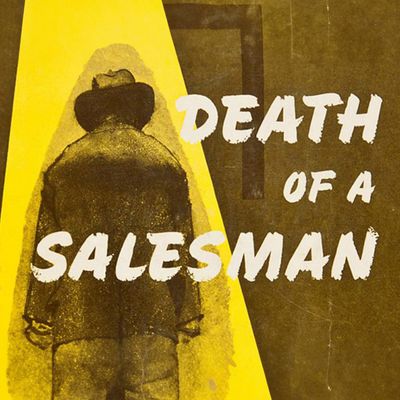
[2:12] Avi Hoffman: By the time you get to 1949 and Death of a Salesman, Arthur Miller, not many people know this, and I only know this because I did the research when I was performing Willie Lohman and Death of a Salesman in Yiddish.
[2:25] Avi Hoffman: What I learned was that Arthur Miller intended for Death of a Salesman to be an immigrant Jewish story.
[2:34] Avi Hoffman: It was based on his uncle Manny, who was an immigrant from the old country, who was a salesman, and he committed suicide.
[2:43] Avi Hoffman: He jumped out of a window on 1501 Broadway.
[2:47] Avi Hoffman: Wow.
[2:47] Avi Hoffman: And so Arthur Miller wrote Death of a Salesman to be a Jewish story.
[2:53] Avi Hoffman: And it was Ilya Kazan who said, no, no, no, no, no.
[2:56] Avi Hoffman: It's gotta be America.
[2:58] Avi Hoffman: Hap and Biff, not Duvid and Goshua.
[3:01] Avi Hoffman: It's Willie Lohman, not you know Moishit.
[3:04] Avi Hoffman: Even though they were in Brooklyn, even though they were a Jewish family.
[3:09] Avi Hoffman: Joseph Bulloff, who was one of the great stars of the Yiddish theater at that time, decided he wanted to do Death of a Salesman in Yiddish.
[3:19] Avi Hoffman: Now Bulloff had done Oklahoma tracked.
[3:25] Avi Hoffman: Direct.
[3:29] Avi Hoffman: Hambushed.
[3:32] Avi Hoffman: Friend, what's on your mind?
[3:36] Avi Hoffman: Why are you walk?
[3:38] Avi Hoffman: Around and around with a hand.
[3:43] Avi Hoffman: Followed behind.
[3:45] Avi Hoffman: And your chair.
[3:50] Avi Hoffman: He's the original Ali Hacker, Mr.
[3:53] Avi Hoffman: That's right.
[3:53] Avi Hoffman: Correct.
[3:55] Avi Hoffman: Twenty minutes ago, I am free like a breeze.
[4:00] Avi Hoffman: Free like a bird in the woodland wild.
[4:04] Avi Hoffman: Free like a gypsy.
[4:06] Avi Hoffman: Free like a child.
[4:10] Avi Hoffman: I am unattached.
[4:16] Avi Hoffman: I am minding my own business like I ought to.
[4:21] Avi Hoffman: Ain't meaning any harm to anyone.
[4:25] Avi Hoffman: I'm talking to a Sitan Farmer's daughter.
[4:30] Avi Hoffman: Then I'm looking in the muzzle of a gun.
[4:35] Avi Hoffman: He was already starting the transition into the mainstream Broadway world.
[4:41] Avi Hoffman: But he was still holding on to the Yiddish theater because he could make a lot of money traveling all over the world doing Yiddish theater and playing the roles that he wanted to play.
[4:49] Avi Hoffman: So he translates Death of a Salesman into Yiddish.
[4:52] Avi Hoffman: And he goes to Argentina to Buenos Aires, which had an enormous Yiddish theater community, and he performs it there without permission from Arthur Miller.
[5:01] Avi Hoffman: And it's a huge success.
[5:02] Avi Hoffman: And he writes a letter to Arthur Miller, and he includes all the reviews.
[5:06] Avi Hoffman: And he writes, Dear Mr. Muller, he literally misspells Miller's name, spells it with a U.
[5:12] Avi Hoffman: And he says, Dear Mr. Muller, you don't know me.
[5:14] Avi Hoffman: I'm Joseph Bulloff.
[5:16] Avi Hoffman: I'm a great Yiddish actor, and I just did your show without your permission in Argentina.
[5:20] Avi Hoffman: And it's a huge hit.
[5:22] Avi Hoffman: See the reviews.
[5:23] Avi Hoffman: We sold out.
[5:24] Avi Hoffman: And if I were you, I'd give me the rights to do it in Yiddish all over the world.
[5:27] Avi Hoffman: Arthur Miller was notoriously not favorable to allowing people to do his work without a lot of supervision.
[5:34] Avi Hoffman: And so he loved the idea because that's really how he imagined it.
[5:39] Avi Hoffman: And he gave him permission.
[5:40] Avi Hoffman: Wow.
[5:40] Avi Hoffman: So in 1949, Bulloff does Death of a Salesman in Brooklyn in the Yiddish Theater in Brooklyn.
[5:45] Avi Hoffman: And then he moves it, and then it goes around the world, and eventually it was revived five years ago, I believe.
[5:52] Avi Hoffman: In New York, I had the honor of playing the role, getting nominated for a drama desk in Yiddish.
[5:58] Avi Hoffman: And then we did it in Toronto at the Ashkenaz Festival and sold out.
[6:02] Avi Hoffman: It was really quite extraordinary.
[6:04] Avi Hoffman: But I guess the point I'm trying to make is that when we talk about Broadway today and your Jason Robert Brown's and your Sondheims, and again, if you look at Broadway not just as an acting medium or a writing medium, but also a producing medium, Joe Papp.
[6:20] Avi Hoffman: Joe Papp was Yosl Papirosky.
[6:23] Avi Hoffman: He grew up as a child of immigrants who spoke only Yiddish.
[6:28] Avi Hoffman: He went to the Yiddish theater.
[6:30] Avi Hoffman: He was a communist.
[6:31] Avi Hoffman: That was the movement, the labor movements.
[6:34] Avi Hoffman: He was all about social justice.
[6:37] Avi Hoffman: I just did a new musical about Joe that tells his life story.
[6:42] Avi Hoffman: And what's fascinating is that he took his Yiddish sensibility, social justice, equality, all people, multiculturalism.
[6:53] Avi Hoffman: He brought that to the public theater.
[6:55] Avi Hoffman: And he created the New York Shakespeare Festival and the public theater based on those principles.
[7:02] Avi Hoffman: Menace Skullnick was one of the great stars of Yiddish theater.
[7:06] Avi Hoffman: He was a Yiddish vaudevillion.
[7:07] Avi Hoffman: For 25 years, celebrated comedian actor Menachos Skolnik has starred in the Yiddish theater.
[7:14] Avi Hoffman: We are delighted tonight to present Menasha Skullnik again on our stage.
[7:19] Avi Hoffman: Let's have a wonderful reception for her.
[7:22] Avi Hoffman: He slowly started working in English.
[7:26] Avi Hoffman: Well, you know, usually, usually when when I appear for such for such nice, intelligent audience, I always I always like to say something, although I never have a lot to say.
[7:40] Avi Hoffman: At my last appearance here, I asked Ed Sullivan about what subject I should talk.
[7:46] Avi Hoffman: So he asked me to talk about some great personality.
[7:50] Avi Hoffman: So naturally I spoke about myself.
[7:53] Avi Hoffman: Oh, I'm known in this part of the country very well.
[7:56] Avi Hoffman: Of course, I must admit uh I'm not as famous as let's say as uh Sammy Davis Jr.
[8:03] Avi Hoffman: Although I was Jewish before him.
[8:07] Avi Hoffman: All I can tell you, I have played for your fathers and for your mothers.
[8:12] Avi Hoffman: And maybe maybe for your grandfathers and grandmothers.
[8:16] Avi Hoffman: My only ambition is to play for your children.
[8:19] Avi Hoffman: I don't know how long I'm going to serve the public.
[8:22] Avi Hoffman: All I want is another 25 years, that's all.
[8:26] Avi Hoffman: And after 25 years, I'd like to go into a legitimate business.
[8:30] Avi Hoffman: He was watched by the great comedians like Henny Youngman and Rodney Dangerfield and Milton Burl, and eventually influenced Mel Brooks and Carl Reiner and Woody Allen, which leads us to Paul Reiser and Gilbert Gottfried.
[8:47] Avi Hoffman: Jerry Seinfeld.
[8:48] Avi Hoffman: Jerry Seinfeld, thank you.
[8:50] Avi Hoffman: And your chain from Menaceus Skullnick through the comedy is extraordinary as you look at how it influences what we think of as modern stand-up comedy.
[9:03] Avi Hoffman: So the influence of that world is truly extraordinary as you bring it forward.
[9:09] Avi Hoffman: Now my personal connection, which is, you know, again, it's all circumstance, and I'm very privileged.
[9:16] Avi Hoffman: I'm a child of Holocaust survivors who decided that Yiddish was a culture that couldn't be lost.
[9:22] Avi Hoffman: And when I was born in 1958, Yiddish was starting to see an enormous decline.
[9:28] Avi Hoffman: Now, once again, there's a natural assimilation that happens to all ethnicities, all groups.
[9:35] Avi Hoffman: The immigrants came over in the 1880s.
[9:38] Avi Hoffman: They had a kid in America.
[9:39] Avi Hoffman: They spoke Yiddish at home, the kid kind of knew it, but didn't understand everything.
[9:44] Avi Hoffman: And sometimes they spoke Yiddish when they didn't want the kids to understand.
[9:48] Avi Hoffman: You should learn English.
[9:50] Avi Hoffman: You should be an American.
[9:51] Avi Hoffman: Don't speak that language.
[9:53] Avi Hoffman: Now you have grandchildren, second generation, who remember their grandparents spoke those funny words and they ate that really good food.
[10:01] Avi Hoffman: And I remember they sang that song.
[10:07] Avi Hoffman: Yeah, I don't really remember the words, but I remember the melody, but it makes me feel good.
[10:12] Avi Hoffman: Well, by the time you get to the third generation, they basically know nothing.
[10:17] Avi Hoffman: But they know that they're Jewish.
[10:18] Avi Hoffman: And so there's something called the third generation principle.
[10:21] Avi Hoffman: That's, and this is actually a sociological principle that says every three generations of every ethnicity, the great grandchildren go back to find out what it means.
[10:30] Avi Hoffman: Which is why today, in 2022, we're having this enormous global renaissance of Yiddish, Yiddish language, Yiddish culture.
[10:39] Avi Hoffman: So in the 1950s, when I was born, and into the 1960s, that natural assimilation had already taken hold, and the third generation wasn't quite there, and so Yiddish was seeing an enormous decline.
[10:54] Avi Hoffman: But now add to it two more horrible elements.
[10:57] Avi Hoffman: Self-inflicted one of them and one of them not.
[11:00] Avi Hoffman: In Europe, there were 12 million Yiddish speaking Jews in 1930s.
[11:05] Avi Hoffman: Yiddish theater was very popular.
[11:07] Avi Hoffman: Well, what happened in the 1920s and 30s and into 40s, we all know, which we now know as the Holocaust.
[11:14] Avi Hoffman: Six million.
[11:17] Avi Hoffman: Just imagine how many people in New York, 10 million people in New York.
[11:21] Avi Hoffman: What if you went out and killed five million people?
[11:24] Avi Hoffman: Actors, singers, dancers, directors, and everybody else.
[11:28] Avi Hoffman: The devastation on the culture is enormous.
[11:31] Avi Hoffman: Half the Yiddish speaking community of Europe was murdered, including much of my family. So Yiddish, by the very nature, took an enormous blow to add insult to injury when those Jews came to America or Israel or other places around the world. Yiddish suddenly became associated with concentration camps and victimhood. So nobody wanted to speak that language. It was like, no, no, no, don't talk that language. Don't sing those songs. No, learn Hebrew. Hebrew's coming. Israel's coming. There's gonna be a country for Jews. And that is now the third blow. And again, I love Israel. I lived in Israel, and I'm a great supporter of Israel, and I think it's magnificent that the Jews finally had a place to go where they could be safe, even though they were attacked on day one and continue to live under enormous tension.
You know, how would you feel if you know you're living in Miami and Cuba decides to send a missile over to you? You know, you'd feel pretty bad. We wouldn't stand for it. In Israel, it happens almost on a daily basis. So here was this new country with a new language, a new Jew. Modern Hebrew was developed around the same time of the 1880s, but now it suddenly had a state. And everybody spoke Hebrew and nobody wanted to speak Yiddish. In 1951, I have a document from the Israeli government, from the Department of Culture, the Ministry of Culture, that says no Israeli performers, actors, directors are allowed to perform in Yiddish. What was the thinking behind that? They just were ashamed of it at that point, or they were embarrassed by it?
Well, I think that was part of it, but I think more than that was the thought that in order to create a new Jew, they had to get away from the old Jew. So the Holocaust survivors in Israel spoke Yiddish. Yiddish theater came from America to Israel, and that was allowed. But in Israel proper, you weren't allowed to perform in Yiddish theater, which is amazing. I mean, I just find that to be a crime. As far as I'm concerned, that's criminal. And one of these days I'll have a discussion with the Prime Minister of Israel and talk about it and say, hey, it's time for reparations. But in any event, Yiddish theater saw an enormous decline. So by the time I came along, 1958, I was in one of the last enclaves of Yiddish that was still left in New York, which was the Bronx.
And on Bainbridge Avenue in the Bronx, there was a little Yiddish school called Sholam Alechim Folk School, Folkschule number 21. And we were a group of families, including Zalman Molotek, who now runs the National Yiddish Theater Volksbina in New York. The Gottliebs, the Goddessmans, the Schechters, the Fishman's, the Hoffman's, the Walezkis, many of the people in today's resurgence of Yiddish, especially in New York, are products of what was left of that little group in the Bronx. And so by the time I was four in the Yiddish school, my mother was writing little musicals for me to star in. When I was six, my mother took me to see Fiddler on the Roof on Broadway, which changed my life. By the time I was eight, I was performing as Teviat in Fiddler on the Roof, in English, in the community center on Hillman Avenue in the Bronx, and Zalman Molotik was my piano player.
He was the music director. And then by the time I was 10, the Yiddish theater, those who were still left, and it had really deteriorated pretty substantially by then, heard about me and called me up and said, We're doing a show called Bronx Express 1968. I was 10 years old. It was based on an old Yiddish theater show called Bronx Express from the early century, and they had updated it to 1968. It was by Osip Dimov. David Licht was the director, a famous Yiddish theater director, and the stars of the Yiddish theater that were still left were in it. And I got to play the role of the young son. And what had happened to Yiddish theater at that point was it had gotten to the point where the only people who were interested anymore were the old, old Yiddish speaking people who wanted to see their little melodramas.
And so that's what it was. It were these melodramatic, theatrical, socialist pieces. Bronx Express was about a guy who worked in a sweatshop and he was on the subway every day on the Bronx Express, going from the Bronx down to the sweatshop. And he'd work 12 hours, 14, 15 hours a day, and then he'd schlep back on the Bronx Express back home to share his meager earnings with his poor, poor family. And one day he is on the subway and he meets an old friend from the old country who's dressed in furs and he's got diamond rings. And he says, Oh my god, look at you. You've done well in America. And he says, Come with me, come with me to Wall Street, leave your family, those greenhorns behind. Come with me, I'll make you rich.
And so my father, the character, goes off to become rich and famous on Wall Street and abandons his family, right? Very socialist theme. Needless to say, now I am 10 years old. I become the breadwinner. I'm shining shoes on Wall Street, and I end up shining my father's shoe. And I look up and I say, Tate, tattoo. Don't you recognize me? This is me, your son, Yasaly. Tate, give Tsrikaheim, please, father, come home. Come back to your family. Right? All in Yiddish. And I'm 10. And he, of course, has a change of heart. He goes back home, and then he wakes up and the whole thing was a dream. That show was my first professional Yiddish theater production as a professional actor. And I got paid a hundred bucks or whatever it was.
I don't even remember. 400, I think, for the whole run. But the New York Times reviewed the show and said, Avremel, my name was Avremel at the time. Avremel Hoffman shows a sense of humor, which was kind of ironic since most of the time I just cried. This was what was left of the Yiddish theater by the 1960s. But how fortunate you were to have it passed on to you in this way to have this direct contact with all these amazing people who had had direct contact going back to Boris Tomashewski. That is correct. And I got to meet some of those who were left over. And then I left. I left for Israel. I spent nine years in Israel. Nobody was interested in Yiddish. There was no Yiddish theater. I did Hebrew theater.
I did English theater. I made movies. I did television. I became an actor. And then I came back to the States for college and decided to pursue my career again. And when the Yiddish theater, whoever was left, and there was very little left at the time, Ben Bonus and his wife Mina Byrne were still the great stars that were left over. They heard I was back. And they called me up and said, Listen, we want you to come and play this role. And I told you the story earlier. I'm supposed to play the lead role, the young love interest. And I get there and he says, Look, you're gonna play the ADL bookseller. And that was my reintroduction into professional Yiddish theater in New York in 1981. But then Yiddish theater takes a very interesting turn.
Because by 1982, 83, there were a lot of young people like myself who were still kind of leftovers, who grew up speaking Yiddish, children of survivors, a few grandchildren of survivors who still had access to the language. And we were asked, actually, Zalman Molotik and his cousin Moisha Rosenfeld were asked to put together a tribute for the 75th anniversary of the Yiddish newspaper The For Week. And they said, Wow, we're gonna get some of these young actors together, and we're gonna put together like a program. And they called it the Golden Line. And they took all this old Yiddish theater music and Yiddish theater sketches, but they approached it from a 1980s modern young sensibility. A foggy night, a bitter night that cuts you to the bone.
There's a little rack, a muffin standing all alone. He holds a basket in his hand, within his eyes an old old man. Although this little boy is hardly grown. He said to me, I'm hungry and I'm wet. Won't you try to help me out and buy my cigarettes? Please don't laugh and run away. I'm out here on the streets all day. I'm tired, and I haven't eaten yet. Cigarettes and matches by the dozen. No one sells for less. I swear it, I'm so hungry I can't bear it. Anything you offer, I'll agree. Oh, won't you buy my matches for a penny? I try and try, but no one's buying any. He looked as if his heart was breaking, reaching out, his hand was shaking. Then he turned and walked away from me. And we went to the Stevensville Hotel in the Catskills, and we performed it for the 75th anniversary of the forward.
And we must have gotten a 10-minute standing ovation at the end. People literally could not get over young people doing Yiddish, but in a new way. And I call that the first modern revolution in the Yiddish theater. Because basically that led to a production called The Golden Land, which ended up becoming a massive off-Broadway production that ran for four and a half years all over the country, including Lincoln Center, where we performed for Ronald Reagan in Washington. Not Lincoln Center, I'm sorry, Kennedy Center in Washington. It was an extraordinary phenomenon because suddenly all the old Yiddish speakers who were still around and their children wanted to see a show that was different. Yiddish theater wasn't melodrama.
We'd laughed at the melodrama. We had scenes of melodrama where we would laugh at it. You know, the old scene of Jacob P. Adler playing King Lear. There was a King Lear scene, and he's upset and he's angry, and his daughters have abandoned him, and he's thirsty, and I can't even get a glass of water in my own house. And from the audience, and on stage in our production, the old Yiddish speaking lady shouts out, Mr. Adler, Mr. Adler, come to my house, I'll give you our less water and a nice chicken soup. You know, and this was like we were commenting. Making fun of it in a certain way, in a loving way. And loving it. So that became a revolution. Koif Chabili Benamonis Koifton Hotov Mirafmonis.
[23:22] Avi Hoffman: Don't go away.
[23:23] David Armstrong: Broadway Nation will be back right after this quick break.
[23:33] Avi Hoffman: And I saw that show on Broadway.
[23:35] David Armstrong: Am I correct?
[23:36] Avi Hoffman: Well, it actually wasn't on Broadway, it was off Broadway at the Second Avenue Theatre, which was Maury Schwartz's old Yiddish art theater, 11th Street, 2nd Avenue.
[23:44] David Armstrong: I know I saw the show, yeah.
[23:46] Avi Hoffman: Then there was a son of the Golden Land called Those Were the Days.
[23:50] David Armstrong: And I saw that show as well.
[24:00] Avi Hoffman: This is Geschmacky Hub is a meeting.
[24:15] David Armstrong: And she got nominated for a Tony for best directing.
[24:18] Avi Hoffman: And Brucey was nominated for a Tony for actor.
[24:21] David Armstrong: You know, it's amazing.
[24:39] Avi Hoffman: And so Yiddish theater in the 1980s started to work its way back into the main street.
[24:59] Avi Hoffman: Now, 1985-86, Joe Papp has now embraced his Yiddish self, and he's looking for a Yiddish outlet, and he meets my mother.
[25:09] Avi Hoffman: And my mother speaks fluent Yiddish, she interviews him for the Forward, he falls in love, and thus is born the Joseph Papp Yiddish Theater.
[25:18] Avi Hoffman: And so by the time 1986, 87, 88, we were developing different pieces under the auspices of the public theater.
[25:26] Avi Hoffman: In 1989, we come up with a piece that I think of as the second modern revolution of Yiddish theater called Songs of Paradise.
[25:36] Avi Hoffman: And this was a totally original new Saturday Night Live meets the Book of Genesis.
[25:43] Avi Hoffman: And it was just all contemporary young, me, Eleanor Risa, Adrian Cooper, David Kenner, Rosalie Gerrett, all in our 30s, which was young for Yiddish theater.
[25:54] Avi Hoffman: And suddenly we're doing a totally new approach to Yiddish theater.
[26:00] Avi Hoffman: Joe Papp comes to see our opening performance at the Riverdale Y in the Bronx and falls in love and says, I'm opening this at the public theater next month.
[26:10] Avi Hoffman: And a month later, January 19th, 1989, we open a modern Yiddish theater musical comedy at the public theater.
[26:21] Avi Hoffman: And it runs for eight months, sells out, then we move to the Astro Place Theater, and then it travels all over the world.
[26:28] Avi Hoffman: So by the 1990s, we start to see a rebirth of Yiddish theater.
[26:34] Avi Hoffman: Now the Volksbina, under the guidance of Zalman Molotik and Eleanor Risa, starts doing more modern interpretations of old Yiddish theater.
[26:44] Avi Hoffman: And now you have these new companies, the New Yiddish Rep, and all these individual performers that are starting to do different ways of presenting modern approaches to Yiddish theater.
[26:56] Avi Hoffman: So New Yiddish Rep does Waiting for Godot in Yiddish.
[26:59] Avi Hoffman: New Yiddish Rep does Death of a Salesman in Yiddish.
[27:03] Avi Hoffman: And so all these different companies and actors, and you've got modern young people who fall in love with Yiddish.
[27:11] Avi Hoffman: Now keep in mind, at the same time, you've got this re-emergence of klezmer music becoming a thing and becoming popular and winning Grammy Awards for world music.
[27:22] Avi Hoffman: And so there's this fascinating transition into the renaissance of Yiddish language and theater through the 1990s and into the 2000s, and now here we are in 2022.
[27:36] Avi Hoffman: I'm talking about producing a film version of Death of a Salesman in Yiddish.
[27:42] David Armstrong: Wow.
[27:43] Avi Hoffman: We're having serious discussions of actually producing a full-length feature film of Death of a Salesman in Yiddish.
[27:51] Avi Hoffman: Netflix is showing shows like Stissel in Yiddish and in Hebrew, and one after the other.
[27:58] Avi Hoffman: Yiddish theater, of course, bringing us up to date, Fiddler on the Roof, Full Circle, comes back in Yiddish to New York and becomes a multi-year hit sensation.
[28:12] Avi Hoffman: A fiddler off and shug name.
[28:17] Avi Hoffman: Over by Zinankis, Yeder Rainer, I mean Fiddler Afenda.
[28:30] Avi Hoffman: Unless is Nish does I like sold out, you can't get a ticket because everybody wants to hear the original version of Fiddler on the Roof, even though it was written in English.
[28:44] Avi Hoffman: But the stories themselves were written in Yiddish originally.
[29:27] Avi Hoffman: And I would bet that all of them went to see Yiddish theater when they were kids.
[29:31] David Armstrong: Yeah.
[29:31] Avi Hoffman: And so we've gone full circle.
[29:33] Avi Hoffman: Yiddish theater, the foundation of modern culture.
[29:36] David Armstrong: Fantastic.
[29:37] Avi Hoffman: Before I let you go, tell us just a few of the most famous Yiddish musicals.
[29:43] David Armstrong: You talked about the sorceress. What are the other most popular, most foundational Yiddish musicals and songs from those shows?
[29:50] Avi Hoffman: You know, I wish I were more of an expert on what you're asking, but you know, Mamala comes to mind.
[29:57] Avi Hoffman: Mamala was a Molly Picon classic.
[30:00] Avi Hoffman: And Molly, who became one of the greatest stars of the Yiddish theater, and I had the privilege of meeting her when I did the Golden Lamb.
[30:08] Avi Hoffman: She came to see the Golden Lamb.
[30:10] Avi Hoffman: She was singing some of the greatest Yiddish theater songs, like Abigazint, Abyssal Fay, the Bislalach, Abigazint, Kem and Gliklach.
[30:21] Avi Hoffman: And as long as you're healthy, you can be happy.
[30:24] Avi Hoffman: Abyssaz, Abyssarig, Aruik Ottin Kopzu Ling, Abigazin, Ken and Glik.
[31:18] Avi Hoffman: So, you know, if I have to look back at the classic Yiddish musicals, I would go to the Molly Picon shows, some of the Boris Tomashewski shows.
[31:28] Avi Hoffman: But really, where I love Yiddish theater more were the adaptations of the great classics.
[31:35] Avi Hoffman: The Yiddish King Lear.
[31:38] Avi Hoffman: Those Chekhov adaptations, to me, were the influence for Arthur Miller and all of the writers of that period who were starting to write these new American gritty stories.
[31:53] Avi Hoffman: And so many of them, again, these great Jewish writers were influenced by those socialist, communist, dirty, theatrical Yiddish theater productions that they were seeing when they were young.
[32:08] Avi Hoffman: That Yiddish sensibility, I believe, really influenced what became the American theater of the 50s, 60s, and eventually Joe Papp in the 70s and 80s.
[32:19] Avi Hoffman: And today, I don't separate Hamilton, believe it or not, from what I'm talking about.
[32:26] Avi Hoffman: Or Tony Kushner is certainly influenced by that.
[32:28] Avi Hoffman: Definitely Tony Kushner, obviously the Jews, but I'm even talking about the non-Jews.
[32:33] Avi Hoffman: Absolutely.
[32:33] Avi Hoffman: You know, when you think of Hamilton, he was influenced by Fiddler on the Roof.
[32:39] Avi Hoffman: Heavily.
[32:41] Avi Hoffman: Heavily.
[32:41] Avi Hoffman: And so as you look at the modern American and European and Israeli creative forces, you can't separate what they grew up on, which was the heavily Jewish influence of Broadway and off-Broadway of the 1940s, 50s, 60s, 70s, and 80s.
[33:04] Avi Hoffman: As Mr. Sondheim said, children will listen.
[33:07] David Armstrong: Children will listen.
[33:08] Avi Hoffman: And Sondheim, of course, himself was influenced by Bernstein.
[33:12] Avi Hoffman: All of them are a chain.
[33:14] Avi Hoffman: This is an ongoing chain of now a hundred and forty years, which really is a chain that goes back to the 1600s and the Baudelzinger and the thousand years of Yiddish and 5,000 years of Jewish cultural contribution to the world, the mainstream world.
[33:34] David Armstrong: I think that's a perfect way to end because that's one of the main threads of this podcast is that connection over time between all the creators of this.
[33:41] David Armstrong: I have one more question, though. If we did a Yiddish translation of The Sound of Music, would we call it klezmer?
[33:48] Avi Hoffman: Wow, what a funny, what a funny.
[33:51] Avi Hoffman: You know, that's a I mean I appreciate the joke of it.
[33:55] Avi Hoffman: And yes, maybe, you know, Klays Mel, Klesmer.
[33:58] Avi Hoffman: Yeah, let's go.
[33:59] Avi Hoffman: Let's do it.
[34:00] Avi Hoffman: I'm ready.
[34:01] Avi Hoffman: As a matter of fact, I think somewhere in my archive, there was a project that my mom worked on with Joe Papp called Yiddish Off Broadway.
[34:13] Avi Hoffman: And basically what they did was take all these Broadway musicals and translate them into Yiddish and do excerpts from all the different, you know, Sweet Charity in Yiddish.
[34:21] Avi Hoffman: Sounds of Music in Yiddish.
[34:23] Avi Hoffman: And so somewhere in my archive, I probably already have a translation, which I could probably fill out.
[34:29] Avi Hoffman: But you know what? Here's where it gets really interesting. So my mom and I were working on this for the last couple of years, and I think we're almost ready to move forward. We're writing a phantasmagorical Yiddish hip-hop fantasy called Schickle Grube and Juga Schwili. What does that mean? Ah, Schickle Grube was the original name of Adolf Hitler. Juga Schwili was the real name of Joseph Stalin. So what were to happen if Joseph Stalin and Adolf Hitler were to meet in purgatory and are asked by Satan to create a new musical for the 22nd century. Wow. It's hip hop, it's rap, it's Yiddish and it's English and it's all these different things. And I'm fascinated how Yiddish is now evolving. Because you've got a lot of non-Jews like Korea O'Brien and Shane Baker, who have learned Yiddish just as a secondary language, fallen in love, and are now some of the most important creative forces in the Yiddish world of today.
It's an amazing language because you know I did that show with Theo McKell and Bruce Adler and Zolman was the musical director, and I was there as the sort of non-Yiddish policeman to say we need to do a little more translation here. I was directing it and just helping to make sure it was accessible to everybody. But what a language to just be captivated by, even when I couldn't understand it. It's captivating just the sound of it. And let me just say that when we did Death of a Salesman in New York, and it was very successful. I mean, people were blown away, just really totally blown away. Somebody came up to me and said, I get it now. He said, Yiddish theater is the new opera. People went to opera, they didn't understand the language.
They just went for the experience. And they could read the subtitles. Yiddish Theater, in his opinion, this was like a major producer. As far as he was concerned, Yiddish theater is the 21st century opera. And I found that fascinating because it appeals to everybody. You don't have to be Jewish to appreciate Death of a Salesman or Fiddler on the Roof, obviously, which has been one of the most successful shows in the history of ever, all over the world. So once again, mainstream culture has been influenced enormously by Yiddish theater and the Yiddish language. And I'm very privileged to have been born at the exact right time, the exact right place, to be able to be one of the forces that are able to bring this back to the world.
And that's what our organization does why I love Jewish.org. Plug some of those videos that people could go and watch. We have a website called why I love Jewish.org. It's a nonprofit organization. I founded six years ago now. It's amazing to me that it's six years. And our entire resondetta is to illuminate this lost connection to the world of Jewish Yiddish culture, but not only Yiddish, because again, Yiddish became Yenglish. So six years ago, my mother and I, my mother was professor of Yiddish language and culture at Columbia University for 25 years. She was a journalist at the Forward Newspaper in Yiddish for 35 years. It's kind of like the Yiddish version of Art Buckwall. She had a weekly column where she would write whatever she wanted.
Very often it was funny, sometimes it wasn't. She wrote reviews of theater, Broadway, off-Broadway, and Yiddish theater, and an award-winning playwright and author. She and I started working together when I was a child in Yiddish theater. So we created this organization, which is now branded as why I love Jewish.org. And on that website, you can find over a hundred broadcast performances that we've done since COVID, because COVID changed everything. We were a live performance producing entity. We were doing festivals and concerts all over the country in Florida and Toronto and Israel. We produced a big Yiddish fest in New York in December of 2019, literally weeks before. And once COVID hit, we lost all of our live performances.
So we had to figure out how to adapt. And we went to an all-virtual existence. So the first thing we did, which really changed my world, we were scheduled to do a concert tour of something we called Yiddish Tangos, which was basically these original songs from the early 20th century into the 30s and 40s when tango music became very popular in America. So the Jewish composers, needless to say, started to write tangos in Yiddish. And Aaron Kula, who was a professor at FAU, a musicologist, found all these songs, and together we created this concert where we talk about the history as well as the actual singing of the songs. And some of them are very funny, and some of them are just very beautiful.
And it's an amazing phenomenon. In any event, our tour got canceled. We literally in one day lost a hundred thousand dollars in future income. And we were stunned. I said to Aaron, listen, why don't you come to my living room and bring the musicians? We'll socially distance, we'll clean everything really well, and we'll do the concert in my living room. I'll get my computer, we'll go on Facebook Live, and we'll just do the concert. And he's like, uh, okay, and you know, and I paid the musicians a couple of hundred bucks to just do something, because we didn't know what to do. Well, a hundred and twenty thousand people watched that concert. Wow. And suddenly we realized we had a worldwide audience.
So from that moment till today, we have over a hundred programs ranging from lectures and panel discussions and educational materials, Yiddish classes, all the way to Grammy Award-winning musicians like Frank London and Eleanor Risa, Tony Award-winning Rebecca Deichmann, talking about how indecent came into being out of Yiddish theater, the god of vengeance, Sholem Ash, some of the great writers of the time, all of whom wrote for Yiddish theater. Thank you, Avi Hoffman, for joining us today on Broadway Nation. It's been such a pleasure to speak with you. It's my honor, and I look forward to doing it again.
[40:47] Avi Hoffman: The best known Yiddish theater song is without a doubt this one by Mir Bistushein. Zugich Du Sat Mechni. It's a song that is known around the world. However, very few of its fans are aware of its birth on the Yiddish stage or even of its Jewish origin, since in its most famous version, the words of the title are usually assumed to be some kind of Americanized German. By Mir Hostichin. By Mir Bistivel. The music was composed by Sheldon Secunda, who was one of the most prolific and successful composers of Yiddish musicals, and the original Yiddish lyrics were by Jacob Jacobs, who was one of Second Avenue's most prominent actors, singers, and comedians. By Mir Bistusin, which translates to To Me You Are Beautiful, was written for the 1932 musical comedy Mekin Labin Normalos Neat, which translates to One Could Really Live If They Would Only Let You.
But the official English subtitle was I Would If I Could. The show had a book by Abraham Blum, and the song was introduced on stage by the beloved Aaron Lebedoff, who was often called the Yiddish Al Jolson. He played the leading character of Jake, a shoe factory worker who was in love with the owner's daughter, but is then fired by her father because of his union organizing activity. He sings this song to her to demonstrate his commitment to making their relationship work in spite of the obstacles that stand in their way.
[42:20] ♪ Musical number: "I Would If I Could" — performed by Avi Hoffman ♪
[44:01] David Armstrong: Broadway Nation is written and produced by me, David Armstrong. If you love this podcast and want to delve even deeper into the world of Broadway musicals, I invite you to become a member of the Broadway Nation Backstage Pass Club. For as little as $7 a month, members will receive exclusive access to never before heard, unedited versions of every season two interview and many from season one as well. I often record at least twice as much conversation as ends up in the public episodes. And this includes additional in-depth conversations with my frequent co-host Albert Evans. You will also have the opportunity to ask us any questions about Broadway musicals that you would like to hear answered and to propose topics and subject matter that you would like me to cover, all of which I will incorporate into a special series of Ask Me Anything About Broadway episodes.
Last but certainly not least, you will receive special on-air shout-outs and acknowledgment of your vital support for this podcast. To join, just click the link included in the show notes for this episode on our website at www.broadway-nation.com. That's Broadway-Nation.com. Special thanks to KVSH 101.9, the voice of beautiful Vash on Island, Washington, and to the entire team at the Broadway Podcast Network. I could say Bell of Bell. I even seven helps me tell you how grand you are. I've tried to explain why me a pistol shame, so kiss me and say that you will understand.
© Broadway Podcast Network, All Rights Reserved