

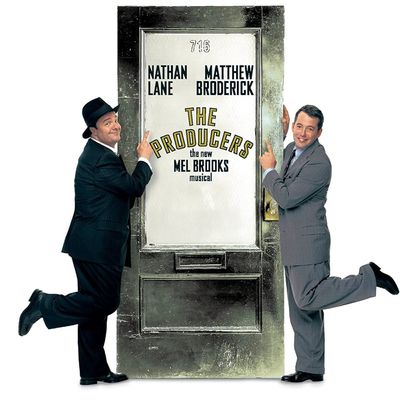
THE PRODUCERS. COMPOSER: Mel Brooks. LYRICIST: Mel Brooks. BOOK: Mel Brooks, Thomas Meehan. SOURCE: Mel Brooks’ film The Producers (1967) DIRECTOR: Susan Stroman. CHOREOGRAPHER: Susan Stroman. PRINCIPLE CAST: Matthew Broderick (Leo), Cady Huffman (Ulla), Nathan Lane (Max) OPENING DATE: Apr 19, 2001... Read More
From the show: Fifty Key Stage Musicals: The Podcast
Featured Shows

About
THE PRODUCERS
COMPOSER: Mel Brooks
LYRICIST: Mel Brooks
BOOK: Mel Brooks, Thomas Meehan
SOURCE: Mel Brooks’ film The Producers (1967)
DIRECTOR: Susan Stroman
CHOREOGRAPHER: Susan Stroman
PRINCIPLE CAST: Matthew Broderick (Leo), Cady Huffman (Ulla), Nathan Lane (Max)
OPENING DATE: Apr 19, 2001
CLOSING DATE: Apr 22, 2007
PERFORMANCES: 2,502
SYNOPSIS: Broke Broadway producer Max Bialystock meets accountant Leo Bloom who offhandedly mentions that under the right circumstances a Broadway show that fails could make more money than one that succeeds. Seeing a way out of his current financial situation, Max decided to produce a musical that is guaranteed to flop: Springtime for Hitler.
Finding waning success in Hollywood, Mel Brooks was eventually convinced to adapt his Academy Award winning screenplay, The Producers, into a musical. Kasey RT Graham follows the ways Brooks, director Susan Stroman, and co-writer Thomas Meehan reinterpreted the cult classic film into a two act Broadway musical. Additionally, analysis of The Producers as a uniquely comic piece among the weightier subject matters of other popular Broadway musicals in the early 2000s and a look at how the 9/11 terrorist attacks at the World Trade Center affected attendance at Broadway shows is provided. The musical’s record-breaking success at the Tony Awards, including for Nathan Lane, heralded a wave of musical comedies based on Hollywood films such as Thoroughly Modern Millie, Hairspray, and Shrek.
Kasey RT Graham is a director, music director, writer, and educator. Associate and resident director credits include the Broadway revival of On the 20th Century, the national tour of The Phantom of the Opera, and the US and Australian tours of Dirty Dancing. Conducting credits include the national tours of Oklahoma, The Producers, The Wizard of Oz, and Spring Awakening. Kasey is head of the Musical Theatre department at the University of Nevada - Reno. His book Small Talk is available on Amazon.
SOURCES
The Producers, Original Cast Recording, Sony (2001)
The Producers: The Book, Lyrics, and Story Behind the Greatest Hit on Broadway by Mel Brooks and Thomas Meehan, published by Miramax (2001)
The Producers, starring Matthew Broderick and Nathan Lane, directed by Susan Stroman, Universal Pictures (2005)
Recording The Producers, starring Matthew Broderick and Nathan Lane, directed by Susan Froemke, Rhombus International (2001)
A Year With The Producers: One Actor’s Exhausting (But Worth It) Journey From Cats to Mel Brooks’ Mega-Hit by Jeffry Denman, published by Routledge (2002)
Transcript
This transcript was automatically generated and might contain errors.
[0:10] ♪ Musical number: "I Wanna Be a Producer" — performed by Andrew Child ♪
[0:20] Andrew Child: I'm Andrew Child and welcome to Fifty Key Stage Musicals: The Podcast, a companion piece to the Routledge Press publication Fifty Key Stage Musicals, which is available for purchase by going to Routledge.com or clicking the link below in today's show description.
[0:36] Andrew Child: Today's episode focuses on chapter 42, The Producers, and with us today is author of that chapter, Kasey R.T. Graham.
[0:44] Andrew Child: Kasey is a director, music director, writer, and educator. Associate and resident director credits include the Broadway revival of On the Twentieth Century, the national tour of The Phantom of the Opera, and the US and Australian tours of Dirty Dancing. Conducting credits include the national tours of Oklahoma, The Producers, The Wizard of Oz, and Spring Awakening. Kasey is head of the Musical Theatre department at the University of Nevada - Reno. His book Small Talk is available on Amazon.
[1:16] Andrew Child: Kasey, thank you so much for joining me today.
[1:19] Kasey RT Graham: Thank you for having me. It's great to be here.
[1:21] Andrew Child: So, just to kick things off, can you tell us a little bit about what is your relationship with the musical The Producers?
[1:29] Kasey RT Graham: Yeah, I conducted the first non-equity tour, so it was 2005. The first non-equity tour of The Producers to go out, and I didn't know anything about the show beforehand.
[1:39] Kasey RT Graham: I grew up on the West Coast, so I was not quite as in touch with musical theater on Broadway and in New York as a lot of people were. It was, you know, kind of before the days of chatrooms really taking off, so like the Broadway news didn't circulate quite as heavily. So I was familiar with it from the Tony Awards and kind of word of mouth, but hadn't seen or really heard much about it until I was hired to conduct the tour.
[2:00] Andrew Child: Okay, wow. And what were your original impulses when you were interacting with this material?
[2:09] Kasey RT Graham: Yeah, I mean, first of all, like obviously it is wildly funny. And then you sort of get past that, and there's like an immense amount of heart to it, which is what really got me, surprised me. It like sneaks up on you because it's so over the top and so ribald that then to have kind of this, it's a love story really between Max and Leo at the end. And so it really like hits you in a different way that you're not expecting so late in the show.
[2:32] Kasey RT Graham: So once I was hired to do the tour, they took me to New York to see the show a couple times to like get a feel for it and how it flows. And my first thought was like it was so wildly funny, and like I didn't know how it was going to play across the rest of America. Because on a non-equity tour, you're not playing the major cities. So you can expect it to play similarly in Boston or LA or Chicago, but when you get into like tiny towns like Waco, Texas or Paducah, Kentucky, like how is it going to play in smaller towns when the humor is so broad, it sort of mocks everyone and anyone under the sun?
[3:07] Kasey RT Graham: It's so non-politically correct. Like, how is all this stuff going to play in smaller towns? I remember they get to the number "Keep It Gay," and I was like, I don't know what this is going to do in small town America. And it was one of the biggest surprises of my career because it played wildly successfully in these small towns who just like ate up every moment of it, laughed along with you. There was no, I was afraid there'd be a little bit of laughing at because it's such big characters, but just like laughing with the show, which was such a nice experience.
[3:35] Andrew Child: Was that, do you think, sort of a nervousness that was shared by the company, by the whole production team when the tour was starting?
[3:45] Kasey RT Graham: I think a little. I think especially the cast was, you know, it is a comedy you have to throw yourself into, or it doesn't work. And so I think that, you know, until you get that first couple test audiences on the road, you're not sure. And when you do a show in the same city, you're gonna have generally the same audience feel. But when you're taking it to all these different markets, north, south, east, west, you're just not quite sure what to expect. And it sort of was universally just adored all over the country, all over Canada, everywhere we played. Just people ate it up.
[4:14] Kasey RT Graham: Which this is not a show that is that's necessarily a given. You know, you've got "Keep It Gay," you've got "Springtime for Hitler," you know. Yeah, you've got that entire sequence. You've got, I mean, misogyny all over the place. You've got Ula, and like how are people going to take it? And what it's one of the brilliant things about the show, I think is the way it's structured. Like you get to "Keep It Gay," and you're like, okay, well, anybody in the audience who's maybe even slightly homophobic is like gonna leave by now. But then you introduce Ula, so they're like, well, maybe I'll stay, because like there's obviously like sex symbols in the show as well. For me, there's just like something for everyone. I think it's one of the like little Easter eggs of the show is how it's structured to like just keep offending you, but then bringing you back in the next scene.
[5:00] Kasey RT Graham: There we go. That can be the something for everyone in The Producers and something to offend everyone too. Just, you know, kind of balance out the scale. Did you come across anything in researching for this chapter that you felt like content-wise sort of paved the way for this show to become such a runaway Broadway hit?
[5:21] Kasey RT Graham: Uh, yeah, I think part of it was the timing. You know, we hadn't at the, at like 2000, 2001 in New York, it was a very serious time. Like we didn't have, we had family shows and we had serious shows. We had like the hangovers of Phantom and Les Mis that sort of like played out for the next decade. And so we didn't really have like shows that were just written to go and laugh and to go and have fun. And so I think that part of is really what like set it up to be successful is people were hungry for something like that.
[5:49] Kasey RT Graham: Okay. The other thing, the other nugget that I researched that I must have known at some point in the back of my head was I hadn't realized or remembered that Mel Brooks was a World War II combat veteran. Like, you know, you can say, you know, he's Jewish, he's allowed to make these jokes about the Holocaust, but he like really is allowed to sort of make these jokes. He was there on the front lines like this is in his DNA and in his history. It comes from obviously a long line of Jewish comedians poking fun at themselves and poking fun at their adversaries, but like he lived this experience which I don't know that I had appreciated when I was doing the show.
[6:25] Andrew Child: That does, it certainly gives so much context. I remember really not loving, maybe controversial opinion, the movie Jojo Rabbit just because I felt like it wasn't harsh enough about Hitler.
[6:41] Kasey RT Graham: It didn't hit hard enough and I think the gold standard if you're going to make a Hitler joke is "Springtime for Hitler." It is so vicious, it has such a bite to it, but it's also so iconic and over the top and obviously stands on the shoulders with such a respect for musical theater history that he also has. So I do think that is something that gives us context that he was actually in the field. He was actually on the ground.
[7:10] Kasey RT Graham: And that's certainly we can imagine colors "Springtime for Hitler." Do you I love, oh sorry, go ahead.
[7:19] Andrew Child: Go for it.
[7:20] Kasey RT Graham: No, I just I love the two layers of "Springtime for Hitler." The layer of Mel Brooks writing it and it's just so funny and so wrong. But then the layer of Roger Debris directing the show and like his take to it and like how over the top that character takes to thinking he's making something high art. Like I just love watching it through both of those lenses.
[7:40] Andrew Child: I'm curious, you know, because so many people say about so many different movies, so many different shows, you know, oh they couldn't get away with that today. Do you think The Producers is something that we will continue to produce, continue to see produced and continue to enjoy?
[8:00] Kasey RT Graham: Yeah, I've gone back and forth on whether where it like will fall as far as that in history and being revived and being reproduced. It is produced still a lot around the country. So I think that question isn't is answered as yes it will continue to be produced. I don't know like what a revival of The Producers looks like if there's tweaks at all. You know, it's one of those, it's such an equal opportunity offender that I don't know if you take one thing out it's going to make one group happy but if you take something out it's going to make another group unhappy. And there are obviously some negative stereotypes of various folk in the show and I don't know, I haven't answered that for myself and it's not I don't really have to which is nice but um yeah I don't know what that next, I think the person who directs the first Broadway revival of it has a challenge on their hands as to whether or not you're going to do a kind of museum style, like A Chorus Line is always generally done, or if you're going to take it in a whole new direction and find something new to tell about it, or find new ways to find humor in it without necessarily causing harm to minority groups.
[9:01] Andrew Child: Well, and it's such an interesting conundrum because I feel like The Producers, when we talk about a revival, Susan Stroman and Mel Brooks working together, firing at 100%, have it such down to a science, to a point where if listeners are interested in the interview I do about Hello Dolly, Leroy Reams talks about going in as a replacement for Roger Debris and sort of presenting this idea. He thought it would be funny if he didn't shave his legs for the role, and how that becomes this whole conversation, and you know, you need Mel Brooks' approval because everything is that much of a science with all of these jokes and the pacing and everything.
[9:50] Kasey RT Graham: Yeah, it's one of those shows that I when you license it, you get the option to like do the original choreography and it comes telling you exactly how it goes because it is so like from the jokes of the choreography, it is such a specific machine that a lot of the jokes don't play if you don't do the original choreography, you know, they don't have the same impact. It's one of those shows where like every aspect of the show is in on the joke. So if you change it up a little bit, the joke becomes something different.
[10:16] Andrew Child: Do you think working on The Producers was similar or different from the other national tours that you were working on?
[10:25] Kasey RT Graham: It's a little, it's different. I mean, it's very specific, but also comedy is specific to the actors. So they did give the director of the tour, who was the associate of the London production, they gave them license, you know, to play with the actors in the beats and find things that really work for them. You found that in places where you tried to force people to do something that Nathan Lane makes funny, they may not be able to make funny in the same sort of way.
[10:48] Andrew Child: Okay.
[10:49] Kasey RT Graham: So you might have to play with it a little bit differently. When you're doing a show that's not quite as broadly comic, I found that, you know, replacements and new casts fit into the mold of it a little bit better because you know, they bring themselves to it in a way that reads naturally without really changing the rhythm of the show. Whereas comedy can really change things up and can really alter the like pacing and the rhythm of the piece.
[11:11] Andrew Child: Okay. And you can probably speak a little bit more about working with replacements and stand-ins. You've worked as an associate director and resident director as well.
[11:23] Kasey RT Graham: Yes.
[11:24] Kasey RT Graham: Could you tell us a little bit about like your work on On the Twentieth Century, for instance?
[11:32] Kasey RT Graham: Oh, yeah, we had a lot of like random things happen on On the Twentieth Century. It was a very short run, but we had a lot of, well, we had a very serious illness in preview. So we had to cancel a preview one night because Peter Gallagher had at the time didn't know what it was, but it ended up just being like a viral infection that just needed antibiotics, though we didn't know exactly what it was. So half an hour before curtain, you know, canceled the show, had to put the understudy on and it's preview. So you haven't had any time to rehearse understudies yet.
[11:57] Kasey RT Graham: So spent that night in the theater with the cast and Kristin Chenoweth like frantically flying through the associate choreographer and I put him into the show. That taught a lot about putting people in in high pressure situations. And he had obviously like done work in advance. So it wasn't starting from scratch, but figuring out, you know, you have two and a half hours to put someone into a two and a half hour show. So, how do you triage? What are you going to do tonight? What are you gonna do tomorrow at 45 minutes before curtain? Because there are also union rules, so you can't call them in like four hours early and work on the set. So, you know, you got to be like organized in that moment.
It was the most like West Wing experience I've ever had, like walking through the theater with the creative staff and like, are we gonna cancel tonight? Like, what's gonna happen? The director and choreographer were at another function, so like they weren't available. So we just had to like make all these random decisions. And Kristin Chenoweth was lovely and like stayed the whole night to help them because it was her scene partner for the whole show. So, like, you want to make sure that you're gonna be on the same page tomorrow when you get to that.
[12:53] Kasey RT Graham: But yeah, what was the rest of the question about putting people into the shows?
[12:58] Andrew Child: Yeah, I'm just curious for listeners who are maybe interested in what is that like? Would you have any tricks or tools of the trade that you think make that process easier?
[13:09] Kasey RT Graham: Yeah, it's if you are an actor, you want to, I always think you want to approach the understudy role, bringing yourself to it, but also realizing that you're fitting into a production.
[13:19] Kasey RT Graham: So we've had you have some understudies who come in and want to make like wild changes to the role and change the sexual orientation of the character or make like large things that you just can't do because that upsets the balance of the piece, and it's not the way that the production has been structured.
[13:34] Kasey RT Graham: So you want to work with your director and your associate director to find like how you can make the role your own while still kind of coloring inside the lines, if that makes sense.
[13:42] Kasey RT Graham: So you're gonna bring your own shade of the role, but you can't all of a sudden decide to cross downstage left if there's no lighting downstage left.
[13:48] Kasey RT Graham: Like they're not gonna follow you, they're not gonna redesign the show for each understudy who's on.
[13:52] Kasey RT Graham: And it also varies greatly by who the creative team is.
[13:56] Kasey RT Graham: Some creative teams kind of want everyone to be exactly, you know, like come in at the same time, do this the same way. Everything's a little bit more cut and dry.
[14:04] Kasey RT Graham: And other creative teams are like, no, you're a living breathing person, do what like you do, work with your understudies, work with your associate or resident director, find your way into the role.
[14:14] Kasey RT Graham: I know on the Phantom tour, we were very loose with understudies.
[14:17] Kasey RT Graham: They were like blocking was not, and it came from a British team.
[14:21] Kasey RT Graham: So I think that might have something to do with it, but it wasn't as rigid as a lot of shows I've worked on.
[14:25] Kasey RT Graham: We had no number line. They had like they were all in spots, so you could kind of vary up your blocking a little bit within reason.
[14:31] Kasey RT Graham: So all of those understudy performances were very different, which I think can be really fun for kind of groupies.
[14:37] Kasey RT Graham: You get groupies at shows who want to come to see like everyone who's ever played the role of Christine Daaé.
[14:41] Kasey RT Graham: So they'll come and see and see like what different things that person brought to the role, which can be really fun.
[14:46] Kasey RT Graham: Which so I the Phantom of the Opera episode, I got to chat with Susan Russell, who was a replacement in the Broadway production in the role of Carlotta, and she has a lot to say about going in as a replacement, um, what that's like, and also I believe she started as an understudy in the role.
[15:06] Kasey RT Graham: So there's a super interesting conversation.
[15:09] Kasey RT Graham: I'd love to coming back to The Producers a little bit.
[15:14] Kasey RT Graham: What is it like when you're preparing to conduct a show with this huge big Broadway sound that's clearly, you know, inspired by influenced by a you know, a century of these huge shows?
[15:30] Kasey RT Graham: What does it look like? What's going through your mind as you're preparing to conduct a national tour of with this score?
[15:37] Kasey RT Graham: Yeah, it's a lot of pre-preparation.
[15:39] Kasey RT Graham: So, like looking at the score, looking at the instrumentation and figuring out like why is this one section super brass heavy, or who's like the most important voice here?
[15:47] Kasey RT Graham: Because you have like a sound engineer, but a lot of a conductor's job is to balance amongst the self, amongst the orchestra itself a little bit, because you can only do so much at the board.
[15:56] Kasey RT Graham: So you want to give them something good to start with.
[15:58] Kasey RT Graham: So figuring out like who's your solo, what are they saying with this particular instrumentation?
[16:02] Kasey RT Graham: There's like a gorgeous alto, I think it was alto flute solo in um Till Him.
[16:08] Kasey RT Graham: That's the name of the song, right?
[16:09] Kasey RT Graham: Yeah, end of the show Till Him.
[16:10] Kasey RT Graham: Um, that's beautiful and that you like rarely get to hear, and like you sort of do a little bit of creative problem solving and questioning of like, why did you pick this particular instrument here?
[16:19] Kasey RT Graham: And personally, I just think it's because it has a lower, like sweeter, you don't notice it quite as much as if you were to have a flute solo there.
[16:26] Kasey RT Graham: And so it like sneaks up on you a little bit.
[16:27] Kasey RT Graham: And for me, it sneaks up on you in the same way that the emotion of the song sneaks up on you, that you don't realize like this whole show has been about these two, like actually forming a legitimate friendship that neither of them has really had the skills to do before by the end that it's not a love story.
[16:41] Kasey RT Graham: I mean, Ulla and Leo have like kind of a superficial, not two-dimensional, but it's more surface level love story.
[16:47] Kasey RT Graham: But the real heart of the show is between these two.
[16:49] Kasey RT Graham: And you find moments like that that are echoed in the orchestration.
[16:52] Kasey RT Graham: Um, also looking at the vocal breakdowns and how things are scored that way.
[16:56] Kasey RT Graham: Producers has a lot of offstage singing that they originally record to happen backstage while things are happening.
[17:02] Kasey RT Graham: So Springtime for Hitler, you know, you've got most of your ensemble on stage, but then you've got this like heavenly chorus backstage.
[17:08] Kasey RT Graham: And so deciding like how is that, how does how do we get that sound out of the singers?
[17:12] Kasey RT Graham: Because some of it is, you know, from the soundboard, but a lot of it isn't how the singers approach it.
[17:16] Kasey RT Graham: And is it it's going for kind of an old school MGM sort of sound here on the Springtime for Hitler?
[17:21] Kasey RT Graham: Uh uh, and all that background stuff.
[17:23] Kasey RT Graham: And so kind of knowing what's being referenced or figuring out what's being referenced is half the job.
[17:28] Kasey RT Graham: And do you specifically remember anything that you felt like you were really digging into?
[17:35] Kasey RT Graham: Like you mentioned MGM sounds.
[17:37] Kasey RT Graham: Was there anything else that you feel like is directly and strongly referenced in this score?
[17:43] Kasey RT Graham: Uh I don't I off the top of my head, I don't know any specifics.
[17:48] Kasey RT Graham: Um I do know that the like Judy at the Palace moment is is kind of a famous nod to Judy Garland sitting on the edge of the stage.
[17:56] Kasey RT Graham: So they brought uh Roger Debris down as Adolf Hitler to have his Judy Garland moment at the edge of the stage.
[18:01] Kasey RT Graham: So as if he weren't camp enough, he's going even a step further.
[18:04] Kasey RT Graham: So that's like an illusional, an illusion reference, they always call it that Judy at the Palace moment where he comes down, he sits in a really like stark spotlight down there, like her um concerts at the palace in New York.
[18:16] Kasey RT Graham: There's also the high the high lows section, which is sort of old school 1940 sound of tight harmony.
[18:23] Kasey RT Graham: It's the it's in Springtime for Hitler, and it's the what is the lyric?
[18:27] Kasey RT Graham: The Fuhrer is causing a Fjora.
[18:30] Kasey RT Graham: It's like the four, the four tappers, and it's like really tight harmony.
[18:34] Kasey RT Graham: So that's a fun, a fun thing to to teach and to work on and to try to get that specific sound that harkens back to it's kind of Mannheim Steamroller today or Manhattan Transfer, that sort of tight harmony that we don't hear as much, but we get to like get a little tip of the hat in this number.
[18:51] Kasey RT Graham: So do you think is there a different process when you're taking on this show as opposed to when you're taking on conducting uh more traditional show like Oklahoma?
[19:03] Kasey RT Graham: Yeah, it can be.
[19:04] Kasey RT Graham: I would say, I mean, obviously, all musicals are like the music is steeped in the character and what's happening, but with a show like this that is so heavily um parody and and satire a bit that there are going to be other things that they are going to be paradizing, if that's the right word.
[19:21] Kasey RT Graham: Parroting, paradizing.
[19:23] Kasey RT Graham: Um anyway, gently sending up.
[19:25] Kasey RT Graham: Um so you find those moments like the Judy at the Palace or the Hilos, or you know, Ulla's number, which sort of just harkens back to a vamp number of like the 30s, 40s, which you just get two guys who just get to sit there and watch this bombshell sing this like great song.
[19:40] Kasey RT Graham: So it's a little bit more, I think, research as far as history in in a show.
[19:44] Kasey RT Graham: Like if you're doing a show like Oklahoma, you're not necessarily researching the style of music they're singing as much.
[19:50] Kasey RT Graham: You're digging more into the character and why is the character singing in this register, maybe, or why is the character have this particular song at this moment so that you can help in in coaching the singer and how where it comes as far as that goes.
[20:01] Kasey RT Graham: So I would say for Producers, it's more researching the time period, the variation in styles because you have a lot of different musical styles.
[20:08] Kasey RT Graham: There's some like conga sections, there's the sections that want to sound like old German folk songs that that Franz gets to sing.
[20:15] Kasey RT Graham: So lots of different, you know, you have your sound of like the show, and then you've got all sorts of different pastiche sounds that come in throughout.
[20:23] Kasey RT Graham: Okay.
[20:23] Kasey RT Graham: And then how would you say that is even different from conducting a more contemporary show like Spring Awakening?
[20:32] Kasey RT Graham: How's it different?
[20:33] Kasey RT Graham: Uh, I mean, well, stylistically it's very different.
[20:36] Kasey RT Graham: Um it's it's a show that should is uh intended to sound not super amplified.
[20:41] Kasey RT Graham: So that's its own challenge.
[20:42] Kasey RT Graham: Whereas Spring Awakening is like this is a rock concert, we want to blow the audience out of their seats at times.
[20:47] Kasey RT Graham: So approaching it that way, I mean Spring Awakening to me, I would approach in a much more a much more similar fashion to how I would approach Oklahoma.
[20:54] Kasey RT Graham: Like they're more the songs are more um storytelling than necessarily Producers don't really dig into the characters as much.
[21:02] Kasey RT Graham: They're more on the surface.
[21:03] Kasey RT Graham: But Spring Awakening has its own issue because the songs are like a different style than the rest of the show.
[21:09] Kasey RT Graham: And so you really dig into like the lyrics are very poetic and do not mean what they mean on the surface.
[21:14] Kasey RT Graham: And some of them I'm still convinced don't really mean anything, like they're poetic.
[21:18] Kasey RT Graham: Um, but you have to like find something that they mean to you for it to like talk to the actors about, because they have to be personal to the actors.
[21:25] Kasey RT Graham: And the songs are intended to be Spring Awakening is a little unique because the songs are intended to be the like actors' emotions, as if they were experiencing it as the character.
[21:35] Kasey RT Graham: So it's a little bit removed from the character.
[21:37] Kasey RT Graham: So it's kind of why it's more contemporary than the text is.
[21:41] Kasey RT Graham: Okay.
[21:41] Kasey RT Graham: So that's a whole nother layer of talking to actors and coaching and working with actors.
[21:45] Kasey RT Graham: And sometimes that is a music director's job.
[21:47] Kasey RT Graham: I've worked on shows as a music director where it was like definitely teamwork in working with the director and talking coaching actors through songs.
[21:55] Kasey RT Graham: And sometimes it's not that.
[21:56] Kasey RT Graham: It's more that that's the director's job, and you take more of the like technical backseat a little bit.
[22:02] Kasey RT Graham: It just kind of depends on the project.
[22:04] Kasey RT Graham: Phantom was very much like a Venn diagram of like whose job was what, because it's all sung through.
[22:09] Kasey RT Graham: So like the conductor has very strong opinions on how you sing this and what your meaning by how what your voice is telling the audience in this particular moment.
[22:17] Kasey RT Graham: So there's much more overlap between director and music director.
[22:21] Kasey RT Graham: And you would say that's not as present with something like The Producers?
[22:24] Kasey RT Graham: I think it, yeah, I think it would be not as present if it was something that had to do with like a joke isn't landing because we can't understand this word, or because the song is too fast right now.
[22:33] Kasey RT Graham: That would be where you might like chime in a little bit more.
[22:35] Kasey RT Graham: But in Producers, it's more about um getting the sound you want out of the singer and less about the meaning, I think.
[22:42] Kasey RT Graham: It's not always that cut and dry, but I would say that it falls more into that category.
[22:46] Kasey RT Graham: Okay.
[22:47] Kasey RT Graham: So this chapter on The Producers, this comes pretty late in the book, you know, where what chapter 41 out of 50.
[22:55] Kasey RT Graham: Do we see and can we already trace the influence of The Producers on later musical theater works?
[23:05] Kasey RT Graham: Oh, yeah, absolutely.
[23:07] Kasey RT Graham: I think Producers sort of gave permission to be a little bit more adult, a little bit naughty, a little bit more satirical.
[23:15] Kasey RT Graham: I think you see it in Book of Mormon and Something Rotten, and you see it in these kind of more broad comedy shows for sure.
[23:22] Kasey RT Graham: And it also was a for me, and it's a template that I don't think a lot of people have observed.
[23:27] Kasey RT Graham: For me, it was a template on how to make a movie work as a musical.
[23:32] Kasey RT Graham: And part of it is it falls into two categories.
[23:34] Kasey RT Graham: One, I think the best movie adaptations into musicals are not your blockbusters.
[23:40] Kasey RT Graham: They're shows that were a little more cult, a little more like had a maybe a very rabid loyal following, but it wasn't like the show that everybody could quote and knew everything about.
[23:49] Kasey RT Graham: Because you look at something like Young Frankenstein, which same team wasn't as successful, and I think it's because the movie is much more well known.
[23:57] Kasey RT Graham: You have to include like every little joke that the audience loves and is coming to expect.
[24:01] Kasey RT Graham: Producers, they had license to just change so much about it that they could really make it work on stage.
[24:07] Kasey RT Graham: Do you have other movies in mind, like The Producers that were kind of cult classics or had a smaller following, but they became successful musicals?
[24:19] Kasey RT Graham: Yeah, I mean, I think I think Once is a good example, you know, it captured a like an art market, but it wasn't, you know, your your audience that came to see Once the musical was a broader audience that went to see Once the movie.
[24:32] Kasey RT Graham: Um, I think also, I think Hairspray is a great example because that movie is like it's a great movie, but it is weird, and it is nothing like the tone of the musical is vastly different.
[24:42] Kasey RT Graham: So they were able to just make it a a musical that was its own thing.
[24:46] Kasey RT Graham: Um, I think those two are like standout examples.
[24:49] Kasey RT Graham: Yeah, I think um John Waters, who obviously directed the movie Hairspray, has a joke where he says, Yeah, next they're gonna do uh Polyester on Ice.
[24:59] Kasey RT Graham: Um just because the musical is is unrecognizable, has a totally different audience following it's totally different, and kind of I guess like The Producers, in a way, went from a movie to a musical, and then that musical was then made into another movie.
[25:19] Kasey RT Graham: Yeah, yeah.
[25:20] Kasey RT Graham: And there's other shows like you look at a show like Big, that the movie was wildly successful, and there's so many points of that movie that people remember that you have to recreate that then it just becomes about coming into the theater to like see that moment.
[25:33] Kasey RT Graham: Whereas when you pick musicals or movies that are less popular, the audience expectation is just different.
[25:38] Kasey RT Graham: Right.
[25:39] Kasey RT Graham: I feel like Waitress is another good example of that because I know people who have gone to see the musical, open the program and said this is based on a movie.
[25:49] Kasey RT Graham: Um, it's uh got a smaller following.
[25:54] Kasey RT Graham: And I think time, I think time that might be the second thing I was gonna say.
[25:57] Kasey RT Graham: I think time is also a factor.
[26:00] Kasey RT Graham: You know, they the musical came so much after the movie.
[26:03] Kasey RT Graham: Same thing with Waitress.
[26:04] Kasey RT Graham: It was 15 years or more, around 50, 10, 15 years.
[26:07] Kasey RT Graham: When you make it, you know, after the big hit, people are expecting that's very fresh in their mind.
[26:12] Kasey RT Graham: They're expecting that, especially back in the days when we didn't have Netflix.
[26:15] Kasey RT Graham: You know, if you saw a movie and then two years later it was on stage, you're gonna have very vivid memories about what that movie's gonna look like and sound like, and you're dealing with performances, you have to feel like do you recreate?
[26:25] Andrew Child: Do you tip your hat? How do you approach that aspect? Do you think that the success of The Producers, because it was wildly successful, it broke records with its ticket sales and the Tony Awards it won? It was a hard ticket to come by. Do you think that the success of The Producers sort of inspired an influx of movies to musical adaptations?
[26:49] Kasey RT Graham: Oh, yes. I think I absolutely you see, I mean, after it in its wake, you see a lot. I think the next like three or four Tony winners for Best Musical were based on movies. Still to this day, I mean, we have so many films adapted. Um, I do think it sort of opened that floodgate more than had been in the past. I mean, because it's been happening since the beginning of movies that they're being adapted into musicals, but I do definitely think, you know, not that I have quantifiable research on this, but it seems like at some point there had to be something that just drove it up because for a while there that's and maybe still it's that and the jukebox musicals is really what we're seeing over and over again.
I mean, I do think The Producers is a large part of that influx in the last 20 years of movies to musicals. I've I mean, I remember I wasn't able to follow Broadway news as closely as you are now growing up in Washington State in the early 2000s, 1990s. But I remember it was like a huge story in like national news when they brought Nathan Lane and Matthew Broderick back and they were gonna make a hundred thousand dollars a week, and it was just this big story. So they had great press people, first of all, but then secondly, you know, it just it was successful. So I think producers were like interesting. Let's see if we can capitalize on this. You know, I think they maybe sometimes misread the situation and that it wasn't that it was a movie because it wasn't successful because it was a movie, and then we got a rush of, you know, popular movies turned into stage shows that can't really live up to what you were able to do on film.
[28:22] Andrew Child: Do you think was there a different lesson that producers should have picked up on The Producers to say, if we want a surefire hit, this is what we should be taking from The Producers?
[28:36] Kasey RT Graham: I mean, yes and no. I think the lesson to take is like you should find lightning in a bottle. That's like the lesson. You should find an author and a director and a design team and six actors who like all can create magic together. You know, I do think a lot of it was that combination. But I think the lesson that many did pick up on was it's like the time to laugh. It's like the time to bring adults back to Broadway to enjoy musical comedy. You know, we'd sort of lost musical comedy for a while and got very serious when all the like London shows came in and all the very serious Les Misérables and Phantom and Miss Saigon and Cats. Well, Cats isn't all that serious, but um, these big spectacle shows that it was more about like getting a ticket to be wowed by that rather than to go and just like laugh harder than you have all week.
And so I think The Producers kind of gave that permission to like it can it's okay to have an evening where you're just having like a great time, and maybe the message isn't huge and looming and like something you're gonna carry with you for the rest of your life, but you are gonna carry that sensation of just having a great time.
[29:40] Kasey RT Graham: It's it is fascinating. One of our interviews is with Susan Stroman, um, our episode about Showboat and Susan Stroman choreographed a revival of Showboat. That's mostly what we're talking about. But we do talk about her work uh directing and choreographing The Producers, and it's just so evident the minute it comes up as a subject, uh she says that Mel Brooks is one of her close friends. So I think when you say it's lightning in a bottle, it is just sort of everyone firing at 100% and making this near perfect comedy.
[30:19] Andrew Child: Yeah, I talk, I teach some directing classes, and I talk a lot about collaboration between directors and writers and designers. And I just think their collaboration is one of the best. I think it's one of the best in history. And it's partly because I think it's so smart. I think Mel Brooks was so smart in how he went about doing this. Like he didn't want to write the score initially. He was talked into writing the score. He didn't approach it from a point of view of I want to have like control over every aspect of this. So he knew he like wanted, so he found a music arranger who helped him arrange the music. He found he could have directed it himself, but he found someone who like really had musical comedy and musical theater in their blood, and was like, let's do this together.
And I just think that give and take between that creative team is so special. And I think most shows that I am attached to have that same sort of love, and you can't you can't make it, you know, a producer can't put people together and force them to enjoy the process. So it happens sometimes, and I think it really comes out in the final product of this particular show.
[31:18] Andrew Child: Do you have other shows that you think like this have that lightning in a bottle quality to them that you would absolutely love to work on to direct to music direct to conduct?
[31:32] Kasey RT Graham: Yeah, uh, yes and no. I mean, I think I don't think I ever want to direct Hamilton, but I think Hamilton has the same situation with Tommy Kail and Lin-Manuel Miranda, two people who were like friends in college who have this relationship in the shorthand and are able to like, I mean, Lin-Manuel Miranda did so much for Hamilton, but to be able to stand back and like hand over some of the control to a person you trust is really special. So I think that creates just a final product that is so seamless, and you can't, you don't know where the writing began or the directing takes over, and you don't know like how much was the idea that was in the libretto and how much came up in the rehearsal room, and with actors as well.
Um, you know, they had that big lawsuit that the actors ended up being compensated, which was great because we often undervalue the contributions actors make in a workshop that bring their ideas, and like it's great when you can capitalize that and use everyone's idea in the room. Um, other shows that I like the original collaboration on. I mean, I think Hal Prince and Stephen Sondheim, like I think the shows they made together are pretty special. And I think Hal Prince and Sondheim, when they worked would work together, was pretty special as well. Um, and you read like lots of things about the ups and downs in their relationships, but like obviously when they were working together, there was something very special happening.
So I mean I would direct any Sondheim show in a heartbeat. Like if you're a theater out there and you need someone, you hit me up. Um, just because they're always special. But I think their shows like Sweeney Todd is such a special show that obviously was influenced by a director as well as the composer. You know, there's you can just feel the different strokes in there. You don't necessarily know whose idea was what, but you know that there was a give and take there and a trust between them. It's that overlapping the Venn diagrams like you were talking about already, which is Yeah, I think those are some great examples, all the names that you gave, all those shows.
[33:22] Andrew Child: Do you have anything that if a young person came to you and said, I'm gonna be directing a production of The Producers, would you have anything that you would say to them would be like key, should be in the front of their mind at all times?
[33:39] Kasey RT Graham: Yeah, I would say cast funny people. You know, it's musically, it's difficult, but there are plenty of people who've done the show who aren't the strongest singers. Ulla is a hard one because there are some very specific voice stuff going on. But otherwise, like cast people who are funny and who make you laugh, because that is something that you can't teach in a rehearsal period of any length. Like you're not going to be able to find that. So do what you need to do in a rehearsal process if you don't know the actor or an audition process. If you don't know the actors to like find what they can do and what their comedy styles are, because you also want people who are sort of on the same page.
It's a specific Borscht Belt kind of there's lots of verbal wordplay as well as physical comedy. So, you know, you don't want to find one actor who's really funny with words, but can't like move their both their legs at the same time. All of the characters are very physically demanding and very physically funny. You get to the end of that show and those actors are exhausted because it's not, it's very different than a lot of musical theater. It is very physically active. A lot of musical theater is, but it is very physically demanding in a way that some roles just aren't. So finding actors who can bring that to the table. I would test out, you know, test out vocally all six of your principles and the stuff on the big stuff you really need to hear.
I mean, that's kind of audition 101, but make sure that your Ulla's got that belt at the end of that song because if she doesn't, there's no point in that number. That whole number is about the end of that song, hitting that. I don't remember what the note is, but it's a high belt E flat or D or something, making sure that they have that and that they have that while they're physical. So finding, I would find a way in auditions to marry physical with the vocal, because that's a big part of it. And then just using once you've cast funny people, using their sense of sensibility and their sense of comedy. So like it's one of those processes that I wouldn't come in having blocked it all out in advance.
I would come in like with a sketch and like really ready to play with these actors so that you can find stuff that use the stuff that's in the script, and then the other stuff that they sort of fill in, you can use their instincts because that's always going to be funnier than you painting your comedy on them.
[35:40] Andrew Child: Right. Would you say when you talk about this show being so physical, so exhausting, um requiring you know, wide range and Ulla's voice, things like that. Is this like would you say that this is like a send up of Guys and Dolls, Hello, Dolly!, like older shows like that?
[36:03] Kasey RT Graham: Yeah, I know I know the creative team have talked in the past about it being a love letter to classic musical theater. And if you look at like the original design, the original design is not as it is innovative. It is not as visually innovative as designs were in like 2000. It was very much like let's give an updated look to the shows of the 40s and 50s. So like the walls are, you know, kind of flat-ish and painted on posters of the shows, and the way the show moves is it's beautiful and it's not I'd say it's old fashioned, but it's like old fashioned done brilliantly well. So you've got like a lot of drops and a lot of like pieces that come in because they wanted it to look and move like a 50s musical, but with a much more um adult sort of sensibility to it.
[36:48] Andrew Child: And do you think that sort of this design that's hearkening back to a different time? Does that sort of keep the show looking timeless? Because I don't feel like it dates it.
[36:57] Kasey RT Graham: Yeah, no, I totally think it does. I think you could look at photos of much of The Producers and be like, is this 1947? Is this 1997? Is this 2037? Like it just has a classic feel to it. Um and I mean they like spruce things up like William Ivy Long did his signature Sparkle Tights where there's like diamond studs sewn into all the showgirls tights so that they will glisten as they walk. And so it's like your love letter to the 1950s musicals just like kicked up a notch.
[37:26] Andrew Child: Would you say that you have any recommendations if there are listeners who maybe don't know The Producers that well, what would you say is the best way to get into it? Should they see the movie, hear the soundtrack, see the original movie, should they be reading it? What would you recommend?
[37:43] Kasey RT Graham: I would recommend the original cast recording, like listen to the album. I think you get a lot of information off of that. And I would find the script and I would read the script. Okay. I don't think I don't think the original movie gives it it's good to reference but it's tonally so different. I don't know that it gives that a director of the musical that much new information. And plus I I don't I like to I like to go to like the source material when it's helpful and I don't know that it's helpful here. And I don't think the movie I wouldn't necessarily watch the movie adaptation only because it is a very faithful filming of the stage show but the stage show works so well on stage and the film feels just a little bit 2D in a weird way.
So if you can find a video of the original production and you want to watch that at the center library or wherever they show that sort of stuff that can be helpful. But I think you can also just turn on your creative part of your imagination. And the libretto and the score and the cast recording will give you enough information to do it justice.
[38:41] Andrew Child: Great. Well, thank you so much for making the time to chat with me today.
[38:45] Kasey RT Graham: Yeah, thank you for having me.
[38:46] Andrew Child: And thank you, listeners, so much for joining us. Please make sure to purchase a copy of Fifty Key Stage Musicals by visiting Routledge.com or by clicking in today's show description. If you want to learn more about The Producers, please also review the links in the below description. I'm Andrew Child and thank you for listening to Fifty Key Stage Musicals, the podcast.
© Broadway Podcast Network, All Rights Reserved