

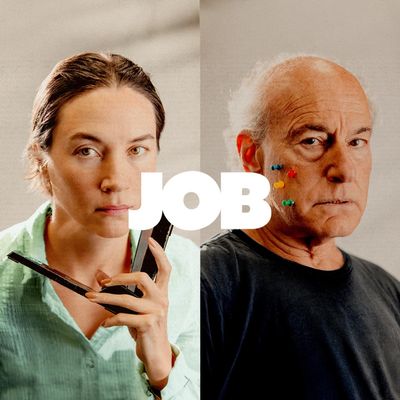
In this episode, we sit down with playwright Max Wolf Friedlich to discuss his current play, JOB, starring Peter Friedman and Sydney Lemmon. Please note that this episode will contain spoilers about the show... Read More
From the show: Half Hour with Jeff & Richie (Post-Show Broadway Discussions and Interviews)
Guests
Featured Shows
About
In this episode, we sit down with playwright Max Wolf Friedlich to discuss his current play, JOB, starring Peter Friedman and Sydney Lemmon. Please note that this episode will contain spoilers about the show. If you haven't seen the play yet, you can catch JOB playing at the Connelly Theatre in NYC until March 23rd.
Follow and connect with all things @HalfHourPodcast on Instagram, TikTok, and YouTube. Share your thoughts with us on JOB on our podcast cover post.
Transcript
This transcript was automatically generated and might contain errors.
[0:08] Richie Grasso: Welcome to Half Hour with Jeff and Richie.
[0:10] Jeff Malone: I'm Jeff.
[0:11] Richie Grasso: And today on our show, we have Max Wolf Friedlich.
[0:14] Richie Grasso: Max is a New York City born playwright whose work has graced prestigious venues such as the Cherry Lane Theater, The Crane, and The Access Theater.
[0:21] Richie Grasso: He's also made a mark regionally, collaborating with esteemed institutions like IAMA Theater and Pasadena Playhouse.
[0:28] Richie Grasso: Max's talent has garnered attention in the entertainment industry.
[0:31] Richie Grasso: He's worked with major names, including FX, Sony Animation, and AMC.
[0:35] Richie Grasso: And he's currently represented in New York City in the off-Broadway space with the play JOB.
[0:39] Richie Grasso: Welcome to Half Hour Podcast, Max.
[0:42] Max Wolf Friedlich: Thanks for having me, guys.
[0:44] Jeff Malone: Yes, Max, it's great to have you on the show.
[0:47] Jeff Malone: And before we get into your current show, we did want to start off by letting you have the floor and kind of tell our audience a little bit more about yourself and how you got started as a playwright.
[0:57] Max Wolf Friedlich: Um, sure. Well, so I grew up in New York City, um, as was stated. Um, and I hope a lot of them are still around, but there used to be, I grew up in like the '80s of like youth enrichment programs for theater.
[1:12] Max Wolf Friedlich: So like I did, I was in the inaugural class of something called Mind the Gap at New York Theater Workshop that really informed this play because it paired high school students with senior citizens, and we would write plays together.
[1:26] Max Wolf Friedlich: Um, I did Steven Sondheim's Young Playwrights program.
[1:29] Max Wolf Friedlich: Um, I did the Blank Theater's Young Playwrights Festival in Los Angeles.
[1:33] Max Wolf Friedlich: So there was a lot of encouragement and there were a lot of things to be done.
[1:33] Max Wolf Friedlich: Um, where in there on a whim, I applied to the New York Fringe. R.I.P.
[1:46] Jeff Malone: Yeah, I know.
[1:47] Max Wolf Friedlich: It's so sad.
[1:48] Jeff Malone: Really a bummer.
[1:49] Max Wolf Friedlich: Yeah, like really a bummer.
[1:51] Max Wolf Friedlich: And I feel like it'll come back one day.
[1:53] Jeff Malone: Yeah, I have faith.
[1:55] Max Wolf Friedlich: It makes too much sense.
[1:58] Jeff Malone: You're right.
[1:59] Max Wolf Friedlich: Um, so I was in the New York Fringe with this play called Sleepover that was, uh, in the words, I think of this Vulture article where they mentioned it was very naughty.
[2:14] Max Wolf Friedlich: Um, it was, uh, I think something that was, uh, slightly illicit coming from a 17-year-old at the time.
[2:22] Max Wolf Friedlich: Um, it garnered some attention, largely on the basis of my age, not necessarily like rave reviews.
[2:30] Max Wolf Friedlich: Okay.
[2:31] Max Wolf Friedlich: Uh, though we did, you know, it was, I mean, it's the Fringe.
[2:33] Max Wolf Friedlich: There's five shows, so like we weren't getting reviewed in like The Times or anything.
[2:37] Max Wolf Friedlich: But there was media being created that was like including this Daily Beast profile that was like this person is so young.
[2:44] Max Wolf Friedlich: Um, you know, at the time when you're like a teenager, you're like, "Joel, I'm not young, right? I'm old."
[2:49] Max Wolf Friedlich: Right.
[2:51] Max Wolf Friedlich: You know, now obviously it would be a welcome, it would be very welcome if someone wanted to write an article about how young I am.
[2:59] Max Wolf Friedlich: Uh, but um, I've never told this on a podcast.
[3:05] Max Wolf Friedlich: Um, this is like usually my spiel in general meetings.
[3:09] Max Wolf Friedlich: Um, but uh, I was in fifth period lunch.
[3:12] Max Wolf Friedlich: So like we do the play, it sort of goes away, and um, you know, our last couple shows, we had like 200 person wait lists, and it was crazy.
[3:22] Max Wolf Friedlich: We were at the Cherry Lane, beautiful, great, wonderful, and you know, now over.
[3:27] Max Wolf Friedlich: Uh, and during like fifth period lunch, I got a call from someone at Esquire magazine asking if I wanted to be in the 80th anniversary edition.
[3:36] Max Wolf Friedlich: I assumed it was like men of theater or something.
[3:40] Max Wolf Friedlich: Because why am I gonna be in the 80th anniversary edition of a magazine?
[3:44] Max Wolf Friedlich: Right, right.
[3:45] Max Wolf Friedlich: The idea, it's a very antiquated sort of men's magazine idea.
[3:49] Max Wolf Friedlich: It was a picture of one man for every year the magazine had existed.
[3:53] Max Wolf Friedlich: And I went down to get my picture taken and Mike Tyson was just finishing up.
[3:59] Max Wolf Friedlich: Wow.
[4:00] Max Wolf Friedlich: I was like, "What is the deal with this?"
[4:02] Max Wolf Friedlich: Uh, it was genuinely kind of a fluke on two counts.
[4:05] Max Wolf Friedlich: One, I had had five performances of a play.
[4:08] Max Wolf Friedlich: The photographer was like, "So you're like a Broadway playwright."
[4:11] Max Wolf Friedlich: I was like, "No, Broadway."
[4:13] Max Wolf Friedlich: I was like, "I think also technically no," and I looked at the form when I was like signing off on it and they had my birthday wrong.
[4:23] Max Wolf Friedlich: So I'm in that magazine representing a year that I was not born.
[4:27] Max Wolf Friedlich: Oh, so I was born in 1994, not 1995, and the cover of that magazine is like Barack Obama and I'm in there being like, "I wrote a play," and I got signed to UTA from that article.
[4:44] Max Wolf Friedlich: Wow, that's sort of my professional journey which, you know, had a good deal of luck involved as I think most journeys do, but particularly mine in that instance.
[4:44] Max Wolf Friedlich: And then since in the 10 subsequent years, you know, I kept writing plays, kept any opportunity to do any kind of reading anywhere I tried to take.
[4:44] Max Wolf Friedlich: Um, I did a lot of crazy inadvisable stuff like, you know, paying out of using money from my tech job to fly a bunch of my actor friends to LA to do like a two-night reading with the Pasadena Playhouse.
[5:26] Max Wolf Friedlich: Um, a lot of inadvisable stuff like that.
[5:30] Max Wolf Friedlich: And then, um, JOB also, crazy set of circumstances had to come together for that to work, and now we're, I'm here talking to you guys.
[5:39] Richie Grasso: It's amazing.
[5:40] Richie Grasso: And I think, well, we're gonna kind of go into JOB now.
[5:43] Richie Grasso: For those of you, it's playing in off-Broadway downtown in New York City, and there will be spoilers.
[5:47] Richie Grasso: We're gonna talk about some spoiler things.
[5:48] Richie Grasso: We have a whole episode out about the show already, but we're here talking about Max a little bit about this.
[5:53] Richie Grasso: And you know, when Jeff and I left this theater, we had so many questions.
[5:56] Richie Grasso: And I always say when you leave a play and you're with people, and I think something different, and the person thinks something different, and we're talking about it, and we're just talking and talking and talking about it, that is just such a good play.
[6:06] Richie Grasso: You didn't beat us over the head with like, "This is how it's supposed to be," and "This is the message."
[6:13] Richie Grasso: It was like this, that, and the other thing.
[6:15] Richie Grasso: And we were just so blown away by this piece.
[6:17] Richie Grasso: And congratulations to you and the success of all of it.
[6:21] Richie Grasso: The questions we have are what inspires you to write this?
[6:24] Richie Grasso: What made you even think of putting these two people in a room like this and starting this dialogue?
[6:30] Richie Grasso: And then I do want to ask you a little about the ending too and your thoughts on that because the ending is so mind-blowing.
[6:35] Richie Grasso: So inspiration for this, go.
[6:37] Max Wolf Friedlich: Um, I'll give you the annoying artist answer, and then I'll give you the real answer.
[6:41] Max Wolf Friedlich: Okay.
[6:42] Max Wolf Friedlich: The annoying answer being like, I really try not to think about inspiration too much just because something will pop in my head, and then I just can't get it out.
[6:53] Max Wolf Friedlich: And you know, I really try to, um, I just try to lead with having fun with everything that I do professionally, uh, for better or for worse, and then lost.
[7:06] Max Wolf Friedlich: You know, like this, I was just having, it was just really fun to write and fun to rehearse and, um, less fun to watch in previews, and now it's fun again.
[7:16] Max Wolf Friedlich: Wow.
[7:18] Max Wolf Friedlich: Uh, but the tangible answer is twofold.
[7:22] Max Wolf Friedlich: One, I, the lead character in the play, well, they're both the lead character, but the female protagonist in the play is a content moderator.
[7:31] Max Wolf Friedlich: I met someone at a party who had that job very randomly.
[7:35] Max Wolf Friedlich: Wow.
[7:35] Max Wolf Friedlich: Um, someone who looked sort of visibly like they were having a hard time.
[7:41] Max Wolf Friedlich: Wow.
[7:41] Max Wolf Friedlich: Um, and it really stuck with me.
[7:43] Max Wolf Friedlich: And I had no idea about the world of content moderation.
[7:46] Max Wolf Friedlich: I just found it endlessly fascinating.
[7:49] Max Wolf Friedlich: The, uh, the other major source of inspiration was I worked for, when I first moved to LA, I, in the vein of being an Esquire representing not my age, uh, I accidentally started working in tech.
[8:06] Max Wolf Friedlich: Wow, for this company called Breud, which built fictional influencers, the most famous of which was called Lil Michaela.
[8:14] Max Wolf Friedlich: Um, so, and when I say accidentally, I, I started, I got a weird meeting with this company because in another meeting I mentioned that I had a fake Instagram where I pretended to be an actor because I was bored and kept talking to this guy.
[8:30] Max Wolf Friedlich: I did not perceive him to be the CEO of a tech company.
[8:34] Max Wolf Friedlich: Um, it was only I found out via TechCrunch there was like a leak that they were like, "Oh, this is like a company valued at, you know, $35 million or whatever."
[8:44] Max Wolf Friedlich: And I was like, "That's interesting. I make $700 a month."
[8:47] Max Wolf Friedlich: Um, and you know, then got a proper salary and whatnot.
[8:51] Max Wolf Friedlich: But I ascended, you know, it was my job to cosplay as these three different characters, um, who were all fictional people.
[9:00] Max Wolf Friedlich: Wow.
[9:01] Max Wolf Friedlich: Um, and it was my job to transition the world of those Instagrams from being sort of like art project adjacent, like it felt like a social experiment trying to write real lore and try to make it like look like a story.
[9:16] Max Wolf Friedlich: But the part that really inspired the play was circuitously, I had the weird experience of being like a famous woman on the internet.
[9:25] Max Wolf Friedlich: Wow.
[9:26] Max Wolf Friedlich: With a million plus followers.
[9:28] Max Wolf Friedlich: Wow.
[9:29] Max Wolf Friedlich: And, you know, communicating whether I liked it or not, with like teenagers in the Philippines and fashion people in Paris who wanted to send me clothes, and people who said I was an inspiration, and people who told me to kill myself, and people who, so you know, I never, the character in the play is again a content moderator, so she's sort of engaging with the worst parts of the internet.
[9:55] Max Wolf Friedlich: Right.
[9:56] Max Wolf Friedlich: I wouldn't say I was doing that, but you know, being able to open my phone at three in the morning and have someone be like, "You're beautiful," and then the next message be like, "I hate, like you're a bitch."
[10:07] Max Wolf Friedlich: Right.
[10:08] Max Wolf Friedlich: It's like that's like a, I was floating, so I thought it was fine.
[10:14] Max Wolf Friedlich: But um, but yeah, so that, that there's an element of the play that is more autobiographical than I think people might think in that way.
[10:25] Richie Grasso: Yeah.
[10:27] Richie Grasso: Uh, it's really cool kind of like hearing where some of this is coming from because one of the things that really stood out for me in this play was really how you started with like that big moment, and then you kind of like took us into the play, and it wasn't something like you were doing in reverse.
[10:47] Richie Grasso: And I kind of wanted to see a little bit more of how you went about crafting that intense and psychologically challenging narrative from the start.
[10:55] Richie Grasso: Cause you know, what I feel like in a lot of plays that we do see, it's like the moment, and then it's like, okay, now let's bounce back, um, you know, two weeks early or something like that.
[11:05] Richie Grasso: And this was the complete opposite.
[11:10] Jeff Malone: We'll be right back.
[11:14] Richie Grasso: Welcome back.
[11:15] Max Wolf Friedlich: Yeah, I mean, I think that I'm always, we love, we, we love a twist.
[11:22] Max Wolf Friedlich: I mean, it's a corny, it's a corny thing, but like the movies that, you know, a lot of movies that I think become sort of cult, classic, stand the test of time things are like "Usual Suspects," you know, "American Psycho," "Fight Club." These are not even necessarily my favorite movies by any stretch, but you know, I think narratively those things really stuck with me. I think in theater terms, Connor McPherson's "The Seafarer." Um, there's this play called "Honey Brown Eyes" that starts with someone holding a gun to someone's head that always really stuck with me. "Gloria" by Brandon Jacob Jenkins, like these moments where you're like, holy shit, you know, and it really, you know, I was like, I feel the most those are moments where I really feel sucked into the narrative.
I was having more success in big quotes, but like more traction in television at the time that "JOB" started, and I think I was a healthy, there was a healthy dose of TV development brain in working on the play, where when you're crafting a pilot episode, you know, you're trying to get people on board for six seasons or at least, you know, another hour. So you don't really have, and I think there's, you know, there's a lot that's said about the sort of playwright to TV pipeline, and we're such allegedly great television writers. But I think there's a little bit that can healthily flow in the other direction that that um obviously TV is inextricable from capitalism in a way that theater need not be.
But I think there is something for being intensely audience focused and being like, you know, what to put it in tech terms, like user experience, you know, and um I don't not I'm no shade or shots at anyone, but I I think in theater sometimes as someone who as someone who's been a playwright who's developed at theaters, you know, it's just it's a lot of like telling you you can do whatever you want to do, which is great in one sense, but then faced with facing down the barrel, you know, kind of pun and metaphor intended of really having to put this up in front of hundreds of people, you start to be like, well, I don't want people to be bored.
[13:40] Max Wolf Friedlich: Um I think again, that moment, I can't tell you exactly where the moment of opening the play with the gun came from, save from maybe stealing it from those other plays. But I think that it cr immediately creates really helpful narrative parameters and it causes problems, but it also makes your development a lot easier from a directing and dramaturgy standpoint, because you're like, okay, well, we started at that moment, so that's that's the you know, sort of ceiling. That's like we have to we have to be surpassing that or like bumping up against it at all times. And if we're too far below it, something's not working, and that's tough, but also in a sense, you know, our director Michael Hurwitz and our producer slash dramaturg Hannah Getz, I'd be like, it's not working.
And one of them would be like, Well, she just needs to move the bag that has the gun in it. And you're like, boom. Right. You know, like easy, you know, in a in a way, like it's like she needs to on that line, she needs to block the door. And you're like, right, we're we're reminded. So I think once we really got it was there as just sort of a crazy idea, but once we really got into development and rehearsal, the three of us um could really see how helpful it was.
[14:59] Max Wolf Friedlich: It was totally clear that you all collaborated and that there were design collaboration as well. And when you see this at the, you know, when you get towards the end, and you know, there's a lot, there's horror here, there's also real world issue reflection, there's so much going on, and towards the end, Jeff actually grabbed my knee and started squeezing my knee, and I was like, why is he doing that? And then it took me about three or five seconds behind him to figure out what was going on when she's really exposing him. And so the rest of the play are like, oh my, I don't know. I saw I didn't see it coming from a mile away. So the question I have is with this ending, are we supposed to believe that she knew all along that she was going in there to expose him?
Is he never even really admits to it in the play? When the play ends, what happens next? Like, there's all these questions. Do you want the audience to have all these questions, or did you say, no, this is how you're supposed to think of the ending, or were you open it both?
[15:50] Max Wolf Friedlich: I'm I'm open to whatever. I mean, I think it's uh I think it's the healthy and beautiful part of doing theater and sort of giving it away. I'll also say, like, night by night, um, it's just what our actors find. In that moment, if I'm trying to do this verbally and not visually, but like if if Sydney, you know, has the has is holding the gun on Peter, like you know, arms all the way outstretched in like you know, a good stance, people think one thing, some nights the gun just comes up to sort of solar plexus level, and she's a little shaky, and it's like a totally different, and both are right, you know, like to be totally different experience, and there are definitely audiences who I think feel more united, just kind of based on what the actors find.
No, I mean, I listen, I have an answer, right? I don't think I'm any more of the authority genuinely than anyone else, right? Um, Sydney has her opinion, right? I've spoken to her about it. Peter has never spoken to anybody about it.
[17:02] Max Wolf Friedlich: Wow, bro. Um his logic being like, why, you know, I you know, a you guys don't need to know, I just need to know. Right. But B, and it's a confluence of something he said and something our director Michael Hurwitz said that I really like, is he was he's sort of like, well, what does it matter? Right. And I think something I'm interested in people taking away from the end, and this is sort of the I feel corny talking about my own metaphor. No, that's okay. But I think that uh, you know, there's something in the end to to how truth functions on the internet, where it's like people are like, Well, did he do these things? Is she right? Is she crazy? It's like she has a gun. Yeah, you know, it's like if if someone had a gun on you and you were like, wait, wait, wait, wait, wait, like, I'm not like the thing you believe is not true.
Right, you know, like it what does it matter? And I think that, you know, there were there, we've seen a transition over the last however many eight years or however long it's been, you know, with since the Trump presidency, where we still have this sort of coastal hand wringing of like, but but like that's a lie.
[18:10] Max Wolf Friedlich: Yeah, yeah. No one cares. Like literally it doesn't matter. And so, you know, the the piece is very firmly a period piece that takes place in January of 2020. It takes place before this, you know, almost cosmic magical awful thing that we all experienced, where it's like, it doesn't matter. Yeah, you know, where people it was so much of people on all sides espousing things, and you're like, look, well, there's this, I don't know what I don't care. There's this sickness, and that is what is happening. And I think that the thing that Michael Hurwitz, our director says that I really love is in the end, I think the question we're most interested in is it's these two people who, despite whether this is true or not, they really it's two characters who desperately need each other.
And I think the question in the end is not to me necessarily, though it is, I mean it is a question, does she shoot him? But will these people decide to need each other? That even if Peter's character is this horrible criminal that she thinks he is, she still needs the help of a very skilled therapist. And even if she is his would-be assassin who, you know, hates him and has been tortured by him psychologically Peter's character's reason to live is is helping at risk people right so you know it I think it's about what real solidarity and coming together will look like in America you know that like we're going to have yeah we're going to have to be alongside people who we might ideologically really disagree with if we're if we're to our if we are to collectively move towards shared and common interests.
[20:08] Richie Grasso: Yeah I think it's that's a great way to put it it's so and and I was gonna say is it bizarre that I have this whole other narrative that I've created in my in my idea of this is I actually don't think they need each other because I think she's a plant in this whole scheme and that she actually knows the whole time and she's tricking him that she he needs to confess to um the things that he's done.
[20:33] Max Wolf Friedlich: Oh I love that.
[20:35] Richie Grasso: And that literally I'm leaving here I'm like Richie what if what if she knows what if the whole thing's a setup and all of these videos are created to kind of make him think that she actually was crazy in um you know wherever she's working for the famous tech company and that they planted her there because she goes but then I'm like oh and then she goes and you know she tries to hunt everyone down that she finds doing these bad things on the internet. Anyway, it's that box.
[21:02] Max Wolf Friedlich: That's boring would it be if I was like, actually, Jeff, that's wrong.
[21:08] Richie Grasso: Right, right, right. No, that's why that's why I'm praising kind of your writing here because I think it is written really well that you can go off on a tangent and have all of these different ideas because you you wrote it that way.
[21:25] Max Wolf Friedlich: Thank you. I mean, yeah, that's that's totally, and I really do, you know, it sounds again, it I'm self-conscious, it sounds pretentious to be like, whatever anyone thinks is it truly is. I mean, I really don't I I think that's what this medium is to me.
[21:44] Max Wolf Friedlich: Is you you have to you have to take yourself out of it and be like, I'm not at these shows. I don't, you know, like maybe something happens where you know, whatever theory feels like the only logical conclusion that night, just because of I mean, something like, you know, we don't have to get into this norms too hard, but like something like October 7th, and you know what's happening in Gaza happens and changes the entire tenor of our play about uh you know viewing things on the internet and and what content we should or shouldn't be looking at.
[22:21] Max Wolf Friedlich: So the world keeps moving, and so I think you what one needs to as well. I don't know. I I I don't like to be moralized to, and I don't I don't really like to moralize to people. And I I also think I reject the idea, and you guys haven't said this, but a lot of people will be like, well, the ending is ambiguous.
[22:40] Max Wolf Friedlich: I'm like, I don't think it's ambiguous, like you would never describe, I think, a real world situation. I don't know. Like you would never be like, well, this Trump lawsuit. Well, you know, it's ambiguous. Well, you have, it's not clear in the legal, it has not been proven. Right. But like we have a very strong opinion. It's like very hard to, you know, I don't know, like Aurora Borealis to me is like a and the, you know, you're like, what is I and there's like that's something where I think of and I'm like, I don't know what that might be. Like most things people have like a strong inclination one way or another, and I think this is no different. And tell us a little bit about your thoughts on where your play, this play JOB fits into the Broadway off-Broadway New York City theater space in general.
We have so many Broadway's changed a lot in 20 years, off-Broadway's even changed. Some of the most groundbreaking cutting edge things are coming from off-Broadway. Some transfer to Broadway, some don't. I know there's less and less off-Broadway theaters too, unfortunately. So where do you feel like this play is fitting right now in the current theater landscape of New York?
[23:49] Richie Grasso: We'll be right back.
[23:53] Richie Grasso: Let's jump back into things. I had uh was lucky enough to um have brunch next to uh it was at like an event, uh the one and only event that I've been to. I don't want people to think that I'm out here on this mountain. Um I sat next to someone who is an artistic director of one of a major off-Broadway theater, and he was reflecting something that a lot of my friends feel that I certainly feel is that theater kind of desperately needs to de-institutionalize. And that it's not this notion that theater is dying is obviously patently false. Theater is one of the oldest art forms. Theater is not going anywhere. We're gonna be doing theater in in the nuclear fallout shelter, I think. Yeah. Oh, oh yeah.
There is this, you know, we the institutionalization of theaters make us feel like we're not all on the same team. And what I mean by that is you go to these big off-Broadway theaters, and I want to name check any of them because I love all of them and I appreciate what they're up against. But you go to these theaters and they feel like you know the fanciest places on earth, which they are, which doesn't reflect that a lot of them are fighting to make payroll every year, and that they are, you know, run on, you know, the for better or for worse, like, you know, del Citibank and Deloitte and like Bloomberg needing a tax write-off, and that's the basis of these theaters, and that's out of necessity, not design.
This is all a long-winded way of saying, like, I think that we're in a really exciting moment for independent theater. Um, I think, you know, the success of O'Mary, right? Success of everything that Jack Syrio is doing. Um, you know, I guess Theta Bear is kind of through the brick, but like, you know, Animal Kingdom and and his Uncle Vanya. Um, I'm really excited to see what Ryan Drake and Ryan Dobrin are cooking up at here arts center. Um, you know, you go to, and again, these people have been, you know, institutionally supported in certain ways, but like you go to under the radar, you know, now that it's not affiliated with um the public, and you know, you see what you know the while you were partying guys are doing, you see what Niall Harris is doing, and you're just like, yeah, there's so much beyond these these like little seasons.
And um, you know, it's really hard not to have a subscriber base that you're selling to immediately, but there's also something really exciting about it, and I think part of the success of our first run of the play was we were a nonprofit production, meaning we didn't have to give that much, we didn't have to get anyone their money back, we just needed to operate, and so we could make the ticket prices really cheap, and we could make merch on our own terms really easily. And on this new run, you know, we've had nights where there's like this uh plant-based milk startup called Holy Milk that like sold hot chocolate and cookies in the lobby, which I've never seen at a play. Right now, we have natural wine some nights, you know, as opposed to just like the crappy, you know, generic, you know, just being like, hey, this is like a you paid $57 to be here.
You might want to sauce a wine. Um, we've had people host evenings where they're like, hey, we're gonna have a post-show party that if you buy tickets to the play. We had uh Dream Baby Press, which um uh is this thing that Zach Royf and Matt Starr founded where they do these like goofy, like erotic, silly poetry readings all over the city. So they've done them in magic shops, they've done them in the Sabaros and Penn Station, and then they did them to open for one night of JOB. Cool. Well, all I'm I'm giving you a long rambly answer, but the there's real joy in not being institutionally bound, and you really it really opens up a lot of possibilities. And I hope that I can continue to in. I mean, I wouldn't say no to the chance to produce it a nonprofit, but also the thought of someone if someone came to me tomorrow and was like, Well, put your play up at blank place in New York, it would be in two and a half, three years. I don't really want to wait that long.
[28:23] Max Wolf Friedlich: Um so I'm gonna keep I just think like it's it's um there's a lot of I don't know, there's a lot of possibilities out there, and I think that as things feel like they're falling apart, there's a lot of historically speaking, like that's where innovation comes from. And so I'm really excited about the state of New York theater. Um I don't really understand when people aren't. Like I know that like yeah, but it's like people are again, no shade to anyone, but people colloquially and freely offer that be like, oh, this spring on Broadway is gonna be a bloodbath. You're like, if we know that, like what are we doing? Well, you know, it's just like why, and so I think that like people, you know, there are not being a million things that people kind of know aren't going to do well. Like, I think that that's like a good I think that going away is like a good thing. Yeah, yeah. I think taking the health, and then I'll shut up, I promise.
[29:24] Max Wolf Friedlich: No, you're good. You know, I think that like people using Broadway as like an indicator of like the health of New York theater is also really tough because the budgets are just not comparable at all, you know. Um theater, I think is in like our mixtape era to put it in like music terms, like we have to sort of get the new fans in at a lower price point, and then one day I think there will be a new generation of young people that really views theater as a premium product and it's like, yeah, I will pay $150 dollars to see it, but for now, it's like, no, like there needs to be options where people can pay $35. And I feel really uh excited and privileged to hopefully continue uh trying to offer that.
[30:09] Richie Grasso: And and I know we're almost out of time, but I wanted to just do a really quick two part question. One, what's next for you? What's coming up for you that you're able to say now? And also when you talk about all these inspiring future ideas for shows, what is something a piece of advice that you could give to a young playwright now who's trying to get a show.
[30:26] Max Wolf Friedlich: Um so in terms of what I'm doing next, there's a there's a play that actually predates JOB that I am cleaning up and trying to catch actors to. I don't know, I'll say also like it's it's I've had so much more interest candidly in film and TV than I have in in any sort of theater capacity. Okay. I I don't you know um is a chip that I'm gonna wear on my shoulder for a while and it's gonna I think push me towards doing more theater stuff. Yep. Um but also might be sort of emblematic of what's happening in the scene that um you know not to sound arrogant but like I just like thought that there would be more theaters that maybe wanted to talk to me. Yeah there's been um you know the play's gonna get published um there we have some international things moving that's really exciting.
Cool. Um we just signed the stuff for our first nonprofit you know regional production that will be uh not in America. Okay. Um, which is cool. Um, so just work and I don't know, just like have it again, it's really about having fun.
[31:35] Max Wolf Friedlich: Yeah, yeah. Films. I love, I want to do more readings. I just like there's stuff I want to write, just having a good time. Um, what I'd say to a young playwright is you just you just it's it I think that all of the best advice is really simple, and what changes is sort of our capacity to hear it. Like work hard and be kind, like those are you know, those are profound, but it takes you're not necessarily in the right place to receive that. So the simple thing that I would say is you just have to do it and you know, be kind of stupid and don't listen to everyone is gonna tell you how being it being hard and it being impossible are always going to make more sense. And uh I just don't think that that's true.
And I also don't think everyone is a unique, gorgeous, perfect little snowflake who has a hit playing them, but just do it. I don't know, like just like shoot for the moon, land amongst the stars, like I don't know, just like hit up the local coffee bar that no one has ever asked to do a play reading in, and I bet you know, for 20% of the door, they'll be down. Just do it. You know, like you're not don't wait around for you know insert, you know, nonprofit right like leading to their writer's group because they're probably not going to.
[32:54] Richie Grasso: Right.
[32:54] Max Wolf Friedlich: If they do, that's awesome and good for you, and that's great, and they're wonderful people, but they're probably not gonna let you in. And there's also a lot of respect given, I think, to people who do things their own way and on their own terms.
[33:07] Richie Grasso: So that's no, I I love that. That's and it's the big innovative thinking thing that seems to be lacking sometimes that people just want to hand it to them.
[33:16] Max Wolf Friedlich: So if you think outside the box, right we we are all out of time, unfortunately. For tonight, I could sit here for another half an hour and talk to you. But it's been wonderful. We thank you all so much for joining our episode of Half Hour today. Thank you all so much for listening yes and uh we hope you enjoyed our conversation with Max Wolf Friedlich we will share all information on where you can learn more about Max in the description and where you can get tickets to JOB. Our to our listeners if you have suggestions for future episodes we'd love to hear from you you connect can can connect with us on Instagram and TikTok at Half Hour Podcast. Thanks so much for joining us today Max thanks guys thanks for having me I'm Richie and I'm Jeff saying ta-ta for now bye.
© Broadway Podcast Network, All Rights Reserved