

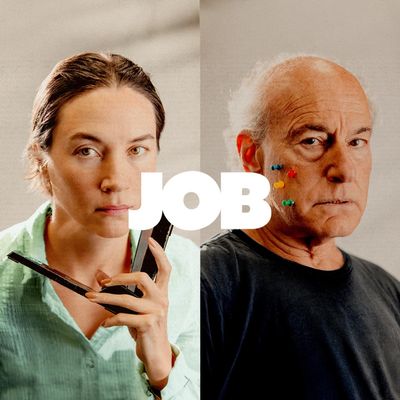
Welcome to "Half Hour with Jeff & Richie," where we dissect the latest theater experiences for both the seasoned theatergoer and the curious newcomer. In this episode, we delve into the off-Broadway play JOB, featuring stellar performances by Peter Friedman and Sydney Lemmon... Read More
From the show: Half Hour with Jeff & Richie (Post-Show Broadway Discussions and Interviews)
Guests


Featured Shows
About
Welcome to "Half Hour with Jeff & Richie," where we dissect the latest theater experiences for both the seasoned theatergoer and the curious newcomer. In this episode, we delve into the off-Broadway play JOB, featuring stellar performances by Peter Friedman and Sydney Lemmon. From unraveling the intricacies of the plot and concept to analyzing the actors' compelling portrayals, we explore how this production transforms from a seemingly straightforward narrative into a gripping psychological thriller. Whether you've seen the show or are intrigued by our take, this episode offers a comprehensive exploration of JOB. The show runs until March 3rd, 2024; you can find tickets here.
If you liked this episode, don't forget to subscribe to this podcast and leave us a review.
Share your thoughts with us on this episode below:
On Instagram: @halfhourpodcast
On TikTok: @halfhourpodcast
On our website: www.twoworldsentertainmentllc.com
"JOB the Play" is a compelling production that has garnered significant attention for its thought-provoking narrative and outstanding performances. The play, written by Max Wolf Friedlich, has captivated audiences with its powerful storytelling and deep exploration of human experience. Sydney Lemmon and Peter Friedman deliver standout performances, bringing depth and emotion to their respective roles. The play has received positive reviews, with critics praising its poignant portrayal of the human condition and the compelling storytelling prowess of Friedlich. "JOB the Play" offers a gripping and immersive theatrical experience that leaves a lasting impact, solidifying Max Wolf Friedlich as a noteworthy playwright to watch.
Transcript
This transcript was automatically generated and might contain errors.
[0:00] Jeff Malone: Welcome to Half Hour with Jeff and Richie, the podcast where we take a deeper dive into the latest shows we see, sharing our insights and opinions on the performances, storyline, and everything in between.
[0:11] Richie Grasso: In today's episode, we'll be discussing the off-Broadway play JOB, featuring the incredible talents of Peter Friedman and Sydney Lemmon.
[0:18] Jeff Malone: Whether you're unable to catch the show in person or you're looking to enhance your experience after seeing it, this episode is for you.
[0:24] Richie Grasso: And as always, we want to give you a heads up that this episode will contain spoilers.
[0:28] Jeff Malone: So if you're ready to dive into this production, stick around with us.
[0:32] Jeff Malone: I'm Jeff.
[0:33] Richie Grasso: And I'm Richie, and we're thrilled to be your hosts for this episode today.
[0:35] Jeff Malone: So without further ado, let's start the conversation today about JOB.
[0:48] Richie Grasso: Welcome everyone to a new episode of Half Hour with Jeff and Richie.
[0:52] Jeff Malone: Today we're going to talk about the thrilling play JOB, directed by Michael Hurwitz.
[0:57] Richie Grasso: JOB follows Jane, an employee at a major tech company who's placed on leave after a viral video. She seeks help from crisis therapist Lloyd to get reinstated and explores what it means to be a citizen of the internet.
[1:07] Jeff Malone: The psychological thriller zooms in on two careerists of different generations, genders, and political paradigms, examining our obligation to help those who need it most.
[1:25] Richie Grasso: Okay. So before we take our deep dive into this show, I think we should start this episode out again with our bold statement about the piece, and then let's see how that unfolds in our discussion.
[1:37] Jeff Malone: Okay. You first?
[1:39] Richie Grasso: Sure. So I will say that this is probably, it's definitely in the top five greatest plays I've seen so far this year. Maybe out of any show I've seen so far this year.
[1:54] Richie Grasso: It is 80 minutes of jam-packed comedy, drama, thriller, suspense, smart theater written for smart audiences, making you think, making you wonder, keeping you entertained at the same time. It is truly amazing and a remarkable play. I can't wait to talk about it more. I really hope a lot of people go see it. It is one of the better things I've seen in quite a long time in New York City.
[2:27] Jeff Malone: I actually, this might gonna be my bold statement. This might be one of the best plays I've ever seen.
[2:33] Richie Grasso: Wow.
[2:34] Jeff Malone: And we've seen a lot of plays.
[2:36] Richie Grasso: Yeah.
[2:36] Jeff Malone: So there's just something about this play, and we're gonna completely dive into this show into the reasons why, but I was gripping the edge of my seat this whole time during this play.
[2:48] Richie Grasso: And just so you all know, as we said in the beginning, there will be spoilers here, and there are some major spoilers at the end of this. So if you really are gonna go check it out, I think it's playing till early March, March 3rd. So if you really are gonna go check this out in New York and you really want to be surprised and not know anything about it, like we did, we went in really barely knowing anything about it. Then you might want to pause and come back and listen because we're gonna ruin some of the ending here. So just letting you all know.
[3:10] Jeff Malone: Yes. And as of right now, there's no transfer to Broadway for this show or any film or TV. It was playing uptown off-Broadway, then it closed there, I think in Soho, and then it's now it's downtown East Fourth Street. And now, and then it will close. I don't know if it'll transfer to Broadway, if they're gonna get film rights to it. I have no idea. Like for people as of now, there's no plans for it to transfer.
[3:41] Richie Grasso: So now let's jump into it. Let's get into our thoughts on the plot, concept, genre.
[3:46] Jeff Malone: Yeah, so basically, I mean, I like the plot in the premise is simple. We have one location, it's a therapist and a client talking about something difficult that the client's been through. There's no filler, there's no bells and whistles when it comes to distracting us or taking other characters that are not needed or projections that are not needed. It's very simple. It's like downtown in this small proscenium theater with two stellar actors giving performances that are thrilling.
[4:18] Richie Grasso: And from a plot perspective, 80 minutes, you know, could kind of fly by. I kind of feel like it flew by, and I was in it the whole time, being brought up and down and pulled left and right, and then it was calm, and then it was not calm, and then it was calm. That is what theater is to me. If I'm sitting, oh gosh, how many plays have I sat through for three hours? And I'm like, oh my god, please, this is so long. But this didn't need to be any longer than 80 minutes. The exact under we understood exactly what we needed to get out of this in terms of the message and the plot in 80 minutes, and it works so well.
[4:52] Jeff Malone: And here's why I feel like I am really gravitating towards this play, because this plot starts out in a gripping moment from the very beginning, because we see Jane, which is the main character, and Lloyd is the other main character. It's just the two of them throughout this whole play. So we see Jane, Jane is holding a gun at Lloyd, and we don't know why. So, right away, it has the perfect setup for you to captivate you enough to say, we need to know why she's holding a gun at him.
[5:28] Richie Grasso: And clearly we start understanding that they're in a therapist's office. And now it's our job to kind of decide is she starting therapy? Is she already in therapy? Are we far ahead into the future? Are we setting this whole, are we setting this up? Like we didn't know anything. So you know how sometimes you see a show, you're like, oh, okay, we're starting at the end, but it's the beginning. Well, this was still the beginning. So it was super cool because there were so many things as an audience member that right away you're like, I have no idea what's going on. This is super cool, and now I need to figure it out.
[6:10] Jeff Malone: Well, there's automatically preconceived notions that the play delves into, right? Oh, as an audience member, are you assuming that she is struggling with something and that the therapist is for lack of a better word, normal or sane or perfect, or you know, we're looking at this older man, he must have his life together. He must be perfect, like the great character that's gonna help this woman who needs help. You know, you automatically go into gender and age stereotypes here, right? And you as an audience, maybe not everyone, but as an audience member, you're like, okay, something happened to her at work. We don't know what happened at work. We find out, not through, thank God they didn't show us the video.
I loved that. Like that we have to in our mind make up what happened to her at work, but we hear audio so we can kind of gather what's happening. She is very distraught, yet we automatically think she's just distraught because of something that happened at work. Meanwhile, you find out at the end she's just distraught for a very different reason.
[7:07] Richie Grasso: But what you go in as an audience, like that's why I would love to go back and see this whole thing again, knowing exactly what I know from the end. It's kind of like, not to compare it at all to a horror movie, but when you look at the movie Psycho and you find out how it ends, then you can go back and say, oh, now I want to go back and watch every move of Norman Bates all the way through because now I know exactly who Norman Bates is. It's the same thing here where you're like, you don't know what's going on until the end, and then you want to go back and rewatch it. So then you learn so much about these people in just the 80 minutes. It's amazing.
[7:40] Jeff Malone: Well, that's what's so great about a play like this when it is so thought-provoking and it is so mind puzzling that there's so much for you to actually figure out that it keeps you interested in the dialogue that's happening. So, with both of these characters, we're learning more and more about each other's job. And obviously, as the therapist, it's his job to kind of pull out rooted trauma that is happening within Jane. And then Jane, on the other hand, we start watching her, and she's pulling out certain things about Lloyd as if she's almost the therapist towards him. Although that is not her job, but she's making it her job because we learn later that she is working for a big tech company, and she has to do content moderation or content, I think it's media control of videos on the internet and flagging things that are inappropriate and things like that.
[8:36] Richie Grasso: So we finally kind of learn a little bit more with Jane, which I think is so cool that it's her job to take that down. But she goes another step further that she makes it her mission to actually if someone is posting something or someone is doing something bad in these videos, she goes and confronts them and says, why did you do this? Why did you do that? So it's very interesting. And I kind of wanted to get your feeling on this in general around therapy. But how did you feel like this show really tackled the whole therapy idea?
[9:09] Jeff Malone: Well, there's therapy and there's jobs in general, right? And there's commentary here on like the therapist's job is to help people. But is he helping or hurting people in his real life? Her job is to help people be protected from what's happening to them on the internet. And it's amazing how she needed her, she needed to go back to her job to feel purpose in her life and in the world. And when she was seeing the videos about what she's talking about, what she thinks the therapist did at the very end with the abuse of the children, she says, I need to go back to, I think no one at work is answering me. I'm on leave right now, and no one's answering me at work. And so she needed to go back to work and she needed the therapist to allow her to go back to work, but the therapist was harming other people. So she put together in his life, but his job was to help her.
[10:00] Jeff Malone: Her job is to help others, but she's also trying to help herself. So it's amazing how like therapy and jobs equal what? Help or hurt. And those are the two words that kind of come to mind here is who helps who in the society, who hurts who in the society, and who does it purposefully, and who is doing it unsubconsciously? It's a whole commentary on. Well, when we get so much deeper into this play as well, like the ironic moment here is the fact of the matter that Lloyd is hurting people, but has to approve her to go back to work, which is what you just said. So she needs him to get there. And we're sitting here and we're saying, wait, why are we holding him to a certain power when he's you don't kind of know who the man behind you know the title is.
But she uses examples of, oh, the older boomer generation always comes at my generation for being on their phones all the time. Meanwhile, what she's allegedly accusing him of or discovering about him is that he was using that exact technology to abuse people. So there is this like very radical shift and look at that. And I think what's also interesting is why there's so many with tech there is so much difference in technology use between generations. And there's always this like do so many boomers love technology and embrace it. Some avoid it at all costs. Then you look at millennials who you seem to use technology the most, but even the generation coming up next, Gen Z uses technology even more and can even be teaching millennials things about technology.
So we're constantly learning and technology. She makes many comments, Sydney Lemmon's character about technology, how it's a part of our day. It's not just something that's attached to our day, it's now a part of our daily lives. And she there's so many one liners, by the way, that she has in her monologues about just commentary on life, ageism, sexism, gender norms, and and it just I can go on and on and on because it's such a commentary, and she really, really does her character goes very deep in that.
[12:13] Richie Grasso: Well, that is what I find interesting in this whole piece in itself is because when you look at things, people used to get away with things a long time ago without technology. So things could go on longer and longer. Now, with technology, someone like Jane uses technology to take down people sooner so that bad things don't happen to them. And I kind of wanted to like get to the major plot point here, the mind-puzzling thing that if you follow along with this show, it's the kind of everyone would be like, when did you figure it out that she was realizing that Lloyd is the man in these videos that she's watching? So, like, when did you feel like you figured it out? I know she made comments about the Berkeley degree and the jewelry making.
Still didn't hit me until she said, But you she turns, I believe, and says, You have a son and daughter too, or you had a daughter and son, didn't you? And when she looks at him, I had one of the moments, one of the greatest oh my god, jaw dropping grip the t the edge of my seat moments I've ever had in the theater was like, oh my god. Oh my oh, oh, oh, oh, oh, oh, oh. I haven't had a moment like that in the theater in so long. Well, there was a few, like you know, Sweeney Todd had a few moments like this. Definitely chilling gripping moments I've had in theater. This was just oh my gosh. And then when he didn't know, but I think there's a difference between chilling moments that are set up by a director versus chilling moments that are actually set up in the writing.
And this we'll get into director in a few moments here, but this was actually in the writing, so it was already there. The director didn't need to enhance this in any way. It was already set up that you know, we're gonna describe Lloyd in a very cool, puzzling way. And if you're very observant, and I like to think I'm a little bit more observant than you sometimes.
[14:09] Jeff Malone: Well, I I'm always looking at a million different things. You have a good eye for some things when it comes to this kind of stuff. As I was watching him, and we'll get into costume as well, because I think it costume becomes like a major point in this show. But I'm looking at him, and he's described as this just kind of middle of the road man in therapy. It kind of reminds my me of when I was in therapy and the guy that I would go to, and it's just like you're everyday kind of guy, and he, you know, has just like Land Zen sneakers on, jeans, a shirt, and like if you're looking closely, you would be like, Oh, why does he have that bracelet on? Or I noticed he had it. Is his ear pierced? And there was just something there that as soon as you start listening to the things that she was kind of describing, you're like, oh, it was like the first moment she was like, and I saw in the video a Berkeley degree, and as soon as I heard that, I think I like grabbed your leg, and I don't think you realized.
[15:12] Richie Grasso: No, I don't think I did. I don't think I don't think he realized because I was like, oh my god, it's him. And I was not ready for it at all, which is probably why I think this was one of the best plays, because nothing in this from the title to kind of the description about it, I would have never guessed. And they the marketing on this is really, really, really top-notch, well done. And so let me ask you like freaking in a way. Let me ask you at the end, do you feel like you know he denies it? She has the gun now. Do you if you're gonna continue this plot? Does he does she call the police? Does she kill him? Does she expose him? Does she go? There's so and and what's the best part about this is the playwright leaves that up to you.
There's a difference, there's a fine line in the difference between an audience member leaving a show and saying, Oh, I don't, I don't know what to think because I'm so confused. Versus, nope, I'm not confused. I understand exactly what's going on, but the playwright still left it up for me to decide what's gonna happen here and continue this conversation, and that's what's happening. What I think he does a really great job of is in two things.
[16:17] Jeff Malone: One we'll be right back.
[16:24] Richie Grasso: Welcome back. He ends the play with Lloyd kind of giving the power of choice in general. So he sets it up where he's saying, Hey, you can kill me, but that's not gonna do either of us any good. Because I still have to approve you to go back to work. But if you kill me, you're just proved to be crazy again. Because there's no proof that I'm the man in those videos. Unless this is where we were gonna go a little bit deeper, like in levels here. I still have this theory that she is a pawn in the system, and she's put there on purpose to get him. It's never said, but I've developed this whole theory in my head that she's in on this whole thing, and that's why she has to go in there. And the video is made up from the working for the video to go viral and all these things.
I know it's a big stretch, but I have this theory that that's like really what's happening. It and and there's such complexities to the characters, which is why I think this was so well cast, too. Why Sydney Lemon and Peter Friedman, who are seasoned performers in their own way, are really working off each other so well here. I mean, top notch acting. If they're not up for off Broadway Awards this season for this, I mean, incredible stuff. Sydney Lemmon, as we discovered actually recently, is the granddaughter of Jack Lemon, the famous Hollywood actor. Peter Friedman is original Broadway cast, ragtime. You know, so we have some, and they've done succession TV shows, things like that. Just really, really wonderful performers, and they're bringing such truth and and raw energy to their performances on stage, too. It's just like top notch.
[18:13] Jeff Malone: And I do think, like, from the end of the plot, though, and what he has written in there, it really comes down to the power of choice. She has the power of choice to say if she's going to kill him or not. But it's the mystery is left there for us all to know like what happens next. And I want to get into that now a little bit, moving into the direction. And we've talked a lot about their character performances, but also the design of this show. And how do you feel like the direction really enhanced this production?
[18:42] Richie Grasso: The direction was brilliant because when she made discoveries, which we didn't know at the time, but when she was gluing and connecting the dots, the lights in the back of the there was a wall back there of different lights that went off, and major sound effects would go off, and we would hear oh anything from audio clips and videos to anything that was triggering her in her mind to then have and then we'd snap back into it, and then the therapist is where did you go just then? What happened? Like he the therapist must have noticed she was going into her space. And that's brilliant directing. And it was it was almost bottom line jump scare. Cause I think I jumped a couple times. I was like, oh my gosh.
Like the first time it happened, I was like, I'm gonna be honest. The first time it happened, I was like, whoa, whoa, whoa, this is so out of place. Why did that just happen? Like this this doesn't make any sense. And when it happens three or four times later, especially in the strobe light moment when he puts the mask on, I'm like, oh, we're really going down into this now. And this is brilliant direction and brilliant lighting and sound design as well. I didn't know at any point if the gun was gonna go off, if someone was gonna come screaming through the audience. It was horrifying to me. I was so scared at many times, and you could hear pin drop in that audience at times. And there was a lot to say about the director's choice and and the sound design of bringing in those elements and not making it very clear about what it is, and the fact that she is proving to herself to be more and more not crazy, and just the fact that she connects things.
[20:11] Jeff Malone: So she has these sound bites connected in her mind about what she's looking for, and it was done so smartly because yeah, I'm thinking of like, is she kind of like you know, schizophrenic, or is she like having an episode in a way? And in this, it's like, no, she's just piecing things together because it's her mission to find these people.
[20:33] Richie Grasso: I will also say there's subtle directorial moments were wonderful too. Like her moving the chair and then shifting the plane of focus a little bit was nice. They weren't just sitting in the two chairs the whole time, they moved throughout that whole space when she was describing her standing on the table at work and people below her looking up at her, and then she came to the edge of the stage, and we were the audience literally below her looking up at her. Brilliant directorial choices.
[20:55] Jeff Malone: It was so so smart, and it just moved and all of it, all of it. I it was eight minutes, every minute of those 80 minutes, I keep saying 80 minutes, 80 minutes of just incredible theater. It's incredible.
[21:12] Richie Grasso: Yeah, and I wonder if some of that contributes to us being downtown, being in this space. There are major characteristics that definitely help here. You know, and I did want to comment a little bit on her too. But like we're watching this, and from the character choices of what she's doing, I would say both of them just bravo, both Peter and both Sydney in the body language that they're putting out on this stage. There didn't seem to feel like there was any filler in the writing. You know, like I feel like we've seen a few plays where like we're watching dialogue happen, and you're like, why is that even being said right now? I never questioned any of it. I questioned getting inside either of their minds instead. And I said, Oh, like it's so important that was included. And it was so important that that was included. And you have to remember each detail about this play, which was just great.
[22:10] Jeff Malone: It's so true. And I I always say in a lot of film and TV, sometimes you can't see the other actors in a scene because the camera's only looking at one face at a time. But I was sometimes watching the other actor responding to the other actor. I would just sit and watch the therapist writing or nodding. I would watch her in her moment while he was speaking. That's what is always good theater and good acting, when you can really see how the other one's processing and not zoning out.
[22:38] Richie Grasso: Well, that's exactly what I'm talking about, because there was a moment when Lloyd is speaking to her, and I'm watching her, and she did this thing with her body where she slowly started moving away from the chair that she was already clenching on. And I'm like, she's literally responding to what he's saying to her. I'm like, does anyone see this? It's brilliant.
[23:01] Jeff Malone: And in general, you know, this play, you know, when you talked earlier about like, does it have a future? I would hope there's a future about going to film. Maybe it could be filmed. I wonder, does this go to a commercial Broadway space? I don't know. I feel like the downtown, you know, a lot of people say, and we can talk a little bit more about our experience with the show in general. We'll be right back.
[23:27] Richie Grasso: Let's jump back into things. A lot of people say, oh, the downtown, gritty, off-Broadway theater is dead in New York City. It's clearly not when you have something like this. We went way down to East Fourth Street, the Connolly Theater, small space, two wonderful performers putting on this awesome show. If it moved to a thousand-seat Broadway house, I don't know if it would lose some of the edginess of it or the you sitting way in the back. But maybe more audiences need to see this. Maybe it does need to go to a film, uh filming. It's just it needs to live on in some way, I think.
[24:04] Jeff Malone: It should, I should for sure.
[24:07] Richie Grasso: I do too agree that it should live on. I definitely think more people should see it. And you kind of wanted to have that commercial run. I do think that they need to do it.
[24:16] Jeff Malone: Yeah, yeah. I'm sure other people can, you know, play those roles, but there's something about their chemistry together that just really works. You know, I feel like it could have an in the round moment because like you were saying, watching from where we're sitting, you're watching him, you're watching her. Does that work if it was in the round? Does it work in like a circle in the square because like there's so many different angles like that you can watch what's happening, or maybe even in a smaller, like um Hayes Theater or something like that.
[24:47] Richie Grasso: Yeah, you know, Prima Facie worked really well.
[24:50] Jeff Malone: Um true, true. And I feel like this has that same moment. Maybe you put you know, chairs on a stage and like everything they're surrounded.
[24:58] Richie Grasso: Um, I want to see it not working.
[25:02] Jeff Malone: Yeah, yeah. What do you what did you think of going downtown to a small throwaway space like this and seeing theater out in these spaces?
[25:08] Richie Grasso: It's just wonderful.
[25:10] Jeff Malone: Oh, I love it.
[25:11] Richie Grasso: Yeah, it really reminds me of like when I went to the fringe festival in Scotland, and you see this really great work, and they're in these like little nitty-gritty theaters, and it's just like uh it's just a different environment. It takes that whole like tourist commercial vibe out of it, and you really are getting people that are passionate about theater and understand uh a piece like this. So it was nice to be in that element, and it was not just like, oh, we're just going to see this because it's Peter Friedman and Sydney Lemmon, you know. It's like, no, we've heard really great things about this play as well.
[25:45] Jeff Malone: And I want to end our conversation here with an uh well, it is a New York Times critic's pick. Uh and this is a quote from uh Juan A. Ramirez, who was the uh critic at New York Times who uh reviewed this. And the quote says, quote, Sydney Lemmon searingly captures the frantic essence of a person overwhelmed by the ceiling like a different internet. Peter Friedman imbues his counter-arguments with genuine passion, nimly directed by Michael Hertz. It's refreshing to see characters who are not afraid of their intellect or feel the need to condescend by slowing down their high-speed streams of life or death consciousness. It does feel like you're on this trip, and this review from the New York Times really understood it too. And to be a New York Times critics pick totally makes sense.
[26:31] Richie Grasso: I love what he's saying, though, about it's refreshing to see characters who are not afraid of their intellect or the feel to need to be condescend by slowing down. Sometimes I feel like characters are written way too slow. And this had that high energy of like, we're gonna keep going, we're gonna keep going, and we're not like you say, we're not dumbing down our audience for this show.
[26:57] Jeff Malone: No, we're making our audience think for this piece, as everyone should when they're watching something like this.
[27:04] Richie Grasso: For sure. You have to use the mind that you were given to explore and see like where this playwright is going with this, and also why? Why is this playwright writing a play like this? Well, I and the playwright was interviewed recently and said there was an um the world we live in today of videos being all over the world. Everybody can make a video at any time. There's horrible things happening all over the internet. People's jobs are to watch find these horrible videos and remove them. There's this whole culture there of horrible things happening. And it was an interesting commentary. This play on like how do people handle that in their life and expose people and create better good in the world by removing the bad and what the job is.
That's why I think this title of this play is so fascinating. Job. It's just job. What is your job? Is your job to go go to work nine to five and come home? Is your job your whole life? Is it both? Is your job different than what you're doing in your personal life, or vice versa? And it's like all this commentary on that. It's mind-blowing, it's crazy. Uh it would, it was, it was just amazing.
[28:12] Richie Grasso: I totally agree.
[28:13] Jeff Malone: Yeah.
[28:15] Richie Grasso: Oh my gosh. Time is almost out. We're wrapping up here. Let's show final bold statement on job. Thoughts on this piece. Go.
[28:24] Jeff Malone: I could have continued talking about this show for so much for so much longer. Um I really, like I said, I really, really enjoyed this. I don't think this is the last we're gonna see from this playwright. I think that, you know, he's young and hungry. I think he's only 29, which is wonderful that we're getting work written this well for the stage. And I really hope this is not we the last that we see about this play because I think that this is what we need. I really do.
[28:54] Richie Grasso: You know totally. It's I loved the off-Broadway space, going downtown, seeing something edgy and gripping and dark and and and moving. And yes, trusting the audiences I was I felt like I was there on the journey with them the whole time. This is exactly what I want theater to be always. And I hope we see more of this in the off-Broadway space and the downtown theater space. Whether it transfers or not, that's okay because this had this awesome run. And I hope we see more from this play, right?
[29:21] Jeff Malone: I really do. Really, really do. Um, it was uh Max Wolf Friedlich who wrote this.
[29:27] Richie Grasso: Yes.
[29:27] Jeff Malone: Uh well, that does wrap up our discussion of the episode today. We hope you enjoyed our deep dive into JOB. The show is playing until March 3rd, and we will share the link in our description with ticket information. And don't forget, we want to hear from you. Continue the conversation with us on Instagram and TikTok at half hour podcasts, and let us know your thoughts on JOB. And if you enjoyed our show, please leave us a review. Your feedback helps us bring more theater to you. Remember, you can listen to our past episodes and stay tuned for upcoming ones as well.
[29:54] Jeff Malone: Yeah, so until next time, I'm Jeff.
[29:57] Richie Grasso: And I'm Richie saying ta-ta for now.
[29:59] Jeff Malone: Bye.
© Broadway Podcast Network, All Rights Reserved