

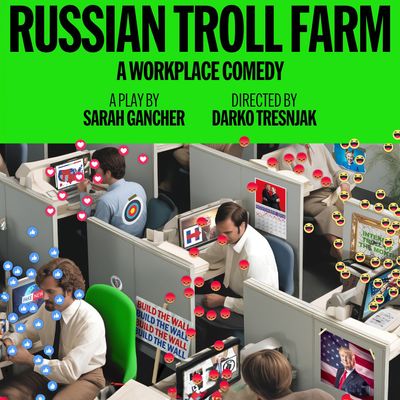
Recorded live from the Vineyard Theatre in New York City with the original off-Broadway cast, listen to this insightful and provocative talkback with all 5 cast members of the original off-Broadway cast of Russian Troll Farm... Read More
From the show: Russian Troll Farm, The Podcast
Guests




Featured Shows
About
Recorded live from the Vineyard Theatre in New York City with the original off-Broadway cast, listen to this insightful and provocative talkback with all 5 cast members of the original off-Broadway cast of Russian Troll Farm. The event, hosted by the Vineyard Theatre Associate Artistic Director Jesse Cameron Alick, dives deep into why the characters do what they do, and how the actors themselves get into these morally ambiguous characters and then back to themselves afterwards.
The full off-Broadway cast includes Christine Lahti, Renata Friedman, Haskell King, Hadi Tabbal, and John Lavelle.
Transcript
This transcript was automatically generated and might contain errors.
[0:18] John Lavelle: Hello again, you podcast listener you. Glad to have you back to Russian Troll Farm, the podcast. I'm your host with the most, John Lavelle. And this is episode three. If you missed episodes one and two, go check them out now. Go ahead. I'll wait right here. Okay, now that we got that out of the way, let's get to the meat and potatoes of why you're really here. Or as they say in Russian, Meyasol Kartoffi. This episode is a recording of a talk back that happened recently after one of the Russian Troll Farm shows at the Vineyard Theater here in New York City. For those of you who don't know, a talkback is when the audience gets to hang around after the show and ask questions directly to the cast members.
Pretty cool, huh? This particular talkback with all five cast members of the show was hosted by Jesse Cameron Alick, the Associate Artistic Director of the Vineyard Theater. Kicking off the conversation, he asks, how do we prepare to play real-life professional internet trolls?
[1:24] Renata Friedman: I thought a lot about Masha's arc within this play, which is a very funny sort of raucous construction, except her personal journey in it is actually quite tragic. That happened that led her to this point. Um, the reason she needed the job so badly, and why then needing Nikolai and being reinvigorated by the power of story um was so transformative for her. So I just I would say the first time we did it, I did a lot less of that work. I was just sort of trying to experience the world of the play, and this time around, I tried to get much more specific about character details like that and the stakes for her.
[2:17] Haskell King: I had had some experience with a few years before the election. So I had written a story on the FBI's infiltration of that group and their trolling of that community. So I had some experience coming into it in that regard. But really, for somebody asked me this question about preparing for this role in the research, and I just really didn't do that much research for it. I just people are like, yeah, could tell. But um really just like working, just working with the scripts and just working on the relationships and the intention. It's it's simple stuff.
[2:52] John Lavelle: Now you might recognize a familiar voice, because it's me, John Lavelle. I play Steve. How quickly you forget. Fine. Here's my amazing answer. I did a little bit because uh it was a different world, uh, obviously Steve's world. So I read a lot of um Julius Evola and Anarchist Handbooks, destroyed my web browser search history. Um there's a book called It Came from Something Awful, The Creation and the Weaponization of 4chan. And, you know, just understand the why. Why are you doing these things? And really, you know, physically, I like did a lot of research on incels and neck beards and um what their kind of ethos is and why it's women's faults as they're not cool's. And essentially trying to trying to really kind of look at it through an empathetic thing, because you know, try to figure out Steve is trying to do something good, but he's doing it in an awful, horrifying, terrible way, um, and still being funny.
So that's that's kind of it too. And the playwright actually sent us a lot of stuff. And also we have this wonderful dramaturg in Jiva, Fiona, who gave us like one of the most thick, well created dramaturgical packets I've ever gotten in my entire life about the history of Russia and about the uh IRA and all that stuff. So it was it was like a it was a team effort educating little old me from all the people who supported it. So yeah.
[4:17] Christine Lahti: Well, Luba's journey is just one of the most remarkable journeys I've ever had the um opportunity to bring to life. She goes from A to Z and then back again, and it's just extraordinary. So I worked a lot on um, you know, not judging her and loving her, you know, realizing that once she gets to the monologue, it's it's just getting the opportunity to get to explore the underbelly of a person who is so closed off and so brittle and controlling, and just to explore that is such an incredible opportunity. And to me, it the tragedy of Luba is that when she finally learns to love again, is that's the what brings her down. That's her what takes her down tragically. But the the research I did was in this packet, it was incredible.
I learned so much about Russian history and KGB and what happened during um Glasnost, and yeah, I mean I can share a substitution I use, which I'm which I think is pretty obvious, but every time I had to talk about the the law the downfall of USSR, I was thinking about the downfall of America that is, you know, potentially happening in November. The downfall of our democracy. So it is it was a really easy, is an easy substitution for me. It's just terrifying.
[5:46] Hadi Tabbal: I think for me, I leaned more into the things that happened to him or he does outside of the trolling world, right? The being married to an oligarch's daughter, and this idea of being a frustrated, a frustrated artist and feeling unseen, which is one of my favorite scenes and lines of the play, and I'm very happy that I get to say it, which is all Americans want is to be seen. And I think that's true to a very, you know, certain to a certain extent. So I think to answer your question, yes, it was more about the outside of the trolling life that really made the trolling kind of just fall into place. One of the super cool things about the way playwright Sarah Gancher wrote the play is that each of the characters has their own chapter, focusing on their personal story.
And just like in real life, people often act differently around different groups of people, or even depending on who they think is watching them. This results in all of us as actors having to go through a wide range of personas to put together what ultimately ends up on stage.
[6:43] Haskell King: When our wonderful moderator, Jesse Cameron Alick asked us how to balance the seemingly conflicting emotions and acting styles, I think we had pretty cool answers, if I do say so myself. I mean, I think Sarah's language sort of carries us most of the way, and then Darko. I mean, in a in a sense, it was less our job to be concerned with that, and much more theirs as the sort of crafters of the whole adventure. I think that as much as we could be specific in each moment, the more it sort of fed into that end of it into that unique style. I don't think of it as different styles. I think it's you just tell the truth. Um and it's up to the director and the designers to create a weird world that is more stylistic.
But I'm not thinking about style, I'm just trying to tell the truth and play my objective. Yeah, the language is there when it shifts, and I trust the playwright, trust the writing, and trust the you know, trust everyone uh that that that's the the tone, the tone will come through.
[7:44] Hadi Tabbal: Uh for for me, my experience with the practicalities of it in our scene with my scene with Luba, so we have like starkly different, right? Like the music is different, the lighting is very different, and our blocking is very different. So when she yells at me, I go under the table and and then up on the chair, and that's Darko creating that image. And that's very different than being in the office comedy world. And then that's very different than being in the Mission Impossible Steve's world. So I think that like he accomplished for me, like you're still on your intention, I'm still on my intention doing what Igor does, but I'm influenced by the music choice, and I'm influenced by the lighting. And when he says lights, I mean it changes everything for me. That that red, whatever's I don't mean, I don't just kind of see the bleeding of it, but does anybody else feel that? There's no red light. Oh, there's no line. You are in the Yeah, totally, totally in the moment.
[8:43] John Lavelle: Jesse Cameron Alick took us to another fun topic, asking us if performing in the show has changed how we trust what we read or see on the internet, especially as it relates to global elections. When I read the Sora and Lulsa in that infiltration, that changed everything with for me how I saw Twitter. And that was about like 2011, I think. Wow. So that changed everything because I saw that how the progression of is anybody familiar with this or no? I'm just okay. So there was there was a group within Anonymous called LOLSEC, and it was a five uh group of five um elite hackers. The kind of leader, even though they said they didn't have a leader was Sabu. And Sabu was went dark for about 24 hours.
And at this time I was watching them pretty closely. He was gone, and this was pretty unusual. He came back online, and his rhetoric over the next few months became progressively more revolutionary. He had been turned by the FBI. He'd be taken in, arrested, and turned. And so he ended up setting up a number of people, including Jeremy Hammond, who hacked Stratford. And he was Jeremy Hammond was sent away for 10 years in prison. I worked for the uh legal team that was defending Jeremy Hammond. That whole experience changed my the way I looked at profiles that we see online. But when it came to this play, and I was immersed in it in a totally different way. And I had this experience in the I guess it was 2020, where some friends, I'm from Oklahoma, and some people I know from there were arguing on Facebook about this post about some kerfuffle that happened at Walmart.
[10:19] Haskell King: And there was this post about this person's experience at Walmart and it was had to do with Black Lives Matter, and they're upset and they'll never go to Walmart again. And then I'm seeing people I know responding to this. That's right, I won't go either. And it was in it's kind of crazy. And I read the story and I said, there's something off about this. And we had already started working on this play, and I was like, it's too clean. It looks too clean. There's like paragraphs, like people don't, when they're angry, they don't write like that. And it turns out Walmart has a fractional Facebook presence or did at that time. And so it's regional. And so you could cut and paste that story in each region and just change the name of the town.
And that's what they did, whoever was the troll for this. And so this same story was across the US. People were only seeing what was in their region on Facebook. That was pretty amazing for me to see. Like uh that was a really unique experience that I it was very different than what I had experienced before. And I wouldn't have I wouldn't have said I don't think I would have seen that if I hadn't been doing this play.
[11:18] Hadi Tabbal: Yeah, when I get those messages on my Instagram account, like Keanu Reeves, I'm like just imagining more empathetically the guy on the other side or the person the other side trying to fish. But that's why I I mean everything's private. Everything's private. All my accounts are private now. Um, just because I don't want anyone to know anything and use it against me or my family. Don't let that inspire anyone to take me down. For me, two th there are two things that happen to me when in this play. The the first one is it kind of awakens this idea of how we receive stories. And I consider myself quite a medium vigilant kind of person. I'm not like, you know, super vigilant. It reminds you of how how we receive stories and not just like not just in tweets that are meant to be inflammatory or false.
[12:05] Hadi Tabbal: Any story, any narrative, in a conversation, especially with people who are of your own political opinions. And we because some of the bias is so big to receive a story a certain way, that this just kind of goes into the granular aspect of it, right? And that is kind of enlightening if you think about it. Like, how do we believe what we believe in? You know, even when it's not so blatantly an act of misinformation? But the other thing is, I didn't grow up here, I grew up abroad. And so what interests me about this too is also realizing and remembering that the United States interferes a lot in other people's elections. And we have to remember that. And it has so the US has given itself the right as the biggest empire today to do that, which is understandable from an empire's perspective, but also it has sowed a lot of historical enmities with a lot of countries because of that.
And for me, what Russia does in display is more interesting on a macro level of what we do to each other than like, oh, look what the Russians did in 2016. Because also the impact, the actual impact of Russian interference in 2016 has been highly debated. And also what this play makes me think about is how much are we, how much do we have to be responsible about how we create and believe stories, but also how much do we have to be responsible in not shifting the blame away from us, because we elected the people that we elected at the end of the day. So there's a lot of things that come from this that are much bigger than oh, look what happened in 2016. And I think those levels of understanding of the play can be very exciting.
[13:43] John Lavelle: Throwing the question to the audience now, though, the first question is simply how do you consume the news and how does it affect you? Here's my answer. I was actually just, if you don't mind me saying, I would sit next to Hadi, and he sometimes would say, I should never read the news right before we're about to go on stage all the time. And I think it does, you know, as actors, as artists, the biggest thing, one of the biggest tools we have is deep empathy. And it does affect us. Like I try to find multiple outlets because I do have to read the news. I have to read it because I'm also a writer. I have to understand what's happening, what sensibilities are. I couldn't do that before the show today, some of the stuff, because I think I'd be in such a hard, sad place.
So I'll wait later with the glass of whiskey. I mean a glass of orange juice. It's gotta be multiple sources. I don't know which periodicals I should shout them out or not. I do appreciate AP. How do Zera? I mean, New York Times if I want to feel better about myself because if it's like a so leaning left, but I also have my dad who watches Fox News and he has conversations with me and what he sees. And sometimes my dad will, you know, talk to me about a meme he read as if it was an opinion. So that's the dangerous thing, right? Opinions become facts. That's my kind of journey, but I'm not as astute, I don't think, as so many other people on this panel here. Yeah, I'm just trying to understand. It just, yeah, that's me.
[15:07] Haskell King: Spoiler alert, within the show, Renata's character of Masha gets pregnant. We won't tell you why or how. You have to see the show to find out that info. But just know that it has a profound downstream effect on Christine's character of Luba. The question the audience asks is if Masha didn't have the pregnancy written into the show, would Luba and Masha still have a connection? Absolutely, yes. I think that's a snag. It's a little snag. There's a lot of snags along the way. Bringing down Hillary is a snag. Bringing down a formidable woman is a snag. There's all kinds of like snags. Not being able to do well at my job. When that's my whole life, that's all I have. Makes me realize, oh, maybe there's other things in life that I need to look at. I do think that they would be very close still. They're living together. I think they would be very close even without the pregnancy.
[16:01] Renata Friedman: What do you think, Haskell?
[16:02] Haskell King: I agree. I think that they're two deeply lonely women in a very lonely environment. And through the chaos and anxiety and stress and manicness of where they find themselves at the end of the play. Yes, I think they would find each other.
[16:17] Christine Lahti: Yeah. I think they love each other as friends. The play itself takes place in 2016 during the months that led up to Trump being elected to the US presidency. Our moderator Jesse quickly asks us what we felt our characters have been doing since that time during the last eight years leading up to 2024.
[16:34] Hadi Tabbal: I actually have a very specific answer for this. And Masha has moved to London and she's working in a plant shop. And she had her child and she's raising it alone and she's thriving.
[16:49] Haskell King: Oh no.
[16:53] Renata Friedman: Where's Igor?
[16:55] Haskell King: I see Igor is going into hiding during this fracturing here and working in secrecy for a while and coming back to dominate this field. I had like a whole story about a gulag and Nikolai's my bunk mate, because Luba comes back to us. Like all these things.
[17:09] Christine Lahti: But I think Steve's got all his tattoos covered up. He goes to the Mac store Sephora and gets everything covered up. Super clean cut, kind of like a Richard Spencer thing going on. And I wondered if Luba kept him around as a warning. Like, so I basically am still at the agency, but I'm under her foot.
[17:27] Hadi Tabbal: I'm gone.
[17:28] Haskell King: No, you survived.
[17:29] Renata Friedman: You're such a survivor.
[17:31] Haskell King: I believe Luba lived. I believe that Luba lived.
[17:33] Christine Lahti: She didn't come back to that stupid agency. And I feel like Luba lived and she's got everything on me, and I'm doing what I want to do, but I just desperately want to take everyone down. Because I think I should be in a really loving platonic relationship with Putin. I think that's what Steve thinks he should be in. Like a real, like a real bromance, you know what I mean?
[17:55] Hadi Tabbal: Yeah, that's what I think Steve's still striving for. I don't think he got there because I don't think Putin has that in him.
[18:01] Christine Lahti: So yeah. Well, I haven't really thought of this, but I think now that we're talking about it, I think she does go off to some sort of horrible gulag thing in, you know, Siberia. But she does survive, she doesn't die, and she finds Masha in London and helps raise the child and does everything she can to get revenge on this guy. Like just puts like just make him suffer in horrible insidious, horrible ways.
[18:28] Haskell King: I think I get placed in a kind of a sham position at Yevgeny's company, one of his companies, the father-in-law, and just works under his watch as a depressed manager who does basically nothing, but is just there to be under his watch.
[18:43] Renata Friedman: And yeah, it's sad. The play brilliantly takes the audience through a lot of emotions, sometimes uncomfortably, which will often lead to nervous laughter from the audience. The next audience questions are how we feel about that nervousness we're creating, how we shake off our characters once we leave the stage, and how we as real people deal with the questionable morality of our characters.
[19:06] Haskell King: How do I feel about nervous laughter? I mean, it's great. It goes by their way. If I say something horrible and people are like, which has happened, they're like, yes, you're like, right? But the audience, very much in, you know, soliloquy and a direct address a lot of the time in that particular session is the other character in the play. It's an act of trolling, like literal trolling. That's the structure that Sarah wrote. It's an education at how to troll and push buttons and try to get a reaction. So that's it. As Steve, I just want reactions, positive, negative, whatever it is, is a reaction. The only failure would be no engagement, as we talk about in the beginning of the play. But it's a different beast every night, really truly. You never know what's gonna happen. And I love that. I love not knowing what's gonna happen.
[19:51] Hadi Tabbal: In regards to your second question, how we sort of shake it off, it's actually harder for me in the reverse, harder for me to transition into it. Once it's over, there's sort of this feeling of catharsis by the end of the play, and we've screamed it all out and lived through it all, and it actually I feel sort of buoyant after the show. So I need less of a process after the show to shake it off than before.
[20:17] Renata Friedman: I mean, personally, my individual process for this show, and it changes with every project you do. But for this, I do a short meditation at home before I come to the theater to sort of create a moment of neutrality for myself a little bit, more sort of rid myself of the rest of the day leading up to that moment. And then on, I mean, just this is so silly, but on my way to work, I just listen to some music, frankly, that puts me in the mood, and then I actually listen to music a lot during my warm-up. I do some visualization again leading up to going on stage. So that's much more of a journey. And I don't often do that for plays, but for this one in particular, I've sort of needed it.
[21:01] Haskell King: Someone want to answer that first question.
[21:03] Renata Friedman: That's great.
[21:03] Haskell King: How you deal with the morality of it.
[21:05] Renata Friedman: Oh, yeah. I think for me, it's, you know, and again, what's really exciting about this piece is I feel like all these characters just need want to be heard or seen in some way. And so when you think of that, it's hard to judge that. You know, and then I think people do things because of these inner desires that they have. They do different things. And it happens that in this play they do horrible things to deal with that. But if you dig in, the impetus is actually not immoral, right? So they just land there. That's how it expresses itself. And so you always find that thing that makes you kind of not judge, or else you I don't know how you would even say those words. You know, you'd be just kind of playing some bad guy.
[21:43] Haskell King: But yeah.
[21:48] Hadi Tabbal: Yeah, I think also for just acting terms, justifications. If you can find an empathetic core, emotionally charged justification for what your character is doing that may be looked upon at the outside as amoral, it'll be justified and you can play that with love. Like Hadi just said, I want to be seen, I want to make a difference, I want to save the world. I'm so afraid of the future for the future generations of little Steves, right? All of a sudden, you're like, okay, and then he's trying to create this world. I think with that with the moral stuff, and then as far as the recovery, I think Renata touched on it wonderfully, ritualization, which is something that's very much important for theater actors, is I do it this time, at this time, at this time, at this time.
Some people call it self-care, but it's ritualization of how you get into and get out of the day-to-day of doing eight shows a week. So yeah, and hydrate, like drink lots of water. Or you get off stage and you have 40 minutes to just do whatever you want in the dressing room. Drink bourbon, it's enough time to just get out of the play. Like Andy Crashbacks stage.
[22:51] Haskell King: Yeah, we drink a whiskey after, so that's one thing. I want the cathartic feeling, but I always feel really chaotic when I leave here. It's I haven't figured that out yet. The moral aspect, like I don't have any moral qualm at all with playing the role because I never looked at it that way. I was getting into a conversation about this with someone before, and I just had to stop because it gets too complicated for me. I'm following those goals and they're my needs, and that's really all there is for me. So I never have any problems at all with Igor. Even though if I stop long enough to think about it, it's really horrible stuff that we're all doing.
[23:33] John Lavelle: And that's it. Our 30 minutes were up. Thanks for listening to this lovely third episode of Russian Troll Farm, the podcast. Thanks to Sarah Goodman and Alan Seals, our sound engineers and editors, and to Kim Garris, the head of production over here at Broadway Podcast Network. I'm John Lavelle, your host, and so much more. Read more about this episode and all other things by visiting BPN.fm slash Russian Troll Farm.
© Broadway Podcast Network, All Rights Reserved