

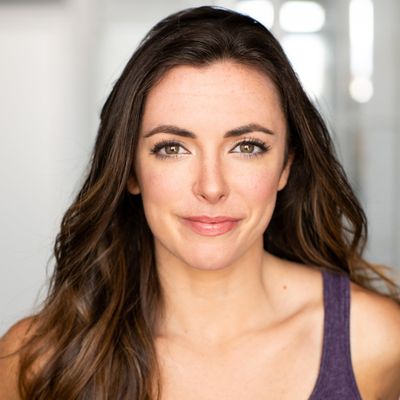
Nobody has climbed the Broadway ladder with as comprehensively as Desi Oakley. Fresh off a run as Jenna in the national tour of Waitress, when we spoke she was starring in Chicago on Broadway as the iconic role of Roxie Hart... Read More
From the show: The Ensemblist
Guests
Featured Shows

About
Nobody has climbed the Broadway ladder with as comprehensively as Desi Oakley. Fresh off a run as Jenna in the national tour of Waitress, when we spoke she was starring in Chicago on Broadway as the iconic role of Roxie Hart. But that stardom comes on the heels of experience, after standing by for the role of Eva Peron on the national tour of Evita, as well as swinging two Broadway musicals: Annie and Wicked, her Broadway debut. Here’s our conversation...
Transcript
This transcript was automatically generated and might contain errors.
[0:00] Mo Brady: You're listening to My First Time, a miniseries from The Ensemblist, the only podcast that shows you Broadway from the inside out. Welcome, I'm Mo Brady.
[0:26] Mo Brady: Welcome back to My First Time, where we talk to stars who made their Broadway debuts in the ensemble to talk about why that experience helped shape them as an artist. No one has climbed the Broadway ladder as comprehensively as Desi Oakley. Fresh off of a run as Jenna in the national tour of Waitress, she is currently starring in Chicago on Broadway as the iconic role of Roxy Hart. But that stardom comes on the heels of experience. After standing by for the role of Eva Peron on the national tour of Evita, as well as swinging two Broadway musicals, Annie and Wicked, where she made her Broadway debut. Here's our conversation.
[1:03] Mo Brady: Hi, Desi.
[1:07] Desi Oakley: Hi.
[1:10] Mo Brady: Will you tell us who you are and when you made your Broadway debut?
[1:20] Desi Oakley: Yes, my name is Desi Oakley. I made my Broadway debut on January 12th, 2012 with Wicked.
[1:28] Mo Brady: You remember the day even.
[1:29] Desi Oakley: Oh, honey. She'll never forget it. It was my dream come true. And so you can't forget a day like that. Yeah, for sure.
[1:38] Mo Brady: So take us back to before you got the audition.
[1:41] Desi Oakley: I had moved here May 12th of 2011.
[1:45] Mo Brady: Oh, my goodness.
[1:47] Desi Oakley: And which is when I graduated the University of Michigan and got here, was so lucky to sign with representation that still represents me to this day. They are like my family. I have kind of an interesting story when it comes to this. I think they had really high hopes for me and they said, you know, gosh, you really have the it factor. You have this star quality, blah, blah, blah. You're going to be a lead on Broadway immediately. You're going to go straight to the top. We're going to get you into all of these really high end, you know, calls. You're going to go to callbacks. You're going to... I remember and I was legit 21 years old and signing in underneath these names, like names like at the time, of course, Patina Miller, Laura Bo Bundy, like Laura Benanti, signing underneath their names that I'm also here at this call and thinking, you know, I love being here and I'm so grateful that I'm alongside all these women.
And it was about probably five or six calls a week for about five months like this, thinking something's got to stick. There's got to be this, you know, thing that's going to happen. And I remember saying, you know, I'm going to run out of money, but I got to have a job. I can't just do this. I need a job. And I remember walking into the agents, my agent's office. I love that they saw me as a star. Thank goodness. You want your mom to think you're a star and you want your agents to think you're a star. You know what I mean? And I'm so glad they saw me. But I said, can we get realistic here? Maybe my path is to start in the ensemble. So, I walked into their office and I said, what audition can I go to, to where I can do what I love for a living sooner than maybe we're shooting for the stars here?
And they said, okay. They looked at their computer and they said, there's an audition for Wicked tomorrow at 1 p.m. Are you free? I said, yeah, what is it? They said, it's the universal swing. What does that mean? They go, you're going to be covering women of the ensemble in both national tours and the Broadway company. It's tomorrow at 1 p.m. I said, great. I'm in, let's go. I'll go tomorrow. And I booked it. And I just want to say out loud that you could think that your path is going to be something. My path looked different. I swung two shows. I did ensemble of three shows. I stood by, I was an alternate for a lead and I'm finally making my leading lady debut in a Broadway show to like literally last week, you know, after being in this business eight years.
[4:04] Mo Brady: You made your debut as a universal swing.
[4:16] Desi Oakley: Oh my gosh. I covered 19 women in Wicked the musical, both national tours and the Broadway company. So, they call it a universal swing and the term swing meaning something a little bit different than a normal show. A swing for a Broadway show is someone who covers the men and women of the ensemble. I'm technically a swing, but more like, hey, you're going to cover this leave of absence for six weeks. Then you're going to cover this injury leave for two weeks. Then you're going to cover this maternity leave for four weeks. Then you're going to cover and you're going to fly to Tampa. Then you're going to fly to the Broadway company. Then you're going to fly to... So, I was on stage every night. It's just like, we got a lot of shoes to fill here and we need some help. At the time with those two national tours and the Broadway company, they were all different.
[5:00] Mo Brady: How different are they?
[5:06] Desi Oakley: Oh my goodness. They were so different. So, think about this over time. Let's say, so it's a tall order. Those women, because of the witches, the two witches, Glinda and Elphaba, they have understudies. Sometimes they're standbys, but then they have understudies who dance in the ensemble and that Wayne's Lunter really crazy choreography. It's a tall order. So, sometimes those women are doing lifts and being in the dancing kind of crossover track is what they call them. Over the years, the Elphaba understudy is the one doing the lifts, but let's say now we get somebody in here who's like, gosh, the Elphaba understudy over time seems a little bit more suited for one of the singers, but our Glinda understudy, she's a great dancer.
So, we'll just switch the tracks. We'll just switch them. I'll never forget. I'm on stage thinking that I'm on for the Saturn hat girl. I go by the hat sometimes and that's the Elphaba understudy who doesn't do the dancing. Then I'm like, oh, it's actually the Glinda understudy and my dance partners over on downstage left doing the choreography by himself because I'm in a different company where the tracks were switched. It makes a Universal Swings life absolutely insane.
[6:11] Mo Brady: So, you booked the job. How long were you in rehearsal before you made your Broadway debut?
[6:16] Desi Oakley: Three weeks.
[6:17] Mo Brady: Three weeks?
[6:18] Desi Oakley: And I started in the Broadway company and they wanted me to sort of learn from the OG and the woman at the time, Alicia Albright, who's sensational, is now over at Frozen, was the dance captain at the time, who taught me the entire language of the show, the entire dramaturgy of the show, really gave me all my footing quite literally. So, that's where I started at three weeks and then I was in. There are kind of like some big breaks for the ensemble women, especially in Act Two. It's about a 35, 40 minute break and I didn't sit down. Not once. They said, Des, you've got at least another half hour. I was like, yeah, I'm cool. I'm cool. I'm cool. And I just was standing over in the corner like they knew, you know, I had so much energy and just my whole body was just so excited. And yeah, I couldn't sit down even on a half hour break.
[7:04] Mo Brady: So, how long were you in Wicked?
[7:06] Desi Oakley: So, I did that stint for about eight and a half months.
[7:10] Mo Brady: What are your strongest memories of performing the show? Like, when you close your eyes and you remember Wicked.
[7:16] Desi Oakley: Yeah, it's one short day. It's the energy of the audience every night. People just loving it. It's the lights. It's wearing the really heavy costumes, you know, like lifting my arm and just feeling the weight of the gorgeous Susan Hilferty costumes. And there's something really special about that show and it's electrifying and there's a reason why it's been running so long and there's a reason why it’s a household name and there's a reason why it is as special as it is because it's amazing.
[7:49] Mo Brady: What are your strongest memories of backstage life?
[7:51] Desi Oakley: On my Broadway debut that night, the curtain goes up and we're all in this clump, basically kind of starting out where, spoiler alert, excuse me, that the Wicked Witch would have melted at that spot. So, we're all kind of over this spot. We're about to say good news, she's dead. And so, all of our hands are kind of almost like in like all the hands in a circle kind of like a thing.
[8:14] Mo Brady: Oh, yeah, sure.
[8:15] Desi Oakley: And I am so nervous and so anxious. And they do this every day. They've been doing this for some of these people have been doing it at this point for 8, 10 years. And somebody is talking about Oreos in this hand circle everybody's in. And someone's like, wait, no double stuff. No, I don't like double stuff as much. I like they're talking about Oreos. And my heart is beating out of my chest. All I can think about is like my next move. It was wild. The juxtaposition between me and my first show and then them being like, you know, double stuff Oreos, like whatever, like they're just like chilling. Like just it's another day at the office, you know?
[8:54] Mo Brady: Does it feel like what you're doing on stage in Chicago? Does it feel different than performing in Wicked?
[8:59] Desi Oakley: It's so funny you say that. No. So, there's hardly a difference, I think, as far as the joy and the truth of those are the same. So, the same effort and excitement that I walked on to the stage with during my Broadway debut is the same when I go out there now eight years later. And that's why I know I'm where I belong. And whether or not the nerves or that kind of, and I was young, that kind of, it's Broadway, this idea of Broadway, you know, and finally, my dream was coming true. I think now it's like, hey, it's okay to accept that. And it's okay to kind of, you know, trust that I belong here. I think that has changed. I think wisdom maturity has changed. But not the excitement and not the joy and not the desire to tell the story. It's all the same. That's all the same.
[9:52] Mo Brady: What's the biggest lesson that you took away from your time at Wicked?
[9:56] Desi Oakley: Oh, my goodness. Wicked taught me work ethic. It's so huge. The show is so huge. And I was, you know, at the time, for lack of a better term, at the bottom of the food chain and learning the way it all works. Learning the importance of recognizing the crew members when I was being recognized or appreciated as a swing coming in trying my best when I wasn't. When kindness, gratitude, awareness of the big picture, it taught me so much. It taught me everything that I know and take into now every show that I do. I mean, it really did. It doing that big of a show and that difficult of a show and that excitement of a show like that, that show is so huge. It's so big. Now learning that and recognizing that there are smaller shows and I say small and big meaning, quite literally, the Gershwin is one of the largest Broadway houses.
There is a ton of ensemble members, there's a huge amount of backstage space, all of that stuff. It makes you recognize sort of, you got to figure out the world around you. It's not all about you. It's not just about what you're doing. This is a huge collective effort, a huge team effort to tell this story every night. Wicked taught me that. Wicked taught me that. It's really important to me to learn people's names, knowing exactly what they do, what their job titles are, what is a props master, what does head carp mean, what do you do, what is this like? All of that stuff is important to me now, I think, because I started at a show like Wicked.
© Broadway Podcast Network, All Rights Reserved