

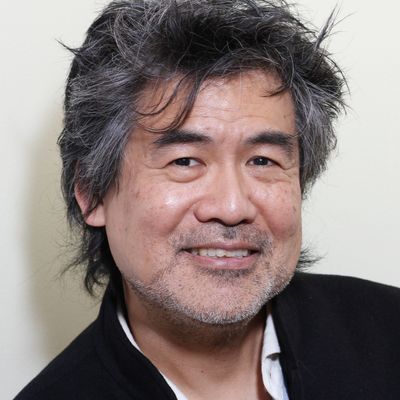
On this episode, Jamie, Rob, and Jennifer chat with Tony Award-winning playwright, librettist, screenwriter, and activist David Henry Hwang... Read More
From the show: The Fabulous Invalid
Guests
About
On this episode, Jamie, Rob, and Jennifer chat with Tony Award-winning playwright, librettist, screenwriter, and activist David Henry Hwang. We discuss David’s very early start as a playwright, his complicated relationship with “The King And I” and how the 2016 election changed the course of his newest work, “Soft Power.” David also discusses his role as Chair of the American Theater Wing, his lifelong activism, including his views on color conscious casting, and his brief stint in a punk band. This week’s music: We hear a brief clip from David’s punk band days with John Vomit and the Leather Scabs, “I Suck,” a small sample of the score from “Soft Power” and “One Hundred Million Miracles” from the 2001 Revival of “Flower Drum Song."
Transcript
This transcript was automatically generated and might contain errors.
[0:00] Jamie DuMont: I'm Jamie DuMont.
[0:01] Rob Russo: I'm Rob Russo.
[0:02] Jennifer Simard: I'm Jennifer Simard.
[0:04] Jamie DuMont: And this is The Fabulous Invalid.
[0:20] Jamie DuMont: Today we have David Henry Hwang, and I know all three of us are very excited to have a chat with him.
[0:25] Rob Russo: So I think we just go right to the uh interview.
[0:27] Jennifer Simard: Let's do it.
[0:28] Rob Russo: Seconded, third.
[0:30] Jamie DuMont: Third. Done.
[0:37] Jamie DuMont: Today we are delighted to welcome Tony Award-winning playwright, librettist, screenwriter, professor, activist, and former punk band member, David Henry Hwang.
[0:47] Rob Russo: Welcome, David.
[0:48] David Henry Hwang: Welcome.
[0:49] David Henry Hwang: Thanks for having me.
[0:51] Jamie DuMont: Oh super excited. I don't know if you're gonna answer this because you began your career at such a remarkably young age, but did you have a terrible non-theater job?
[0:59] David Henry Hwang: So the closest I ever had to uh a terrible uh non-theater job was so the I I was really freakishly fortunate to get out of the starting gate early. Um and I so I wrote this play uh uh uh Debbie Down My Dorm, and then it was scheduled to premiere at the public 14 months later. But um I then had like a year to kill in uh in Palo Alto where I went to college. Um so I thought, oh, I should get a job or something. Um so uh uh on the bulletin board of the career planning and placement center, there was something about um a sweeping job, like I could learn to I could sweep an alley at a bar. And I thought, oh, that would be a really good experience. Um so I applied for this job, and it's not like there was any there were real real no real qualifications, so they gave me the job.
Um and then I discovered I didn't actually know how to sweep. Turns out it's a more technical job, right? Like either you do like long strokes, in which case you don't get any leaves, or you take a lot of short strokes and it just takes forever. And I would say after about a half an hour, probably watching me through the window, the owner of the bar came out and you know, took my broom away and said maybe I was better suited for another line of work.
[2:23] Jamie DuMont: Well that certainly proved to be right. You aren't going to write the definitive book on the science of sweeping anytime soon.
[2:31] David Henry Hwang: Um, I can um give I could maybe write a blog about how not to do it.
[2:35] Jennifer Simard: Yeah. So you're you're in what grade at Stanford, junior sophomore?
[2:40] David Henry Hwang: Um when I wrote FOB, I was a s I was a senior.
[2:43] Jennifer Simard: You were a senior.
[2:44] David Henry Hwang: So your first play was what are you, 22 when you're senior, 23, something like that?
[2:49] David Henry Hwang: Um depending on, I suppose. Yeah, I guess I wrote it, let me see. I wrote it in 78, so I was 21.
[2:55] Jennifer Simard: And how did that get produced?
[2:57] David Henry Hwang: Um, so first of all, I I did write it to be done in my dorm, um, and we produced it there, and I directed a production, um, and the play was called FOB or Fresh Off the Boat. Um, and then I sent it to the O'Neill National Playwrights Conference, uh, and it was accepted there. But I really think the way I got a production was because uh was that around the time that it was being uh done in my dorm, uh the public produced a play called uh New Jerusalem by Len Jenkins, in which a Caucasian actor was cast in an Asian role. And this led to probably the first quote, you know, yellow face protests in New York theater history, where the Asian actors of that day uh picketed outside the public. And Joe Papp, uh, of course, the founder of The Public, Joe, because he was always, you know, a big part of his mission was to create a theater which looked like New York.
So he ended up ended up inviting the protesters into his office and hiring one of them onto his staff with the brief Defined Plays for Asian actors. And it was just about that time that my play came across their desk. So I really consider myself the beneficiary of affirmative action, right? Because that's what it does. It like identifies a social lead and then creates a program to deal with it. So the door got opened and I was the guy who got to walk through.
[4:17] Rob Russo: That's fantastic. And I believe your your first four plays were produced at the public, right?
[4:21] David Henry Hwang: Right. So the FOB was done at the public uh in 1980 and uh did well. It was actually one of uh Frank Rich's first New York Times reviews. Um then Joe said he would produce you know whatever I wrote. So uh FOB then won the Obi in 81 for for Best Best American Play. Uh and then Joe did my next three shows.
[4:45] Jennifer Simard: Yeah, yeah. So you've written yourself into two of your works as a character called DHH, um, in both Yellow Face and Soft Power, which I want to get to and talk about extensively, because I love that musical. Um but I'm I'm curious to know is he you? Or or is is he different? And if so, how is he different?
[5:06] David Henry Hwang: Right. So I think that um many writers write autobiographical characters. Um the distinction is that most of the time we don't name them, name them after ourselves. Um I also think the autobiographical character is more problematic as a whole, in that it's difficult to get perspective on yourself. So even in a masterpiece like Last Menagerie, uh one could argue that the Tom character is less well developed than the other two characters. Paradoxically, by naming a character DHH in Yellowface, I found that I was able to get more distance. Because I think that one of the things that writers do is that we kind of hide in plain sight. So, you know, you create an autobiographical character, you normally don't name him after yourself.
You put in some things that are true from your life, and then you make up some stuff, and you, you know, and people don't know, and people can guess. Um, but once I name the character after myself, in order to hide in plain sight, I realized oh, I I really don't want to be that truthful. Uh because then it just becomes redundant. Um, which meant I had to create a character that had uh a character arc over the course of the show that changed that was flawed, and then learned to sort of deal and face some of his flaws. Um a DHA, and uh in in Yellowface, DHH is really kind of the stupidest character in the show in a lot of ways. I mean, he's really the butt of most of the jokes and makes most of the wrong decisions.
Um, so which is not to say that I don't, I'm not stupid at times, and I make, you know, of course I make wrong decisions, but basically I uh he's a character. Um one of the things that I'm kind of dealing with in Soft Power right now as we prepare it uh for uh for its next production, um is uh my collaborators are I do have a reflex tendency from Yellowfaced to make DHH uh uh ridiculous, and my collaborators are encouraging me to uh to write him more earnestly, which I've makes me cringe a little, but I think it's probably the right thing to do creatively for the show.
[7:25] Jennifer Simard: I find him very earnest in Soft Power.
[7:27] David Henry Hwang: Thank you. I mean I thought he was plenty earnest already. And my collaborators are telling me I could go a little further in being vulnerable, which makes me gag.
[7:37] Jennifer Simard: Did you did when you were writing the character in Soft Power? Did you have Francis Yu in mind, or did you did you write it without an actor in mind?
[7:47] David Henry Hwang: Um in the early drafts of Soft Power, uh, Francis uh and some of the earlier workshops, uh Francis was going to be the Shui Xing character, who is the Chinese executive that is uh arguably the main character in Soft Power. Shre Xing was going to be older and DHH was gonna be younger. So there were readings in which Francis played the She Xing character, uh Francis Ju. Uh and so uh no, that that changed over the development of the show as we learned more about the relationships between those characters.
[8:22] Jamie DuMont: I went out to LA to see it.
[8:24] David Henry Hwang: Oh, thank you.
[8:24] Jamie DuMont: You may not know this about me, but I I've spent the past decade working for Hillary Clinton.
[8:27] David Henry Hwang: Oh my gosh.
[8:28] Jamie DuMont: My day job.
[8:29] Jamie DuMont: So I know her very well. I'm on her personal staff uh currently.
[8:33] David Henry Hwang: Um and so I I read about it in the Times, thought it was happening, and I happened to be in LA, you know, planning a trip to go to LA while it was playing, so I jumped at the opportunity to see it.
[8:42] David Henry Hwang: Um, I hope she comes to see you the next one.
[8:45] Jamie DuMont: I hope so too.
[8:45] David Henry Hwang: I hope so too. She was very intrigued by it. She actually sent me the New York Times article before I found it on my own. And she said, Do you do you know what this is? We're actually gonna go check it out. We had we can really say we had reached out to her through an intermediary. And I can uh talk to you through the details when we're not being taped.
[9:07] Jamie DuMont: Well, I'm I'm curious to know, and I think for folks who are listening to this, they may not know about Soft Power yet because it hasn't come to New York, it hasn't sort of, you know, been on everyone's uh radar yet. Um so I'm wondering if you could explain just a little bit about the show so folks can have a sense of it.
[9:31] David Henry Hwang: So um so let me try to first describe Soft Power, which is incredibly hard to summarize, but um it's a play that becomes a musical. So the first 20 minutes is uh a comedy that takes place in 2016, and then the show jumps a hundred years into the future, and the incident that we saw has since been mythologized and become the source material for a beloved East West musical in China. So theoretically, what we're watching for the rest of the show is a future Chinese musical, which celebrates from a Chinese point of view how uh China stepped in to lead the world when America collapsed after the 2016 election. And so Hillary Clinton is a character uh not so much in the play section, but they do go to a Hillary Clinton fundraiser, and then that incident uh becomes mythologized into this big relationship, a King and I like relationship between uh uh a Chinese film executive and Hillary Clinton in the future musical.
[10:58] Jennifer Simard: That is an excellent job of describing the show.
[11:02] David Henry Hwang: Thank you. It was a it's taken a long time. Unfortunately, we had two productions. I was able to do a lot of press and come up with that.
[11:10] Jamie DuMont: So what was your what how did you happen upon this idea?
[11:14] David Henry Hwang: So the original notion was that I wanted to do kind of a reverse King and I.
[11:52] Jamie DuMont: Where's Anna?
[11:53] David Henry Hwang: Right.
[11:54] Jamie DuMont: Right.
[11:54] David Henry Hwang: Yes, there is theoretically a whole nother version of Soft Power that can be written. But anyway.
[12:01] David Henry Hwang: So the um so I started to think about, you know, the real Anna Lowens and how she kind of mythologized herself and wrote this book, and then uh it several iterations later, it became um became the king and I. And this kind of complex uh dichotomy between art which has a message which is questionable and yet it's so beautifully done that you know, uh even uh at the end of this most recent production, although I was thinking um, oh this this you know is really maybe uh uh uh qu uh somewhat offensive, but at the end I'm still crying, you know, because it's so beautiful and the the sun and he's dying and his son's gonna take over the threat.
[12:49] David Henry Hwang: So uh there's this kind of disjunction, which I think a lot of us feel uh when looking at classic material. Um so I wanted to kind of create that feeling uh for an American audience, and the idea, the original notion of the show was going to be a much more parallel, really, to The King and I, in the sense that it would be about a Chinese film executive who has a glancing uh encounter with the American leader, Hillary Clinton, and then when Hillary becomes president, um it that becomes mythologized into a musical. Um so we actually had a reading of that early version of the show on election day 2016. And then the next day, um I was like, hmm, I think this is gonna be really bad for the country, but it could be really good for the musical. Um so the musical took a very sharp turn after that.
[13:37] Jamie DuMont: Yeah.
[13:52] David Henry Hwang: Reality is stranger than fiction, right? You know.
[13:55] Rob Russo: Did you rig the election? Is that what is that what we're discovering here today?
[13:59] David Henry Hwang: Yes, it's uh I'm it's uh Robert Mueller in Russia and everybody.
[14:03] Jamie DuMont: You're gonna be indicted any second.
[14:06] David Henry Hwang: Oh my goodness. A lot of folks would would describe your work as being political, um, you know, whether it's touching on questions of identity and um you know race and gender, um, or with Soft Power very explicitly, you know, politics. Um would you describe your work as political, or is that sort of a silly thing? Or aren't all plays political?
[14:26] David Henry Hwang: I mean, yes, I would argue all plays are political, but I do think that uh trying to address issues and uh the and my context in the world is something that gets me excited creatively. Um so I find that even when I'm working on projects that are not personal, when I'm um you know, working on somebody else's musical or I'm working on a movie that's an assignment. If I can find what I guess we would characterize as a political angle, um then I I uh it it it acts as kind of an exciting engine for me. Um and I guess I've always felt like writing is about doing something naughty in a funny way. It's like doing something that I'm not supposed to do. And you know, I'm fairly um polite as a a person going through life, so the ability to sort of say things in the work um more strongly than I might say them in life, or more I mean, is uh uh or at least more subversively, um, I think uh makes my engine uh run as an artist.
[15:37] Jamie DuMont: Well something that we haven't um touched on yet that I think we have to say in this podcast because it's important is that you were the first Asian American playwright to have a play produced on Broadway.
[15:48] David Henry Hwang: Yeah.
[15:48] Jamie DuMont: Which was a monumental you know achievement and a great moment for the arts. That was in 1988 with um Butterfly. Um just this past year, we had the first female Asian American playwright produce a play how have a play be produced on Broadway, and that was Young Jean Lee's Straight White Men at Second Stage. That was there's a 30-year gap there between you making history as the first man and she making history as the first female. Are you frustrated by that?
[16:16] David Henry Hwang: I am always kind of surprised at the degree at like I keep asking people who are sort of theater historians, people like Peter Felici. I was like, you know, was there ever another Asian or I mean Asian American or root culture Asian, you know, someone from India, someone from China who wrote a play that made it to Broadway before 1988, and nobody can seem to come up with any examples of that. So it's it's kind of extraordinary extraordinary that it took that long. Um, A, and then B, yeah. I mean, I kind of am surprised that for many years, and for many decades, I still was the only Asian American to be produced on Broadway. And then you had um Ayad, uh Akhtar, you had Rajiv Joseph, uh, the musical Allegiance, uh the Georgia Kay was in, and then Young Jean Lee, but but all of those have been like in the last five or six years.
[17:18] Rob Russo: Right.
[17:19] David Henry Hwang: So I I think progress is rather slow on Broadway, honestly, that there is the desire to um change and to create, as Joe Papp put it, you know, the a theater that looks like New York or looks like America. Um, and I think that increasingly there's the recognition that this is not only kind of a social justice issue, it's really an economic imperative. It's about the future of the field. Because if you know, if if America is going to be majority people of color by 2040, and if we accept the assumption that people like to see themselves on stage, then uh we're not preparing a theater for the audience in the future.
[18:01] Jamie DuMont: Now, and you see that changing in television, you see that changing in Star Wars, um, and there's the desire to change in theater, but it's slower, honestly.
[18:10] David Henry Hwang: Uh, and I think that's partially because like TV's more nimble, um, things you write things in there, but in front of the cameras, you know, the next week, um, as opposed to taking three, five, nine years for for shows to get on. But I also think that theater has a problem in that it is basically content with its audience, which tends to be older and white or you know, or kids. Um that so the need to kind of cultivate a larger audience feels somehow less pressing than it does in some of these other mediums like like film and television.
[18:54] Rob Russo: Right.
[18:54] David Henry Hwang: If if Broadway is selling out and having record profits, why change the model?
[18:58] Jamie DuMont: Yeah, that's what would be the argument.
[19:00] David Henry Hwang: But isn't that audience aging out?
[19:02] Jamie DuMont: Well, yes, and so it's a real long term, I mean, I think everybody acknowledges it's a long term issue, but it doesn't seem to be an immediate I think that's the dichotomy between realizing and what how much of it is economics, right?
[19:17] David Henry Hwang: So how much of it, how much of the problem is also just the economics of getting a show up, right? So it's it's um it's very expensive, it's very time consuming. You don't just write a play and get it produced like possibly happened years ago, right? Like it's it's a much longer process.
[19:35] Rob Russo: Right.
[19:35] David Henry Hwang: I uh yeah, um, you know, like I was saying, I do think it's the length of time um that these things take to develop, which makes the ship a little uh uh harder to turn around. Um but that said, I do think there's uh less uh of a sense of immediacy because Broadway feels pretty, you know, they're doing well uh in terms of economics, they're doing well with the audience that they've got now. And so the and I I often hear this sort of idea that well, you know, we're not sure that if you try to expand the audience that they can afford to go to Broadway.
[20:11] Jamie DuMont: So it's a it's a price issue.
[20:12] David Henry Hwang: But it's not, I mean, Broadway does also have a price issue. But you know, somehow people uh audiences, very diverse audiences manage to pay a lot of money to go see, you know, Jay-Z and Beyoncé.
[20:26] Rob Russo: Um so it's not like these audiences don't have money.
[20:29] David Henry Hwang: Right.
[20:29] Rob Russo: Because premium ticketing isn't just on Broadway, right? It happens in all forms of entertainment now.
[20:35] David Henry Hwang: Yeah, I mean, I just bought, you know, I bought my daughter tickets to the K-pop group BTS, and it was like $2,000 for two tickets.
[20:45] Jamie DuMont: What?
[20:46] David Henry Hwang: Oh my gosh.
[20:46] Jamie DuMont: Yeah.
[20:47] David Henry Hwang: Where are they performing?
[20:48] David Henry Hwang: Um they were at um, let's see. Well, uh, they were at City Field?
[20:54] Jamie DuMont: Wow, that's a lot.
[20:55] David Henry Hwang: Yeah.
[20:56] Jamie DuMont: Speaking of that, what's that's pricier than Hamilton?
[20:59] David Henry Hwang: Yeah.
[20:59] Jamie DuMont: What did you do in this uh punk band that we referred to? You're a singer, a musician?
[21:03] David Henry Hwang: Um so okay, so when I was in college, I was I I was more of a musician uh for many years. I was primarily a jazz violinist. So I played in basically three bands, one of which was sort of a jazz fusion band, one was like an Asian American, like uh, you know, Asian American music band with um a guy who also became a playwright named Philip Khan Gotonda. So um, and I was Philip's sideman. Um, and then there was a punk band.
[21:35] David Henry Hwang: Now the punk band um we did uh we kind of just recorded a single as a joke. Um, and then over the years it's become the band was called uh John Vomit and the Leather Scabs. And my character and my my you know punk name was Maggot Wong. And um, and so we recorded as a joke, and then over the years it's kind of oddly become a bit of a collector's item. And it appears that we are uh some madman is going to reissue it in vinyl.
[22:39] David Henry Hwang: Um and then there was a whole discussion that was being had over emails by many of us who haven't seen each other in 30, 40 years, and I was like, are you sure that I was actually in the band? Because um uh yeah, it was it all happened so quickly, and I just wanted to make sure that there wasn't somebody else who should be getting credit for being in the band.
[23:01] David Henry Hwang: So that's about how much I remember about having been in the punk band. We did go see the final performance of the Sex Pistols, however, in San Francisco, because that was right around that period. And which is much more fun to say than to actually have been at.
[23:19] Jamie DuMont: It's hilarious.
[23:20] David Henry Hwang: You are currently the chairman of the American Theater Wing.
[23:24] Jamie DuMont: And you're in your second year?
[23:27] David Henry Hwang: Third year, excuse me.
[23:29] Jamie DuMont: So, as chairman, what are some of the things that you want to do with the organization? Do you have any particular platforms or causes or or or movements that you want to uh help accomplish?
[23:42] David Henry Hwang: Yeah, so you know, it's unsurprisingly to try to move the needle on uh inclusion and diversity is important to me. Um I think that it uh begins with some initiatives that we are we have in the works um that to start out with are really trying to kind of measure the field, like to really understand the the degree of the problem, for instance, um you know, we already have statistics from APAC that show that um Broadway casting Broadway and the 12 major not-for-profit theaters in New York that over the past 12 years casts average about 75 to 80 percent white. So, you know, that's like a really bad diversity figure. Um, and I think that if we begin to address that in terms uh across the field and get that sort of data where it uh concerns not only uh race but also um gender, um uh issues of non-traditional casting, uh disabilities, all that stuff, um then uh I think we can, a, it surprises people to realize that we've made as little progress as we as we have, and B, we can begin to uh create some programs to address that and and pipeline uh programs uh uh uh because one of the things that the wing does, besides the Tonies and now the Obi's, um, is um to use our resources to create educational uh programs and platforms.
[25:16] David Henry Hwang: Because I feel like the perception of Broadway is that it is very inclusive and that colorblind casting is a thing that Broadway has been championing for years. However, to hear the number of 75%, um that's kind of shocking. Yeah, see, I do think people again have the desire to change, and I think philosophically, um a lot of Broadway is very comfortable with um so-called non-traditional casting. Um, but then if you look at the numbers and what actually gets done, um it's still we still have a long way to go.
[25:55] Jamie DuMont: Sounds like you don't like the term non-traditional casting.
[25:58] David Henry Hwang: Well, non-traditional casting, I think has become somewhat problematic in that people tend to use it in a way that means you can go both ways. So it's like, oh, well, if you know, if um a Latino uh actor can play Hamilton, then a white actor can be in an August Wilson play. Um and I and I think that the statistics really help, because the statistics for me say, okay, what we're trying to do is reduce that 75% figure. So that's why I can be kind of aesthetically inconsistent and say that I like it when uh an actor of color plays a traditionally white role, but I don't like the reverse. I think if you sort of boil it down to an employment issue rather than an aesthetic issue, uh people tend to uh understand it more easily.
And part of it on Broadway too is you know, I there were a couple uh a couple seasons ago, I think it was 2016, everyone was celebrating how diverse it was because you know Oscars were so white that year, and then we had Hamilton and The Color Purple. Yeah, I think that year was like 70%. So that was much better.
[27:02] Rob Russo: Right, there you go, you know. But then the next season it was like, oh no, we're back to all white people because you know so much of it is dictated by what shows get produced in a given season, and there's no one person sort of designing the Broadway season.
[27:16] Jamie DuMont: Right.
[27:16] David Henry Hwang: It's similar to how last season everybody was saying, oh, there are no plays on Broadway, and right in this season everyone's going, there are 21 plays. I remember I think it was the Oscars in 1992. Anyway, it was the year of Prince of Tides, so I'm getting the year wrong. But I remember Barbara Streisand getting up there and it was the year of the woman, the Oscars, the year of the woman. And I remember her speech. I just remember I'm paraphrasing, she said, year of the woman, that's nice. But it'll be really nice when we don't have to make that distinction anymore. And I would argue the same thing with quote non-traditional casting. It'll be really nice to not have to say that anymore.
[27:55] Jennifer Simard: That it's just a couple of things.
[27:56] David Henry Hwang: Yeah, I mean, the term that the term that I tend to like nowadays, by the way, as opposed to colorblind casting is color conscious casting. So just sort of it's not that we kind of pretend like it doesn't exist. We recognize that it's something that uh goes into our calculations and our aesthetic judgments and try to be aware of that.
[28:14] Jamie DuMont: I like that color conscious casting.
[28:17] David Henry Hwang: Language matters, yes.
[28:19] Jennifer Simard: Like that.
[28:20] David Henry Hwang: We like definitives, like we like declarative statements, I think. We like black and white, we like things like the year of the woman, or and and it doesn't tell it, it's not truthful.
[28:32] Jamie DuMont: Well, it sort of absolves people of their, you know, need to have to do more or to care more. It's oh well there's a brand name, there's a name for it, we did it, we achieved it, now we can move on.
[28:42] David Henry Hwang: Yeah, you know, when it's has to be a constant, consistent effort, right?
[28:47] Rob Russo: Yeah.
[28:47] David Henry Hwang: At all levels.
[28:48] Jennifer Simard: Yeah.
[28:49] David Henry Hwang: I feel like we could spend another hour or two just talking about class and how that relates to theater, and we don't talk about it nearly enough in this country, so that's a whole other podcast.
[28:58] Jamie DuMont: Yes.
[29:00] David Henry Hwang: Yes, which relates to the cost of theater, and um as I said, I don't know that cost itself justifies the degree to which uh theater has not been able to diversify uh sufficiently in terms of ethnicity, but class is a whole nother discussion that uh we need to have as well.
[29:20] Rob Russo: Yeah, because the haves never want to historically have the haves never want to give to the have nots.
[29:25] David Henry Hwang: All right, I'm going off here about it.
[29:27] Jamie DuMont: Well, something I'm interested in hearing your perspective on. Um, you know, you mentioned that there's this great dichotomy between last season and this season and the number of plays. Uh I think I remember reading um, and I I'll fact check this afterwards, but in like the 1980 season, there were like 75 plays on Broadway in one season.
[29:44] David Henry Hwang: And I actually went back and I checked, and there were. It was it like unbelievable how that even happened. Um, you know, last season there was where people were scrapping to put together five to nominate or four to nominate for for best play. Do you think that the American play has a place on Broadway anymore?
[30:06] Rob Russo: Not that it should, but does it?
[30:08] David Henry Hwang: Right. So there's a few factors I think that make the play more problematic on Broadway generally these days. Number one is simply the uh the profitability of musicals now, uh that ever since the 80s and since Cameron Mackintosh basically developed the model of a musical that behaves like a movie that you can kind of franchise around the world, and it brings in that all of a sudden Broadway was no longer sort of a mom and pop operation, and that's when you start to get corporations coming in because there's real money to be made.
[30:52] Jamie DuMont: So there's of course the desire, because Broadway is uh this kind of uneasy marriage of art and commerce, there's the desire to uh create to put on the shows that have the potential to make really big money.
[31:08] David Henry Hwang: And then, because they do, um, and they run for 20, 30 years, uh, then there are fewer Broadway theaters available. So there's just this squeeze that happens. I think it is harder nowadays for plays to run, say, you know, and Butterfly ran two years, um Proof, I think, ran uh like two or three years. Um, it's harder for plays to get that length of run. Um, with of course the exception of Harry Potter, which is a play that behaves like a musical.
[31:43] Rob Russo: Um so what seems to have come up in its place, however, is um this sort of limited run with major stars, and then the rise of not-for-profit theaters that own Broadway houses.
[31:59] David Henry Hwang: And so those two factors seem to be kind of counterbalancing one another somewhat, um, which is one of the reasons you have 21 shows uh 21 straight plays on Broadway this season. I believe that number's correct. Uh and I bet you that just about all of them are either in uh Second Stage, MTC, Roundabout, one of the not-for-profits, or um fall into the model of the limited run with major stars.
[32:30] Rob Russo: Wow.
[32:31] David Henry Hwang: That's it's interesting when you say there are 21 plays this season, that's a very encouraging number. And then when you break it down like that, it does seem really problematic and really frustrating. Roundabout, Manhattan Theater Club and Second Stage are producing three each at least, right?
[32:48] Jamie DuMont: So there's nine right there, that's almost half of them are you know taken care of, and that's gonna happen every season, basically, you know, moving forward so long as those companies are in existence.
[32:57] David Henry Hwang: Yeah, and you know that's good in a lot of ways, because otherwise you might given the other factors, the profitability of musicals and the lack of houses, you might not you might have a season like last season where there's hardly any plays. Um so that seems to be the compromise that our field has landed on for the moment.
[33:19] Jamie DuMont: A couple of your works have um explicitly referenced other pre-existing works of art. Um the most obvious example being M. Butterfly, you know, drawing inspiration from the opera Madama Butterfly and Soft Power, you know, having that King and I connection. I'm wondering, do you do you look to other works for inspiration? Or is it just a matter of chance that those are the projects that have come along?
[33:46] David Henry Hwang: Yeah, I'm very conscious of modeling my work on other work. So one of the things that I think tends to get people don't talk about that much where it comes to my work, is the degree to which I'm interested in form. I think because I write largely about Asian and Asian American subjects, and there aren't that many people that do that. That uh factor, that aspect of my work tends to dominate any discussion of what I do. But I'm also, it's really important for me to find the form that matches the story that I want to tell.
[34:23] Jamie DuMont: So, you know, uh Chinglish, which was a comedy we did on Broadway a few years ago. Chinglish is sort of modeled on Glen Gary, Glen Ross, but it's also trying to do a formal experiment of can is it possible to create a bilingual comedy and have the audience read supertitles? Um as you say, has the King and I reference, and then it's also trying to uh address this formal question of can a play become can you do a play that becomes a musical? Um Butterfly, of course, is a deconstruction of Madame Butterfly, but it's also modeled on the Peter Shaffer plays.
[35:04] David Henry Hwang: Structurally, they're very similar to Equus and Amadeus. So I'm usually pretty conscious of that. Soft Power does become like a big splashy musical. It really is, it's really deceiving when it when it starts and then when it opens up and becomes this big, lush, gorgeous, full sounding musical, it really sweeps you away so unexpectedly.
[35:29] Jamie DuMont: Thank you.
[35:30] David Henry Hwang: And and it's um that was one of those things that you know, until first preview, we had no idea whether it was going to work at all. And not only the formal experiment in terms of is our audience is going to accept it as a musical, but our audience is even going to understand what's going on. So it's a great relief that the show is received as well as it was in LA and San Francisco. Musicals are usually very formally simple, right? They're very linear, or you know, there's a very basic plot that you know that pretty much most major musicals follow. And part of what I love about Soft Power is exactly that, right? That it challenges the audience to experience a musical in a way that they never have before.
[36:14] David Henry Hwang: Well, I think the challenge of Soft Power was to that the musical itself, the musical portion of it is actually very simple and does adhere to various American musical tropes. Um but then the play attempts to uh make you see that musical through a different lens. Uh, and and that's kind of the challenge to create something that was sort of or is we're still working on it, um, that is both um a kind of satirical and a deconstruction, and yet completely earnest. Um so yeah and you know, that that challenge represents for me the contradiction of seeing something like The King and I and feeling, oh, content-wise, I'm uncomfortable, but um, but it's so earnestly done and with so much emotion that I feel it anyway.
[37:06] Jennifer Simard: I just love that by any marker, you're a successful person. And you just said that you didn't know if the audience was gonna get it, you didn't know if it would work at first, and I love that you and your collaborators, again, no matter how successful you are, you're putting out your art and your vision and your point of view, and let the chips fall where they may, and it's just it's it's very exciting to hear that.
[37:28] David Henry Hwang: That the work never stops.
[37:29] Jamie DuMont: Yeah, and the risk taking and the bravery.
[37:31] David Henry Hwang: Yeah, I don't think there's any point in doing it really if you're not taking those sorts of risks. Um, which is not to say, I mean, I do a lot of commercial work, and it's not necessarily, you know, those things you're trying to make more of a sure bet. But in terms of kind of my personal work, um, I only want to do it if I feel like I'm exploring something that is new for me. I'm gonna learn something by doing it. Um, and any experiment involves a degree of risk by definition. So, um, yeah, otherwise I could just do commercial work.
[38:08] Jamie DuMont: So, was that the appeal of reworking the book for "Flower Drum Song"? That idea of taking a risk and exploring something, and is that what drew you to that project? Um, did you want to write or wrong what well with "Flower Drum Song"?
[38:25] David Henry Hwang: I feel like that was a musical that, okay, talk about the fact that there, we talked earlier about the fact that there wasn't an Asian or Asian American playwright on Broadway before me, as far as anybody can tell. Um, but there was also no show, there was never a Broadway show, as far as I'm aware, about Asian Americans. There are a lot about Asians in Asia, but in terms of the Asian American experience, "Flower Drum Song" was the only thing. And the fact that for various reasons, whether it was because of content that started to feel outdated, or because people didn't feel that they could cast it, or because it just wasn't, I think most people would agree, not the strongest of the Oscar Hammerstein books and he wrote with Joseph Fields.
Nobody was doing it anymore. So there was a part of me that just wanted to revive "Flower Drum Song." And since we were even then, by we're talking about sort of the late 90s, early aughts, living in a period of revisicals where people were taking books and hopefully fixing them. Um, that was basically my impulse.
[39:44] David Henry Hwang: I love, um, I was a big, big fan of that production, and I listened to the album often, and the thing I love most about the album, which I think is possibly your doing, is at the very end when every character says what town they're from.
[40:00] Jamie DuMont: Oh, I love that.
[40:01] David Henry Hwang: I get teary every time I hear it, and I hear it quite a bit. Um, because I am a huge fan of Rogers and Hammerstein. Um, and I just love that moment where every person says, "I'm from Ottawa, Canada," and "I'm from Glendora, California," or wherever they happen to be from. It's just, it's magnificent.
[40:18] David Henry Hwang: And I have a feeling that was your dual.
[40:20] David Henry Hwang: Well, and by the way, it wasn't something that we originally did at the Century Theater Group in LA at the Mark they perform, and it was incredibly, um, it did incredibly well there, better than it did on Broadway. But anyway, that was not the ending in LA of the show. It was really only, we did one of these presentations for group sales for the Broadway production. And everybody somehow we hit on this idea of having everybody sort of introduce themselves and say where they were from. And it was so moving at the group sales event that I decided to incorporate it into the show itself.
[41:03] Jamie DuMont: Before we go, we always ask everybody this final question, and that is what was that show that you saw that first did it for you that sort of bit you and gave you the theater bug?
[41:19] David Henry Hwang: The thing that actually I'll tell a, there's a few different stories I could tell. Well, I'll tell two, and you can decide which one do you want to use?
[41:27] Jamie DuMont: We'll use both, I'm sure.
[41:29] David Henry Hwang: Um, so one was I did not grow up in the theater family, but I grew up in a music family. My mom's a pianist, and she, uh, so there was a company that was founded in LA called East West Players, which is the nation now the nation's oldest Asian American theater company. Um, and in their like second season, they did a production of Minotti's Operetta "The Medium," reset in post-war Japan. And my mom was the rehearsal pianist, and I was eight years old, and so I could either have gone to rehearsal or I could, you know, have been babysat by my aunt, and I decided to go to rehearsal. Um, and I think I don't actually remember too much about that production, but I do think there's something significant about the fact that at a relatively early age, I just saw all these people who look like me, who were artistic leaders, who were the director, who were the actors. So maybe subconsciously that made me think that it wasn't so outlandish to consider a career as a playwright when I got to college.
[42:35] David Henry Hwang: So, and then the other story is actually not as good, which is that I, um, it was really like a f as a freshman, um, at Stanford, we got kind of bussed up to see things in the Bay Area, and I saw two shows at ACT. Uh, I saw, um, uh "The Winter's Tale" directed by Bill Ball and "The Matchmaker," and those two shows made me think, oh, maybe I can do that.
[43:03] David Henry Hwang: The day I was born in Manila, Philippines.
[43:07] David Henry Hwang: The day I was born in Quezon City, Philippines.
[43:10] David Henry Hwang: The day I was born in Taipei, Taiwan.
[43:14] David Henry Hwang: In Honolulu, Hawaii, in Fairfax, Virginia, in New York City, in Burlington, Ontario, in Providence, Rhode Island, in Carlisle, Pennsylvania, in Ottawa, Canada, in Oakland, California.
[43:26] David Henry Hwang: In Brooklyn, New York.
[43:27] David Henry Hwang: In Seoul, Korea.
[43:29] David Henry Hwang: In Okinawa, Japan.
[43:30] David Henry Hwang: In Selden, Long Island, in Toronto, Canada.
[43:33] David Henry Hwang: In Fremont, California.
[43:34] David Henry Hwang: In Dallas, Texas.
[43:36] David Henry Hwang: In Los Angeles, California, in Hong Kong.
[43:46] David Henry Hwang: Rivers keep flowing too.
[43:50] David Henry Hwang: My father says he doesn't know why, but somehow or rather they do.
[43:59] David Henry Hwang: They do somehow rather they do.
[44:06] David Henry Hwang: A hundred million miracles.
[44:11] David Henry Hwang: A hundred million miracles are happening every day.
[44:15] David Henry Hwang: And those who say they don't agree are those who do not hear or see.
[44:57] Rob Russo: Rob here with you may be wondering. In our conversation, he touched on some of the many ways that theater can be and become more inclusive of traditionally underrepresented and marginalized groups. One way is by supporting theater companies that are specifically dedicated to producing works by and about such groups. You may be wondering, what are some good examples? Well, in the context of Asian American theater artists, David mentioned the East West Players in Los Angeles. Founded in 1965, East West Players, or EWP, is the nation's longest running professional theater of color and the largest producing organization of Asian American artistic work. Started by nine Asian American artists who were seeking opportunities to take on roles beyond the stereotypical parts that they kept being offered in Hollywood in the 1960s. EWP's exclusive focus is on works and educational programs that foster dialogue exploring Asian Pacific experiences.
By doing so, they provide unique opportunities for Asian American artists to work and create, advocate for more diverse representation of the Asian American experience on stage, TV, and across all media, and importantly, welcome and attract both Asian and non-Asian audience members.
[46:17] Rob Russo: To date, EWP has produced over 220 original plays and musicals, including more than 100 premieres, and has held more than 1,000 readings and workshops. Past productions include shows like "Roshaman," "Pacific Overtures," "M Butterfly," "Golden Child," "Changlish," and "Allegiance," all of which are explicitly about Asian characters. But also, they do classic plays like "A Doll's House," "Three Sisters," "Hedda Gabler," "The Twelfth Night," and musicals like "The Three Penny Opera," "Company," "A Chorus Line," "Into the Woods," "Sweeney Todd," "Follies," "La Cage aux Folles," and this season, "Mamma Mia." All of these shows give Asian actors a chance to play parts that are so often just narrow-mindedly cast with white people.
In 1998, EWP moved from a 99-seat black box theater in Silver Lake to its current home, the 240 seat David Henry Hwang Theater at the Union Center for the Arts in Los Angeles' Little Tokyo Historic District. A fitting tribute to America's most prominent Asian playwright, EWP also houses the David Henry Hwang Writers Institute, the most active Asian Pacific American playwright development program in the country. Through that program, they offer a series of writing classes designed to foster new works for the stage that embrace the voice of multi-ethnic America and especially the Asian Pacific and American experience.
[47:34] Rob Russo: Across the country, in New York, the Pan Asian Repertory Theater, founded as a resident company at La Mama in 1977, specializes in intercultural productions of new Asian American plays, Asian classics in translation, and innovative adaptations of Western classics. Mayi Theater Company, founded in 1989, is another organization whose primary mission is to develop and produce new and innovative plays by Asian American playwrights, starting first with a focus on the Filipino American experience, then expanding in the late 1990s to include new works by other non-Filipino Asian American playwrights. This is just a flavor of the many wonderful companies created to give a voice to Asian American theater artists.
It's a truism that talent is universal, but opportunities not. So as you think about your own theater going, be mindful to include shows and companies that feature diverse stories, performers, and creators. There certainly is no shortage of great work being done in New York, from the companies I've mentioned to major nonprofits like the Public Theater, Playwrights Horizons, Roundabout, MTC, Second Stage, MCC, and Classic Stage, to others that are more specifically tailored, like the National Black Theater in Harlem, Repertorio Espanyol in Kipps Bay, and Women's Project Theater on the Upper West Side. If you, like me, want to see theater become more inclusive, support the change you want to see.
[49:06] Jennifer Simard: Jennifer here, that's our show. Thanks for listening. You can hear us anytime on iTunes. The Fabulous Invalid is a production of Owen M, et cetera, and the Fabulous Invalid LLC. Our theme music is by Lucky Chops. Today's episode was edited and engineered by Aaron Kaufman. Find us online at the Fabulous Invalid.com and on social media at Fabulous Invalid, and be sure to tune in next Wednesday.
© Broadway Podcast Network, All Rights Reserved