

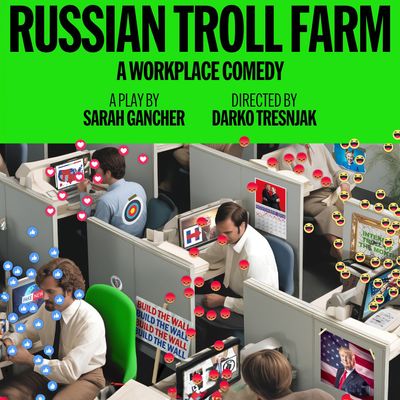
Wowza! Is this show important and magically funny! We are talking "Russian Troll Farm" now playing! Before you believe what you read or press vote come the next election, you need to check this relevant and exciting new show out!.. Read More
From the show: The Roundtable with Robert Bannon
Guests
Featured Shows
About
Wowza! Is this show important and magically funny! We are talking "Russian Troll Farm" now playing! Before you believe what you read or press vote come the next election, you need to check this relevant and exciting new show out! We have stars Renata Friedman & Hadi Tabbal with us to talk ALL ABOUT IT!
The show is playing a limited run til February 25, 2024, at Vineyard Theatre (108 E. 15th Street).
Christine Lahti (“Chicago Hope,” “Evil”) will star as Ljuba, Haskell King (Kingfishers Catch Fire) will play Egor, Renata Friedman (Zürich) as Masha, John Lavelle (Selma, The Graduate) as Steve and Hadi Tabbal (The Vagrant Trilogy) as Nikolai.
Russian Troll Farm: A Workplace Comedy will be produced in association with Dori Berinstein/Dramatic Forces. It is also produced in association with Geva Theatre Center. Liz Armstrong is a Troll Team Partner. The play was originally produced by Geva Theatre Center in Rochester, New York: Elizabeth Williamson, Artistic Director and Christopher Mannelli, Executive Director. The World Premiere of Russian Troll Farm: A Workplace Comedy was produced virtually by TheaterWorks Hartford and TheatreSquared in October 2020 (New York Times Critic’s Pick).
_______________________________________________
Check out “The Roundtable with Robert Bannon” everyday right here on The Broadway Podcast Network!
www.RobertBannon.com
Follow on IG @RobertMBannon or @theroundtablewithrobertbannon
Transcript
This transcript was automatically generated and might contain errors.
[0:10] Robert Bannon: Are you ready? It's the Roundtable with me, Robert Bannon. Welcome to the Roundtable, everybody. My name is Robert Bannon. You're listening to us on the Broadway Podcast Network, or you're watching us on the Roundtable Virtual Talk Show on YouTube. You know, we love to talk about artists and art. And the other day, I went to one of my favorite theaters to see a show in all of New York City, which is the Vineyard, and we have seen some beautiful works there. And I'm a political science major who went to college during the Obama election. And I saw social media and the way it influenced that I did my thesis on celebrity endorsements and how that changes politics. Then we lived through the past, I don't know how many years, six, seven, and the elections of the few, Russian bots, people making false claims.
What is going on in this world? Well, the show is here to tell you all about what's going on in this world with this incredible cast. Renata Friedman is here, Hadi Tabbal is here, and we're here. We're ready to talk.
[1:24] Robert Bannon: I'm a well, when I didn't want to be a singer or an actor anymore at 18 because I had a bad audition for Wrench, I went to the next best thing instead of show business, which I think is politics. It's the same thing. So we never really went that far. You both are in the show right now, which everyone needs to grab a ticket and see Russian Troll Farm, you know, a workplace comedy. Um can you tell us a little bit, Renata? How did you end up? How did you get to this show? How what was your journey to being a part of the show?
[1:58] Renata Friedman: My journey was sort of surprisingly long and winding. I was invited to do I think the very first workshop of it in 20. We got a little background. Don't worry, it's a party. Do you want me do you want to ask me that question again?
[2:15] Robert Bannon: Yes, how did you how did you how was your journey to being a part of this show?
[2:20] Renata Friedman: I was invited to do a super early workshop of it at New Dramatist that I unfortunately wasn't able to do but I was able to do the next workshop in 2020, which was during COVID. So we did a week long workshop with Sarah and at the time the director was Elizabeth Williamson who's our current dramaturg and Jared Mitsaki who is the incredible designer of all of the video work you see in the show. So I did that workshop we did an online presentation of that and then I was invited to do the next full production of it which was at Geva in Rochester which was just exactly a year ago. So I did that production and now a year later here we are and here we are Russian Troll Farm: A Workplace Comedy which you can see you know right now and if you're before we get to continue this on you could go to VineyardTheater.org if you're listening to us that's theater t-h-e-a-t-r-e and the link is below and well we'll get to your past in a minute Renata we'll get to we'll get to some more of that in a moment. Hadi how was your how was your journey to being a part of this show?
[3:20] Hadi Tabbal: You know I'm kind of one of the newest people to the show I joined the play two months ago maybe a bit more than two months ago but it just came to me, just the usual way. It just was an appointment around to it actually. I did not know anyone in the show. Um, and I just I just I just joined the family and it's been fantastic. So I'm new and I'm thrilled.
[3:46] Robert Bannon: Yeah, well, it is a tour de force, it's as relevant as you can possibly be. Um, and you know, it's written by Sarah. I don't want to say her name wrong. Renata, how do you say her name?
[3:58] Renata Friedman: Sarah Gantcher.
[3:59] Robert Bannon: Thank you, Sarah Gantcher. And what writing? What writing? When you read this script for the first time, both of you, what did you think about the language, the rhythm, the case, the whole arc of this whole story?
[4:14] Renata Friedman: I have worked with Sarah before. I worked on a show with her that Rachel Chavkin directed about six, seven years ago. So I was familiar with her style. Um, and I think one of the things that draws me to her work so much is her use of comedy, her sort of very sly use of comedy to tell a story. Um, and in our case, the story we're telling is not a particularly happy story. In fact, it's very much a tragedy, but she finds a way to tell it in a sort of hilarious way that I think really makes an audience listen. So I would say her very savvy use of comedy is the thing that makes it most interesting for me.
[4:59] Robert Bannon: And what do you think, Hadi? When you read the script for the first time, I’ll tell you, can you still hear me just because my earphones are weird? Um, I when I was doing a show in DC, it was a Shakespeare show, and I remember reading it, and then I remember thinking, oh, okay, wow, that was something new. And then I thought, I wonder if I could find this. I don't know. And then I didn't take any action until a few days later because I could have started thinking about it. It's one of those things that just stick to you. And that's when I knew that no, I have to pursue this. And so um, and so it's one of those things that I think the it's a piece that is on the page super special, and then I'm discovering how special it is on the stage too.
[5:47] Robert Bannon: So yeah, well, it's hard to talk about the show when people have not seen the show. So you're gonna have to go see the show, and then we're just gonna have to all have a little round table talk back here because I don't want to give anything away, and I don't want to, but it is so it like I said, it's I never thought I never thought about the perspective that you're telling on stage before. It's so smart and fascinating. We're sometimes so used to our viewpoint, and there's another place in the world and viewpoint, and oh, it's a yeah, and your cast. Renata, this cast is pretty stacked from top to bottom. There's a lot of television, film Broadway, off-Broadway credits. What was it like when you all got together for the first time this particular cast and started the rehearsal process?
[6:43] Renata Friedman: Um well it was absolutely fabulous. I mean, it's it's an incredible group of not only comedians, but real sort of technicians of language, you know, and it's so incredibly interesting to um, for example, with Hadi, to hear the way he is sort of reinterpreting lines that I've heard many, many other actors do in various workshops and productions. And um, yeah, I feel like we've just with the assistance of Christine and Hadi really distilled the play into its sort of purest form, and it's been thrilling.
[7:19] Hadi Tabbal: I have to tell you, I just being I remember the first day, um, there's something about being in a room that's charged with people who are really good at what they do, and that's what it felt like from the beginning. Um I mean, from our technical team, also from our director who's terrific, who's kind of sitting by me right now, but I don't want to get here. Uh and um, you know, and you know, you have I had not met Renata yet or John or Haskell who have been with the show for a while and are absolutely fantastic in it. And um also it was it what it felt like was to you're in a room with excellent artisans, and also you are in a room with people as someone who joined the process later, felt very welcoming, but also they're so good at what they do, and I did not know any of them before that I actually my first impression of them was them reading their parts, and that has stuck. And I actually think of their character names first or their real names, which is totally embarrassing and stupid. But it's also totally understandable given the way I met them.
[8:27] Robert Bannon: So that's Masha. That's not Renata too. Is that what you're saying?
[8:32] Hadi Tabbal: I mean, I really have to like take a second every every time.
[8:40] Robert Bannon: You bring up your director for musical theater fans out there in the world, you know, the Tony winning director, if if everyone with a gentleman's guide to love and murder, um, and then this style is is it's all very unique. So, what was what was the directing? How much I'm always curious as a nerdy actor, Renata, like how much of this work did you do on your own and bring to the stage, and how much of it was directed and and is it is it a good marriage? Is it is it one side versus the other? How does how did it work for you in this process?
[9:10] Renata Friedman: I really don't have a satisfying answer for you because it's just such a jumble in my head. Um, it's very collaborative though, absolutely. I mean, I think Darko hired us because we bring so many ideas to the process. Um, and he's always massively delighted when John comes up with something absolutely hilarious, and also massively delighted to say no, no, tell us what it doesn't work. But I mean, there's so much about comedy that um overlaps with musical theater. I mean, I I certainly am not a musical theater person. I really only do plays, but in terms of rhythm, um, I think there is a lot of symbiosis going on um between us and the director.
[9:55] Hadi Tabbal: Yeah, I I have to say, working with Darko a bit sometimes feels like uh he's done so much musical and so much opera. It feels there's there's something so rhythmic about his work that is very exciting to watch and also to be part of because you uh especially if you're musically inclined in any way, you I feel that I understand the rhythm of what he's trying to do, and that is exciting. Um, and also you you feel like you have your place as an actor, but also you have kind of because the show is also heavy on the tech side, because it's so exciting visually, you feel you're also part of this like bigger world that Darko's kind of orchestrating like a big massive opera, which is also so thrilling.
[10:39] Robert Bannon: Oh yeah, I'm sure tech is a uh was a production, it is a it is a lot of uh technical elements. This is not your uh stereotypical off-Broadway little black box, uh little, you know, a folding chair and a black curtain kind of show. Tickets start at only $35. So it's uh it's affordable, it's a good date night come on Valentine's Day or Valentine's Weekend or I don't know, President's Weekend or whatever. It runs till February 25th. So you gotta grab your tickets while you can. You got you individually, Renata, you individually as an artist. Your New York credits and your regional credits and your television credits and et cetera. And coming from NYU and going to school. How much of that education when you were a young actor and you were just starting out, do you still use a lot of theater students watch this show? Do you still use some of the toolboxes when you get a script that you learned and and and still is it important that the training you got that led you to today?
[11:38] Renata Friedman: So much. And I've been actually thinking about that a lot because my acting studio at NYU was at 890 Broadway.
[11:44] Renata Friedman: I don't know if you know that space, it's this legendary rehearsal space. And you know, we're a couple blocks away at the vineyard, and I used to walk those blocks to get to school every day. So I've actually been thinking about NYU a lot. Um I use pretty much all of it. Uh all the training. Uh I was in the Meisner studio at NYU and then later the classical studio. Um I use different combinations of those techniques and methods in different ways for different roles. Some become more important um depending on the play. But absolutely, I found that training so invaluable, and I'm still learning more. Um, I'm working with a breath work and uh voice coach right now, um, and exploring like a brand new um sort of acting breathwork method just for the show that I'm I've been playing with so yeah I mean it never stops and I'm I'm using all those things I learned at NYU.
[12:36] Hadi Tabbal: There Meisner Studio that we'll do repetition after this interview is over that you the most before we get you to to Hattie's life story you 200 plus audiobooks you can put us to sleep that voice is so I just can listen to it and instantly throw my Xanax in the garbage I can just listen to you.
[13:02] Renata Friedman: That's so nice. I mean yes that's here we have our my fancy audiobook microphone yeah audiobooks have been a a a real uh sort of life changing part of my career because it's allowed me more flexibility in terms of the choices I make with what acting jobs I take can I ask you an a trashy audio book go for it give it bring it what happens when you have to read this 500 page book and it is the boringest most think like it pays my bills what is how do you get through it I actually I'm fortunately at a place in my life where I'm saying I'm saying yes to the jobs that come my way so I can be picky with the audiobooks.
[13:43] Hadi Tabbal: So I say no if it's if it's nonfiction that's gonna require endless um endless research about pronunciation of real people names or foreign words or any of that I just no too much work. I I do a lot of like fantasy and fiction and young adults and lots of dragons, lots of fairies.
[14:05] Renata Friedman: That sounds good to me.
[14:06] Hadi Tabbal: Yeah. Um so that and people, if you think it's easy to to be a voiceover actor or do audiobook, then try it out is not as and not as easy.
[14:13] Renata Friedman: It's an acquired skill for sure.
[14:15] Hadi Tabbal: Howdy, you could you done the off broad, we've been at the big all the fancy spots, like the public, and then you have done the New York television gambit. Like we we can see you on the procedurals and we can see you on the sets around New York, and also an MFA from the new school for drama. So how about your education? How did your education prepare you for uh how did it prepare me?
[14:38] Hadi Tabbal: I mean, look, I I think I think a lot of you know, I I came to the States as an immigrant basically, so um the the first like the first big experience with with with being in the theater here was actually school, so it has its impact, right? I mean, it's the first the first four years of your life and living in you know in a totally different country, in a totally different place. But also I think what's happened is I've had the chance to work with some people over the past ten, fifteen years who have been formative. Um mostly I can think of Mark Me Davy who runs the MYU grad program by the play I did the public two years ago. We worked on for 10 years. So I kind of had like an NYU grad education by just I mean, I've heard every golden thing that came out of his mouth over a decade.
You know, and then you work with people, you learn. I think at the end of the day, what you care about is to kind of um be true to yourself and also to the material and what he's trying to say, and make sure you're not hitting false notes, you know, you're hitting true notes.
[15:36] Renata Friedman: And what that means is different than every production, which is why it's so exciting what we do, because what what what is truthful means there are different things in different places. And so um I think yeah, and and you know, there's something about this show that is um uh I love that we're in Union Square. I love that we're at the thing here and and and and you know, I it has in New York sensibility to it that is so strikingly particular. And um I think everyone here has a New York sensibility in in in the room. And I think, you know, there's something in New York in the show. I don't know what it is, and so or maybe I do. But but yeah, so all of that comes into play.
[16:12] Hadi Tabbal: All of that.
[16:12] Renata Friedman: Yeah, I well I love it down there. It's the it's a fun you can there's good places to eat. It's a fun date night kind of place, and it's a fun evening out spot. There's no Elmos that are asking you to take a picture with them. I can tell us where you know, all the cool kids are off Broadway somewhere right now.
[16:28] Robert Bannon: Ronaldo, when you without giving away the the plot of the show and the story, it we are in a primary season, there is a general election coming up, there's presidential noise and nonsense going on every single day as l and louder and by the day. What do you hope the message of this show kind of is?
[16:44] Renata Friedman: I hope that everyone who sees it walks away with more of an awareness of the ways they could potentially be manipulated by social media. Um one of the I think surprising elements of and true elements of this story is that the trolls in Russian were not only working to um affect the outcome of the 2016 election, but they were intending to create tumult and um discord and anger and rage across the spectrum in America. So they were posing as people on both ends of the political spectrum, and I think that there is a feeling that if you are more of a liberal human or on the left, you're being somehow less manipulated by your social media, but that's absolutely not true. Um, and I think uh especially with what's happening in the world right now, the way posts are being reshared, the way AI is manipulating things. Uh we just have to be incredibly cautious about everything that we ingest. And and remember that what we see on social media is not necessarily news, true news.
[17:54] Hadi Tabbal: You know, one of the things I find thrilling about this play, and what I want people to say from it, is truly the um becoming a bit more cautious about how we receive narratives and stories. Um what is what is the most exciting thing about this play, I think, is you see five characters who are, you know, they're trolls, they're basically doing something that is clearly not a good thing to do without sporting the show. But they are also people who are not terrible people, but they're also people who are spinning stories that because they're spinning stories that are not true that people receive and think are true, regardless of where they are on the spectrum.
[18:37] Renata Friedman: And it's I think given the past, you know, this past decade, I you've we you know, all of us, I think, in in this room and beyond have had such crazy conversations with people about what they believe. And regardless of what they believe, uh, and you know, from you know, from both sides of the spectrum, as Renato was saying, it is it is so it is so interesting to me when I when I see how little awareness that people have about how they receive their beliefs.
[19:06] Hadi Tabbal: And I hope that people can see the show and become a bit more understanding of the way they receive stories and narratives and what power these things have. Uh because they come from personal places and they're received in personal ways that are sometimes very they're that that are very opaque to us. And I think this play makes that very clear.
[19:27] Renata Friedman: So that is exciting.
[19:29] Hadi Tabbal: That is super interesting.
[19:31] Renata Friedman: Wait, Robert, can I ask you a question since you're a political science major?
[19:34] Robert Bannon: Oh boy.
[19:35] Renata Friedman: Yes, you know, I'm just curious what what you sort of took from the show as as what the message was for you, or what imp I guess what like rattled you the most about it. I'm curious.
[19:44] Robert Bannon: I would love I I have an answer. I I did leave and I did think about it and I was really excited to talk to you all. I really wanted to talk to you all, like at this, you know, at the stage door at the diner because I don't want to go in the nitty-gritty of it, but I never thought, you know, there's an um oh god, uh there's a we are we are we are taught, you know, as as an American born here and born and bred here, socialization. I I think it's controversial that it is both sides, you know. They're they they are socialized to believe what they believe, and we are socialized to believe what we believe. And I don't think anyone we think we are right here because we are here, but I never saw the human the human side of that side of things that they're people trying to survive, make a living, do what they're being told is the right thing to do.
[20:32] Renata Friedman: And I wish people would understand that this is and it's my soapbox, but this is democracy at stake, or what we think is democracy. You know, there are people fighting the algorithms that these corporations don't even know how they work, are going to keep showing you false information that you believe, and then you go vote and tell people it kills people, it gets people to have arguments, it allows people to vote for people who are not qualified for jobs, and it's on purpose. And I think there's such a huge part of the world who doesn't still does not believe it.
[21:04] Robert Bannon: My family, I'm gonna call them out. My cousins will be like, I got my news on TikTok. And why are you getting your news on TikTok? Stop. It's not news. She wouldn't go in an Uber because she read how the the amount of sexual assaults and Ubers have gone up. And I said to her, that might be true, but where did you get the information? She said, Oh, I saw someone tell their story on TikTok. That's not fact, that's not a fact-based study. That is not a news, like, oh, so to see it done, not just talked about on CNN or on MSNBC or Box News or whatever you get your news from, but to see it humanize in it in it on stage and and people actually doing it, I think adds a whole other level that we don't get to see here in this country.
[21:52] Renata Friedman: I never saw it.
[21:53] Robert Bannon: What does it look like? Who are these people? I think we think of them in the shadows, you know, hidden in a garage somewhere. Like a no, you guys put a whole different spin on it. And I hope when people go see it, they realize this is this is real, you're being manipulated. There's no pizza gate, don't and don't eat Tide Pods, you know. Like, get into people, please.
[22:15] Renata Friedman: I know, I know. And at the same time, it's a comedy. So if you come see it, you'll laugh.
[22:20] Robert Bannon: It's super funny because it's such a funny premise and topic, and you all are so brilliant in it. And um, yeah, go see it and then vote with facts.
[22:32] Renata Friedman: Yes, vineyard theater.org.
[22:35] Robert Bannon: I love it there. I love the new work. I love the work that you're all doing, and I was so excited to talk to you all. And maybe I have to come back and maybe I then have to say, we may have to do this again. Let people see the show and then talk about it again. Because I I really loved it. I hope that this show is only the beginning um for this show and for all of you. We'll be following you.
[22:54] Renata Friedman: Thanks, Robert.
[22:55] Hadi Tabbal: So nice to meet you.
[22:56] Renata Friedman: Lots more art and work left to do.
[22:58] Hadi Tabbal: So congrats, break legs, and enjoy the rest of the run.
[23:01] Renata Friedman: Thank you.
[23:01] Hadi Tabbal: Take care.
© Broadway Podcast Network, All Rights Reserved