

Tony Award nominee Tim Jackson is helping introduce Broadway audiences to one of the most charming and emotionally resonant new musicals of the year... Read More
From the show: The Roundtable with Robert Bannon
Featured Shows
About
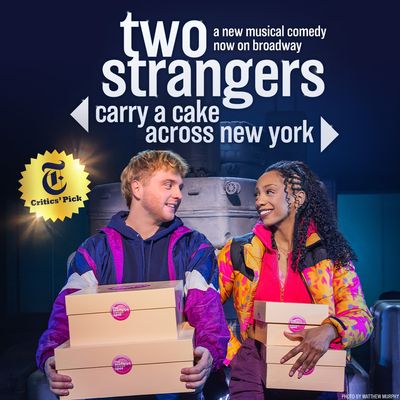
Tony Award nominee Tim Jackson is helping introduce Broadway audiences to one of the most charming and emotionally resonant new musicals of the year. On The Roundtable with Robert Bannon, Jackson shares the creative process behind directing Two Strangers (Carry a Cake Across New York, a musical that blends humor, heart, and unexpected friendship into an unforgettable theatrical experience.
During the conversation, Jackson reflects on the show's journey from acclaimed productions abroad to the Broadway stage, working with its talented cast and creative team, and what makes this uplifting story connect so deeply with audiences. From the challenges of shaping a new musical to celebrating its Tony Award recognition, this is a fascinating look inside one of Broadway's brightest new successes.
Watch the full interview now on BroadwayWorld, The Broadway Podcast Network, YouTube, Spotify, Apple Podcasts, and wherever you enjoy The Roundtable with Robert Bannon!
#TimJackson #TwoStrangers #CarryACakeAcrossNewYork #Broadway #TonyAwards #TonyNominee #MusicalTheatre #TheRoundtableWithRobertBannon #BroadwayWorld #BroadwayPodcastNetwork #Theatre #Theater #NewMusical #BroadwayInterview #Director #NYCTheatre #StageDirector #RobertBannon #TheRoundtable #BroadwayCommunity
Transcript
This transcript was automatically generated and might contain errors.
[0:06] Robert Bannon: Welcome to the round table, everybody. My name is Robert Bannon. You're listening to this on Broadway World over here on the Broadway Podcast Network, iHeartSpotify, wherever you listen to artists talking about art. It is my favorite month. It's June. So June means it's pride. June means it's Tony Award season. June means I'm tired because there's a lot going on, Tim Jackson. Tim Jackson is here. He is a choreographer. He knows that means he can teach me to dance, because God knows that needs to happen. And also he's a director, and he's directed one of the smash breakout super hits of this season here on Broadway. Two people, a cake, two strangers at that. If you love a rom-com, if you want your heart to be literally just bursting with love and joy, and you need this in this crazy world, we got the solution. Tim Jackson is here. Thank you for being here.
[0:55] Tim Jackson: Thank you for having me. It's so nice to meet you. I'm so excited to meet you. I love your work so much. I'm so floored at people who can dance because I can't clap on beat.
[1:07] Robert Bannon: I feel it everyone can secretly. You just need someone to like not make you feel frightened.
[1:13] Tim Jackson: I think a lot of people have been shamed into thinking they can't dance or move and then they get stuck.
[1:19] Robert Bannon: But I'm sure you can, Robert.
[1:21] Tim Jackson: You know, I did take tap dance classes in Paramus, New Jersey. And it was, well, there we are. It was as scary as it sounds.
[1:30] Robert Bannon: When did you discover that art was something that was very moving to you and that you wanted to make it a job?
[1:36] Tim Jackson: I think for forever I've really sort of dived into it and been excited by it. I come from a really lovely, very close family. Um, but no one in the family, uh, well, my parents weren't particularly into music or theatre in a sort of professional way, but they sort of really just facilitated and tried to make me as happy as they could, I guess. And that opened up doors for me. So I mean, from a really young age, I can really remember going to see a production of Fantastic Mr. Fox by Roald Dahl when I must have been like six or seven, and I could still see it in my mind's eye, and I thought, oh, what if I could do that? Yeah, I can still see myself back there. I was a kid reading that kind of work as well. And you get the bug, you get the bug.
[2:30] Robert Bannon: But what made, did you ever do, were you a performer or were you always the boss? He's the boss, like it takes a certain personality to be a choreographer, it takes a certain personality to be a director. When did you decide to take the creative turn?
[2:42] Tim Jackson: Do you know? I've had such a circuitous route to get to where I am now, but I'm really glad that I've taken that route. So I've worn many, many hats over my career. So I went, well after going to school, I went to university and I studied music. I went to Oxford University, and I thought I was going to be a clarinetist and an instrumentalist, and I specialized in orchestration. I was like, this is what I'm doing, and I'm really passionate about that. And then in my three years there, I sort of got more and more into the theatre scene, and then decided after that to go to drama school and trained as an actor, and then I went into the West End as an actor, which was really exciting and went and did Sunset Boulevard, which was where I started off as a swing.
And alongside doing that, fortunately for me, some of my collaborators from university had decided to pursue directing as a career, and so they said, do you want to keep working together? And at uni, I'd been a choral scholar, and I was, as part of my choral scholarship, I wasn't meant to do any singing outside of my choir. And so my way of expressing myself theatre-wise was to either do choreography or musical direction. So that's how I got into that side of things. And so those people, and some of them now like run buildings in the UK or whatever, they were like, would you like to come and do this show with me in the fringe? Which I guess the American equivalent is like off-off Broadway. And so we started making shows together.
So I was very lucky that I had the sabling come from being in a West End show to sort of keep the walls from the door. And then during my daytime, I was rehearsing, and I played in, I did made shows in railway arches and above pubs and in tiny studio theaters that were under the ground, and that's sort of where I learned to do what I did. So I think I've always wanted to be in more of a driving seat position, but I didn't quite know how to get there. And I think someone has to give you permission or sort of invite you in, because otherwise you're sort of saying, well, my opinion counts, and me, I like it counts to be able to tell someone else what you want your vision for a piece to be. So I was fortunate that sort of people took me on the way, and then my horizon sort of broadened, I guess.
[5:01] Robert Bannon: You're very humble because your work, no, because your work, yes, you have that was the way you got here, but your training and went to school and all of that, but you also, you know, just so happened to have worked on like 20 new musicals are very important to you, apparently. You've worked on like 20 musicals, it's very hard to get on the West End. You talk about the fringe, the fringe. Well, things that come out of the fringe come to New York and come to Broadway and come to theater and become television shows, and you got to be a part of that, and then you started to do real, not that that's not, but like very mainstream. Like when you talk about Doctor Who, or you talk about Something Rotten, or you talk about, you know, Merrily We Roll Along, I know comes later down the pike. But like you, you then became fringe to the main. You're the it person, Tim. I'm gonna go, you became the guy, the person.
[5:48] Tim Jackson: Well, I do know what I have someone to thank for that, which is an amazing director called Jeremy Sams. And I was doing a production of a Howard Goodall musical called The Kissing Dance, and it was in a tiny basement theater, which seats like 30 people. It's called the German Street Theater, shout out. And we were doing this really little musical there, and then Jeremy, who's the very big fancy director, saw me in the bar afterwards and said, I've seen seven of your shows off-off West End. And I would really like your work and I think I, we, I'd like to see my next project with you. So I went from that to doing an opera at Garsington Festival with a chorus of 50 plus and a huge principal cast.
There were live llamas on stage, and it just went, whoa, there was like this massive level up moment. But I guess it's because I'd put in the work in the smaller venues, and he'd been able to check out my work over a series of years. So I have Jeremy to thank in a really big way, and then he introduced me to Maria Friedman, who then took me on to choreograph Merrily We Roll Along, and that was when I was 24 years old. So that I had a very sudden shift, having done sort of 10 shows a year in little spaces to then all of a sudden be having to put my big person pants on and get on with that.
[7:15] Robert Bannon: Tim, I now feel like you're slacking. No offense.
[7:18] Tim Jackson: Yeah.
[7:19] Robert Bannon: If you had llamas, how are you doing a show with two people carrying a cake across New York and used to have, where are the llamas on the stage for this show, Tim?
[7:27] Tim Jackson: Exactly. But that was, I knew there was something missing, and turns out it was the llamas. Bring out the llamas.
[7:33] Robert Bannon: When you talk about this, Merrily We Roll Along went on to be a big giant smash hit, obviously, and incredibly lauded. And then this show, though, when I was reading about Two Strangers, what struck me about it, it's been around for a moment, and you've been involved for a long time. So, did these projects overlap? How did this show come to you?
[7:55] Tim Jackson: I feel so lucky that it did come to me. Several years before it arrived in my inbox, I'd been working with one of our brilliant producers, Tim Johansson, and we'd done the Adam Gettel music called Floyd Collins. I'd be the music supervisor of it in the UK in another railway arch, I will say, but a very beautiful one called Southwark Playhouse. And I'd worked with him, and then there'd been this whole breadth of time where I'd been working on lots of new musicals and getting all excited about them, and then Tim called me up and said, I've got this musical that I'm really excited about. I picked it up at a festival. We don't want you to direct it. At the moment we're just looking for someone to develop it as a dramaturg, and I know you're really passionate about the development of new work.
So is that something you'd be interested to do? And I was like, well, send me the script. And honestly, I think I read about 10, 10, 15 pages, and I said, please, please don't send this to anyone else. I just instantly fell in love with it. I loved the characters, I loved the writing, the dialogue was so witty. And the opening song, New York, was already written by this point. And it just knocked me for six. Just the way that the humor and the rhythm and the fizziness of it and the dynamism and the relationship between the lyrics and music just like leapt off the page. And I just thought, if I were at the, at that time, I was only looking at it from a dramaturgical perspective, but I said if I can be any part in the development of this, I'll be really proud because I know I've got something I can really dig into.
But it's very like I get sent stuff all the time, but something as special as this doesn't come across my desk all the time. And there's something about the synergy between the different parts of the writing that is what makes it so special. Kit and Jim, who wrote it, who are now dear friends, I think they're geniuses. And they've become really close friends of mine. They have been friends since they were nine years old. And so there's something that is baked into the making of this piece, which is just a connection between those two people, which has found its way into the piece, and it just makes it the yummiest material to work on. It's so special.
[10:13] Robert Bannon: It is something if you love, if you're around, if you want, like I said, it is just the most heartwarming. It came for people who did not follow its journey or did not see what it's done, it came to Broadway and people saw the ads, and I think people originally were said, what is this show? It's got a peculiar title. It's what are we gonna learn about? Who or what is the story? Where did it come from? And then it just, this ball just kept rolling and rolling, where people fell in love with these characters, Dougal and Robin. Why do you think, why do you think about them makes people feel so connected? What about the story makes this so universal to the audience?
[10:51] Tim Jackson: I just think the characters are so relatable. And so often after the show, I'll have someone grab me outside and say, oh my god, I'm a Dougal or I'm a Robin, or I feel like I'm both of these people. I think what's special is that Kit and Jim have written these characters that are ordinary, not in this, not in the way that they are not special, but they're just day-to-day people who are experiencing something extraordinary. And I think that's what makes it relatable is it reminds us that we all have the capacity if we open our hearts and allow ourselves to be open to the interactions that we have in the world, we have a capacity to have 48 hours of wild abandon and joy, and we have an opportunity to transform.
[11:36] Tim Jackson: We just need to open our hearts to it. Like these two people at the top of the show, what makes it so delicious is they feel like the most unlikely pairing, and because of the circumstances of the plot, which is that Dougal has gone over to America to his dad's wedding and meets the sister of the bride, and they have to spend the next 48 hours together just for various different reasons, because they are forced into each other's orbits, it is they are then put into this pressure cooker where they have to spend time with each other and in the process of spending time with each other, realize that there are loads of similarities because we're all human and we share a common human consciousness.
And by the end of it, what feels really exciting to me is you go into the theater and you watch a show about two people, but I think you step out feeling like you've connected with like a whole room of people because we all know what it's like to feel alone in the city or feel a little bit lost or feel like we are sort of searching for something. And this show shows that if you just allow those channels to open up, you can have a transformational weekend or day or whatever that might be. Um, so I think that that's why people get so excited about the show is it could happen to anyone in that auditorium. It is come see it in New York City, everybody. Or wait a year and go see it around the country, as a tour's already announced with a whole bunch of Tony nominations. And shout out to Christiani and Sam.
[13:10] Tim Jackson: So what was it like? See, what I'm always amazed is I'm very non-Tim. I'm afraid of confrontation. So to be a director, not that you're supposed to be confrontational, but I would have so much stress to tell someone to do something differently or to have a different vision or conversation. What was it like to work with them? How did you have a harmonious, whatever's the fancy word, relationship together? I guess it's because I don't feel like my job is there to like tell them to do anything. I think my job is there to ask questions and try and sort of excavate something within them that they can then own and play on a repeated basis. So I guess my job is to sort of go fishing for ideas and play for ways to tell the story, and then sometimes you throw back some fishes and other times you keep the fishes that you really feel like are going to communicate the best story to an audience.
And when you are working with people like Sam and Christiani, their toolbox and their palette of colors that they can use is so rich that there's so much to investigate and there's so much to play with, and they're really open to making this a super crafted, super detailed, super layered show. Um, it's a gift for an actor to be on stage with only one other actor because you have so much time in rehearsals to really dig in and make your part as rich as possible. And so my relationship with them and my job with them was to put in all that detail and spend all that time harnessing their immense star quality, which they both have in the wildest abundance, and then try and make it feel like it didn't exist at all, and that we'd had none of those conversations, and it was just seeming to fall out of them.
And the way they do that is so masterful, like it's no accident that the audience will collectively gasp at one point, or we hear people sniffling at another, or a huge laugh goes up like a rocket because it's been really carefully thought out, but it requires such skill and such nuance to be able to hit that repeatedly night after night, and they have a million jokes to land and a million emotional beats to hit, and they just ski down this hill with such ease and such flair and such charm. It's really special, and they're the nicest, nicest people, and they love each other, and there's just a feeling in the room of like this family that all care about the show, we care about the writers, we want everyone has this collective will for this show to be the best it possibly can be.
So no one's like shied away from working really hard and putting in so much effort. I mean, it's a big lift, eight shows a week. They're holding a lot between the two of them, and they give every audience 110%. Um, it's really dazzling. And they both are doing these Tour de Force performances because you see them be so funny and so truthful, and they dance and they sing like wizards. It's really, I feel so excited that I even get to be part of it. That's it's his fault that they're out there working so hard because he's got them dancing and singing and telling the story, and they are so brilliant. We saw them at an award show not too long ago on the red carpet. They came off the stage, they glammed themselves up, they threw themselves on the red carpet, and they were like, it's a whirlwind.
We are living this incredible, it's an incredible time to go see this show because they are giving performances truly of a lifetime that you will probably never see ever again at twostrangersmusical.com.
[16:57] Tim Jackson: Speaking of nominations and all of that fun stuff, you are a Tony nominee, you're now thrust into this gauntlet as we march into June. Uh, your show, eight nominations, and you personally, what's it feel like for somebody who's worked so long on so many new works to take a show that started this big that grew into something this big that has now taken over the theater world in New York and globally, uh, and you get to be, you know, such a big part of this process? I feel obviously really proud and chuffed and surprised, and all of those feelings all bottle into one thing. I also just feel so pleased that because we got eight nominations, there are so many people who are experiencing this all together.
Um, and we're just trying to have fun with it, I think. I think there's it's wild, and there's lots of meetings and events around a Tony season that I think we as Brits are not necessarily aware of. But because we're doing it with friends, it just is really fun to lean into it and be like, 'What is happening? It just feels so exciting.' And I mean, to have Sutra Gilmore, our set designer recognized as well for what is genuinely an extraordinary set, um, and also Lux Pyramid for the orchestrations. I just feel I'm so happy for everyone that people have noticed that even though people think of this as an intimate sometimes, then some people think of it as a small show, it actually has a great amount of scale to it.
And so for the set and for the orchestrations to be recognized, I think is a testament to that because when you come to See Strangers, you're not just it's not just two people on stage hanging out. There's so much more to it that's been sort of really thought out. So I mean, it's so exciting, and for us to be experiencing it together, it's is I guess invalidating as well. And um, more than anything, we're just chuffed, I think.
[18:57] Tim Jackson: I think it's valid. What moves this is not shady to anybody else, but what moves this is that you're seeing a story. You don't need a movie star, you don't need a movie, you don't need, you know, you don't need to spend $850 a ticket to go see a Broadway piece of art that will move you, have a conversation, and that theaters around the world are going to clamor to be able to tell the story because it's universal and important for everybody to check out.
[19:22] Robert Bannon: Thank you.
[19:23] Tim Jackson: I agree, yeah. And I think original musicals are such a gift as an audience member because you can go into that space. And I'm deliberately not saying what the plot of the show is because you go into that space and you are an open vessel, and then the performers just put this story into your life and you don't know what to expect. So I do revivals and I do adaptations and I find them really exciting too. But there's something that feels like a real gift when it's a brand new original piece that you can that you know that the person stepping into the room has no idea what twists and turns are going to be ahead. And actually, Two Strangers does have a fair few twists and turns, and I find that so exciting.
And I love going to the intermission and hearing people talk about like, oh my gosh, what's gonna happen in Act Two, or even at the end of the show, actually, people start deciding what's gonna happen next for Dougal and Robin in the future. And I'm like, yes, yeah, you make up those stories. I'd be I'm very happy to hear any of them.
[20:21] Robert Bannon: Love that. So my well, look, Merrily is a big giant Olivier Tony winner. So just hold on to your hat, everybody, because this show's marching into this award season. Tim is back in the rain. You're back up. So we're so excited for you to be here. I have a husband who is obsessed with UK culture. Like, if I'm coming to London, I'm making Tim Jackson take me to a pub. I need the full experience, Tim.
[20:46] Tim Jackson: Oh, yeah. You'd be more than welcome. Do you know we go to sleep? I go to sleep watching, you know, the Duke of Sandwich's house being remodeled and the lineage of old English history. We were very, I'm trashy New Jersey, and he is very civilized. He wants to be in, he's a he wants to be a Londoner so bad.
[21:08] Tim Jackson: Yeah, well, I feel the same. I love being in America. My husband is American, so I get to be in America quite a lot. And being in New York is like having a shot in the arm, you know. It just gives me so much life, especially like the passion towards theater and the enthusiasm for musicals and the respect musicals. It's a privilege to get to work in New York and it's been so lovely like Broadway sort of accepting us and sort of welcoming us with open arms. I was worried we might feel like outsiders and actually it feels really nice. So Brits, America's Loving Brits is very much reciprocated from my point of view because I absolutely love coming to New York and I hope that more of my shows will come over because I feel like I don't know, I just feel like a connection with US audiences and I feel like we have fun together when I make work in America.
[22:03] Robert Bannon: Yeah. It doesn't hurt that you're also so incredibly talented. So we're lucky to have you. TwoStrangersMusical.com is the website, everybody. Go get yourself a ticket. And Tim, your husband, my husband, lunch on me. I'm so grateful. I'm so grateful to be able to have spent time with you. Congratulations. Have an incredible run. Enjoy every single second and thank you for the work.
[22:25] Tim Jackson: Oh, thank you. It's been so nice at all.
[22:27] Robert Bannon: Back at you.
© Broadway Podcast Network, All Rights Reserved