

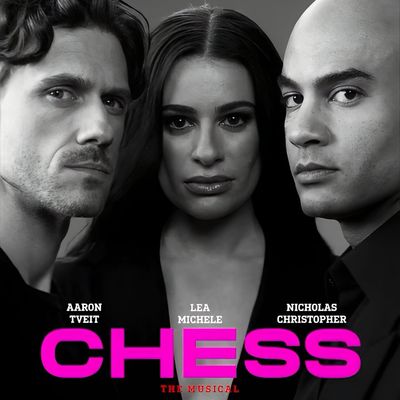
Initially, chess the musical seems like it would be a pretty boring affair. But add in two world super powers holding 99% of the world's nuclear weapons, along with a catchy 80's pop song and suddenly...things become much more interesting... Read More
From the show: Wait in the Wings
Featured Shows
About
Initially, chess the musical seems like it would be a pretty boring affair. But add in two world super powers holding 99% of the world's nuclear weapons, along with a catchy 80's pop song and suddenly...things become much more interesting.
Want more Musical Hell? Your wish is granted!
Transcript
This transcript was automatically generated and might contain errors.
[0:03] Brendon Henderson: At first glance, the game of chess is simple in its presentation. Sixteen pieces placed side by side on a board of 64 black and white spaces. But when those pieces are placed in the hands of true masters, they transcend the simplicity of a game, and it becomes a war between two opposing factions.
[0:27] Brendon Henderson: But instead of a war fought with guns and manpower, it's fought with skill and strategy. Chess becomes a cerebral war in the pursuit of intellectual dominance. So what happens when the chess board transcends into reality, and the players are the world's two leading superpowers? And what happens when Andrew Lloyd Weber's former lyricist and the two guys from ABBA take inspiration from that superpower-backed battle on the chess board and turn it into a commentary on Reagan era politics? And more importantly, how does Chess the Musical serve as the end note for a 45-year battle of innovation, espionage, fear, and a power struggle for national dominance?
[1:13] Brendon Henderson: I'm Brendon from Wait in the Wings.
[1:15] Diva: And I'm Diva from Musical Hell.
[1:17] Brendon Henderson: And this show calls for a double take.
[1:56] Diva: The Russians blew their players, it's the fence. Russia's blew their players like some of the Canadian fans, I'm not saying all of them, some of them booed us, then I'll come back and I'll apologize to each one of the Canadians, but let us have peaceful competition, not only in producing the best factories, but in producing better lives for our people.
[2:23] Brendon Henderson: While they were allies in the Second World War, by 1972, the battle for superiority between the US and the USSR was entering a new chapter. There had always been a level of suspicion and unease between the two nations that spawned from vastly different political philosophies: democracy and communism. Once the war was finished, the Soviet Union slowly receded from the other European allies and erected the Iron Curtain, a political boundary separating East Germany from the West.
[2:59] Brendon Henderson: This was a move that effectively sealed the Soviet Union off from the outside world by drawing a literal and metaphorical line in the sand of East versus West. And to make matters worse, potential nuclear destruction was waiting in the wings. For much of the 40s, the United States held a monopoly on the creation of WMDs. But going into the 50s, the Soviet Union left the world in shock by detonating their first nuclear bomb. Suddenly, the USSR had changed the rules, and the conflict between the two countries began to reach dangerous heights.
[3:39] Brendon Henderson: And yet, through all this hysteria, neither country fired a single warhead. Unlike other historical wars, the Cold War was never fought on a battlefield. It was a war of strategy. And who had the bigger brain? And by 1972, the Cold War found its new battleground: the chess board.
[4:04] Brendon Henderson: Due to the Soviet Union having strained relations with China on one side and the US stuck in Vietnam on the other, the 1970s saw the detente, a brief pause in open hostility between the two nations. The communist and capitalist powers weren't exactly ready to be friends, but they did manage to interact on more diplomatic terms.
[4:31] Diva: They're Russian jokes, and President Reagan loves them.
[4:36] Brendon Henderson: This forming relationship between the USSR and the United States was chilled when in 1980, Ronald Reagan was elected as president of the US. A staunch anti-communist, Reagan's strained relationship with the USSR became what some deemed a second Cold War.
[4:52] Brendon Henderson: We will never compromise our principles and standards. We will never give away our freedom. We will never abandon our belief in God. Initially, he planned to partner with Andrew Lloyd Weber to write about the Cuban Missile Crisis. Sadly, the world was robbed of this production, and presumably the chance to watch anamorphic missiles dance from Cuba to America when Rice decided to switch focus.
[5:33] Brendon Henderson: While there were multiple high-profile confrontations during the Cold War, one that carried potentially the most gravity was one of the most modest. In the 1970s, it was well known that the Soviets were unstoppable, especially after they defeated the entire world. In large part, their dominance could be linked to USSR culture. While Americans prided themselves on their individualism, the Soviets never placed one above the other. So, they often played as a team, while the Americans would go at it alone.
[6:17] Brendon Henderson: And in the end, the USSR strategy kind of worked. The Soviets were ruthless and kept a stronghold on the World Chess Championship for nearly 24 years. That is until an American chess protégé named Bobby Fischer came into the picture. In what would go down in history as the match of the century, Fischer challenged Soviet champion Boris Spassky.
[6:50] Brendon Henderson: Emboldened by Richard Nixon and Henry Kissinger, Fischer and the others knew the best way to humiliate the Soviets was by beating them at their own game. The drama and political manipulation behind the match spoke to Rice. At the advice of producer Richard Voss, Rice pitched the idea to Benny Andersson and Björn Ulvaeus of the Swedish pop group ABBA.
[7:18] Brendon Henderson: The main characters in Chess draw heavily on the real players in the 1970s chess world. The American, who would be named Freddie Trumper for the stage version, was unambiguously based on Bobby Fischer in his youth, abrasiveness, and open contempt for the Soviets. The Russian, Anatoly Sergeyevsky, drew on multiple Soviet players: Fischer's Match of the Century opponent Spassky, Anatoly Karpov, who won the world championship in 1975 after Fischer forfeited by refusing to accept the terms of the match, and Viktor Korchnoi, who defected from the USSR in 1976, leaving his wife and child behind.
[8:45] Brendon Henderson: He's fallen out of love with and his feelings for Florence, Freddy's second, all weigh on him in various ways. The question Anatoly faces is who will he play the game for? His country, his family, or himself? In Freddy's first main solo, "One Night in Bangkok," he takes the audience on an arrogant tour through the nightlife of the Thai capital, looking down on the culture and sex tourism he surveys, positioning himself as the superior intellectual among hedonists.
[9:15] Brendon Henderson: The musical style and instrumentation taps into the sound of 1980s synthpop, made popular by bands like New Order, Depeche Mode, and Erasure. The sound is bathed in flamboyance, color, and glamour that's only further complemented by a neon set design, which relishes in the excess and riches of 1980s capitalism. Freddy's condescending and haughty personality is on full view with this song, which he essentially uses as a way to say, "America's here, you uncivilized swine. You're welcome." But much like the country during this time, while Freddy exudes confidence on the exterior, he's filled with deep internalized feelings of inadequacy.
[10:01] Brendon Henderson: This duality comes to light in his second solo, Pity the Child, a number that displays the broken loneliness Freddy hides with his dismissive attitude.
[10:24] Brendon Henderson: Both songs reflect Freddy and America's duality, while also serving as a study of the double-edged sword that comes from independence and individualism.
[10:37] Brendon Henderson: In contrast, Anatoly's disillusionment with the subservience and conformity of the Soviet Union is demonstrated early on with Where I Want to Be.
[10:46] Brendon Henderson: He is a top player in his game and a favored son of his country, yet he feels unfulfilled and dreads the moment when his usefulness to the state runs out.
[10:55] Brendon Henderson: Unlike Freddy's high-energy, optimistic, pop-infused stylings in One Night in Bangkok, Anatoly's is colder and more sensitive in its approach.
[11:04] Brendon Henderson: Where I want to be draws more heavily on the romantic classical stylings of composers like Tchaikovsky and Stravinsky.
[11:10] Brendon Henderson: The song holds a sense of beauty from the game he loves, while he also focuses on the unease and the consequences he could suffer if he lost his love.
[11:19] Brendon Henderson: For Freddy, a loss would mean a ding in his self-confidence.
[11:22] Brendon Henderson: While if Anatoly were to lose, he very well could be killed or exiled.
[11:27] Brendon Henderson: So, rather than wait for the moment he's no longer useful to the USSR, Anatoly defects and defends his decision in the Act 1 finale anthem.
[11:36] Brendon Henderson: The title is well chosen, as musically it reflects many a country's official paean to itself.
[11:42] Brendon Henderson: But lyrically, Anatoly describes a devotion to something that lies beyond political boundaries and maneuvering.
[11:48] Brendon Henderson: My land's only borders lie around my heart.
[11:51] Brendon Henderson: In the end, Anatoly can only remain true to himself.
[11:55] Brendon Henderson: A sentiment Florence tearfully echoes after Man's Petty Nations separates her from the man she loves.
[12:16] Brendon Henderson: She's not fully Hungarian, but not fully American either.
[12:21] Brendon Henderson: This places her in a position where she can see the best and the worst in both.
[12:26] Brendon Henderson: And much like Florence's duality and opinion, Anatoly and Freddy each view her in a vastly different light.
[12:33] Brendon Henderson: Anatoly sees Florence as an escape, someone who awakens a sense of passion in him that he hadn't felt since he was young.
[12:40] Brendon Henderson: But while wrapped up in his love for Florence and his decision to flee the Soviet Union, he also abandons his wife and child.
[12:48] Brendon Henderson: Whereas Freddy views Florence as someone he's dependent on to validate him.
[12:53] Brendon Henderson: She's one of the only people who truly understands him, but Freddy takes her for granted.
[12:58] Brendon Henderson: Then, much like his parents, she leaves him.
[13:02] Brendon Henderson: In a sense, Freddy and Anatoly mirror their respective countries during the Cold War in the way that both sides are never fully good or fully bad.
[13:12] Brendon Henderson: Sure, Anatoly shows admirable morals when it comes to standing up to his government to uphold the integrity of the game he loves, but he still makes a questionable decision when it comes to his opportunistic sacrifice of his family in pursuit of a better life for himself.
[13:28] Brendon Henderson: Likewise, Freddy is brash and unlikable in his condescending behavior towards others, but as the story advances, he becomes more humane, and even decides to help Anatoly train to win the world championship, a tournament that his government wants him to throw.
[13:43] Brendon Henderson: While the two characters appear to be polar opposites, chess and their internal desire to win is the thing that links them.
[13:51] Brendon Henderson: However, despite this, neither Freddy nor Anatoly play the game for the main reason they should be because they love it.
[14:01] Brendon Henderson: Both characters are instead propelled by more external motivators.
[14:05] Brendon Henderson: In the vein of autonomy and capitalism, Freddy wants to win to prove his dominance, stick it to the Soviets, and make a ton of money in the process.
[14:14] Brendon Henderson: While Anatoly's reason is rooted in playing under autocratic rule and communism, where he has to win because his government won't tolerate anything less.
[14:24] Brendon Henderson: Instead of being a showcase for sportsmanship and mental discipline, chess instead became a game of two governments using the respected players in a larger conflict of power, humiliation, and political supremacy.
[14:39] Brendon Henderson: It's this realization that sparks a renewed love of the game and leads to Freddy and Anatoly coming together as a way to beat the people who corrupted it.
[15:45] Brendon Henderson: It was clear that the war was over.
[15:52] Brendon Henderson: In a case of poetry, Bobby Fischer and Boris Spassky competed again in a historic rematch the following year in 1992.
[16:00] Brendon Henderson: Fischer won, but at great cost.
[16:03] Brendon Henderson: He traveled to Yugoslavia for the competition, defying George H.W. Bush's executive order, imposing sanctions on the country.
[16:12] Brendon Henderson: Fischer would never return to the United States.
[16:16] Brendon Henderson: The man who had once been held up as the free world's answer to the Soviet machine would have his country abandon him and spend the last years of his life in obscurity, descending deeper into madness, fueled by anti-Semitism and approving commentary of the 9/11 terrorist attacks.
[16:37] Brendon Henderson: Likewise, following his loss to Fischer in 1972, Spassky started to become bitter, and the Soviets' disappointment in him led to them turning their backs on him.
[16:49] Brendon Henderson: While no bullets may have been shed during the Cold War, the two countries' ammunition came in the form of their people, with Freddy and Anatoly once again mirroring Fischer and Spassky as nothing more than pawns on a battlefield of 64 squares.
[17:08] Brendon Henderson: The players found themselves placed in an unconventional situation for an equally unconventional conflict.
[17:14] Brendon Henderson: A conflict of democracy and totalitarianism, of individualism and conformity.
[17:19] Brendon Henderson: Freddy and Anatoly not only embody this conflict, but in a way help to preserve it.
[17:25] Brendon Henderson: Chess has transcended from a topical musical of current events to a period piece about the tension and contrasts of the two forces at odds with each other during the Cold War.
[17:34] Brendon Henderson: The show, in a way, predicted what would need to happen to end the conflict, with Gorbachev mirroring Anatoly and distancing himself from his previous Soviet leaders in pursuit of something bigger, and Reagan responding on guard, much like Freddy.
[17:48] Brendon Henderson: It was only after he was able to overcome his indoctrinated hate based in fear that the two would come together to strategize the endgame.
[17:58] Brendon Henderson: With several commanding lead roles, a strong supporting cast, and at least one song that the Boomer and Gen X sets will recognize from the radio, Chess has definitely outlived the political theater that inspired it.
[18:11] Brendon Henderson: Chess was an extremely bold piece to make during this time.
[18:15] Brendon Henderson: But by daring to humanize both sides, it helped to show that during the Cold War, whether they meant to or not, everybody was playing the game, but nobody's rules were the same.
[18:25] Brendon Henderson: Chess also further highlighted the advantages of the individual over the collective.
[18:31] Brendon Henderson: While his motivations were questionable, Freddy was allowed to rise above many of the issues by making his own decisions, and in turn, wound up liberating Anatoly to claim his own independence.
[18:45] Brendon Henderson: For while borders and countries are man-made concepts, the inner will of the humans living in those boundaries can't be manufactured or fully manipulated.
[18:56] Brendon Henderson: In the end, though it may take generations, morality and fighting for the greater good is the only gambit to guarantee a win.
[19:16] Brendon Henderson: You can follow her on Twitter and Instagram at HaileyLongo, and you can feed that appetite for live theater by checking out SAS Performing Arts Company for virtual readings and performances.
[19:26] Brendon Henderson: Also, thanks to Diva from Musical Hell for helping with the insurmountable challenge of recapping the Cold War in eight pages.
[19:33] Brendon Henderson: If you want more Broadway video content like this, be sure to check out her channel now.
[19:38] Brendon Henderson: And of course, thank you to Sammy Kornecki, Mark S, and Ethan for suggesting we cover Chess, and to all of our fantastic patrons on Patreon.
© Broadway Podcast Network, All Rights Reserved