

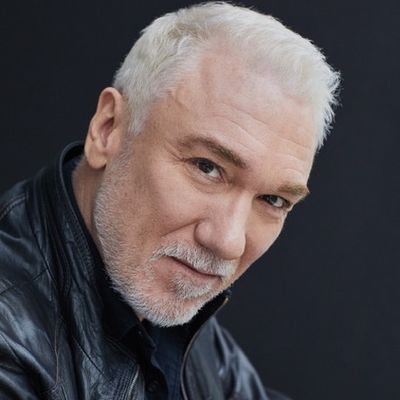
A Broadway and off-Broadway veteran who has starred in dozens of productions, Patrick Page is currently performing in the hit play All the Devils Are Here at the DR2 Theatre. Directed by Simon Godwin, this riveting show explores Shakespeare's most fascinating villains... Read More
From the show: When Lightning Strikes!
Guests
Featured Shows

About
A Broadway and off-Broadway veteran who has starred in dozens of productions, Patrick Page is currently performing in the hit play All the Devils Are Here at the DR2 Theatre. Directed by Simon Godwin, this riveting show explores Shakespeare's most fascinating villains. A Tony nominee for his portrayal of Hades in Hadestown, some of Patrick's other credits include Saint Joan, Casa Valentina, A Time to Kill, Spring Awakening, Spider-Man Turn Off the Dark, A Man for All Seasons, Julius Caesar, The Lion King and on and on. This Grammy-winning gifted actor has also appeared on TV and film in The Gilded Age, Elementary, Spirited, In the Heights, Estella Scrooge, and much more.
Transcript
This transcript was automatically generated and might contain errors.
[0:00] ♪ Musical number: "When Lightning Strikes" — performed by Unknown performer ♪
[0:28] Jeryl Brunner: Hi, this is Jeryl Brunner, and you're listening to When Lightning Strikes, where we talk about the tingly mic drop moments that led you to becoming an artist. A Broadway and off-Broadway veteran who has starred in dozens of productions, Patrick Page is currently performing in the hit play All the Devils Are Here, directed by Simon Godwin. This riveting show explores Shakespeare's most fascinating villains. A Tony nominee for his portrayal of Hades in Hadestown, some of Patrick's other credits include Saint Joan, Casa Valentina, A Time to Kill, Spring Awakening, Spider-Man Turn Off the Dark, A Man for All Seasons, Julius Caesar, The Lion King, and on and on. This Grammy-winning gifted actor has also appeared on TV and film in The Gilded Age, Elementary, Spirited, In the Heights, Estella Scrooge, and much more.
So, so much congratulations on All the Devils Are Here. It's a riveting show from start to finish. There's so many elements to this very unique performance, and I love how inclusive it is. I know you say that it's not just you, it's not just a solo show, that the audience is a very key part of it. So can you bring me to the origin story of All the Devils Are Here? How did you get inspired to create the show?
[2:14] Patrick Page: I have this love affair with Shakespeare that goes back to my childhood. My father was an actor with the Oregon Shakespeare Festival when I was a toddler, and I saw him and the other actors up there on the stage, and I was just enraptured. And then when I got older and began to study Shakespeare in earnest when I was studying English in college, I realized that this was just something one could spend one's life exploring. And if I could gain the skills to be able to share this with people, that would be a worthwhile thing to do. So I've created these solo pieces for most of my life. I started in my 20s with a show called Passion of Slaves, which was about the tension between reason and passion in Shakespeare's plays.
In that, I played Hamlet and Mercutio and Romeo and Benedick and some of those younger characters. I was looking for another solo show to do, and around 2017, I tossed around the idea of doing something with the villains, but I have a dear friend named Stephen Burkoff, who's done a show for years called Shakespeare's Villains, which he's toured all over the world brilliantly. At the time, he was quite active with it. I didn't want to do that then. Now he's mostly retired; he still works, but we're not in conflict with one another, and so I thought it would be a time for me to be able to do this. Around 2017, I thought, okay, let's start thinking about this in earnest. Whenever I want to create something on my own, I have to give myself some kind of date or pressure.
I need a deadline. So I called a friend of mine who ran the Utah Shakespeare Festival. They were having a conference of high school students in the fall, October of 2017. I said, if I do this show, may I come and perform it for these high school students? I'll do it for free. He said yes. So that gave me a deadline, and I began working on the show. I don't know precisely when the idea came to explore them chronologically, but that was really the key that unlocked it. Because in exploring these villains chronologically, you can really see and experience how Shakespeare became Shakespeare. If Shakespeare had died, let us say in 1593, when Christopher Marlowe died, he would be remembered in the same way Marlowe is, perhaps as a lesser player, certainly as a lesser playwright than Marlowe.
At that time, Shakespeare had written only the Henry VI plays and Titus Andronicus, maybe The Comedy of Errors and Two Gentlemen of Verona. He was a very good Elizabethan playwright at the top tier of his peers, but he wasn't this unique, transcendent, transformational figure that he became. Over the course of two decades, he kept looking at human beings more and more closely, specifically, with deeper curiosity and more compassion. With each of these characters, by setting himself the hardest possible problem, which is why do people do terrible things to one another? He comes closer and closer and closer to what it means to be human, and that's what my show's about.
[5:51] Jeryl Brunner: Yeah, it's quite beautiful, and I love that you see the evolution of his villains and how key that is in Shakespeare's history and understanding them. What is it specifically about the villain that so intrigues you that you feel they're so worthy of exploration? And I love that line, just the title you had me at that beautiful line from The Tempest, "Hell is empty and all the devils are here." That's so profound. But what is it about villains that so intrigues you?
[6:29] Patrick Page: Well, I've always been fascinated with antisocial behavior, and I think that we as a species are fascinated with it. I mean, all you have to do is turn on Dateline or HBO or Netflix, and you'll see documentaries and series and movies, and they're all based around the problem of the fact that people do destructive things to one another, sometimes purposely. And why do we do that? And to what degree are we responsible? And to what degree is fate responsible, genetics, the way we were raised? Do we have a choice? Do we not have a choice? Does evil exist in the sense of it being some external force that can act upon human beings? Or is this simply behavior like the behavior of chimpanzees or tigers or lions or sharks?
Are there predators among us? Or are we essentially pack animals, herd animals? All that has fascinated me for as long as I can remember. So that's what Shakespeare explores. And I love the breadth of characters who you inhabit, Claudius to Lady Macbeth, Shylock. How did you pick these villains?
[8:00] Patrick Page: I tried to find those places in Shakespeare's growth as an artist where something new happened that hadn't happened before. So the play begins with Shakespeare as a boy seeing this character who would have appeared in the medieval morality plays. It's a fact that the Earl of Leicester's men visited Stratford-upon-Avon in 1572, and it's a fact that his father was the high bailiff, and it's almost certain that Shakespeare would have been there and seen this particular play, Every Man in His Humor, and seen this vice character. From that beginning, the vice character is not even a human being; it's kind of personified sin, who is dramatic and witty and sarcastic and bad and naughty. I think the young Will fell in love with this kind of character.
When he comes to London nearly 20 years later and he's writing his own plays, his first plays are a trilogy of plays, Henry VI, one, two, and three, about the Wars of the Roses. They're going along very nicely, I think in a quite stentorian manner, really. They're very Marlovian. They seem like they were written by Christopher Marlowe, so much so, in fact, that there are many critics today who believe that the Henry VI plays were written by Marlowe. I don't think so at all. I think they were written by Shakespeare, but that Shakespeare, one of his great gifts, was the ability to completely absorb another person's manner or style. He has absorbed Marlowe's style. But then suddenly there's this character, Richard of Gloucester, who becomes Richard III.
It's as if the plays for me have gone from black and white into color. It's this vivid human being who still is very much like that vice character he would have seen as a boy, but human, describing his reasons for doing things, and in fact, learning who he is, learning more about himself as he speaks. Then, of course, Shakespeare takes that character and writes a whole play around him, Tragedy of King Richard III, which is one of the great, great roles ever written for an actor. So that's the kind of the first event in Shakespeare's life. I'm looking for those events that are like that, not where he's repeated himself or where he's doing something that some other playwright has already done, but where something new emerges in our culture, in our consciousness, and in dramatic literature.
The emergence of Shylock is certainly that for me, his character who is so justified in his resentment of his oppressors, who finally has the law on his side, whose language is so peculiar, enigmatic, idiosyncratic, and who just leaps out of the play. Shylock only has five scenes in The Merchant of Venice, and yet he completely dominates the conversation about the play. That emergence of that character and how the question of revenge then becomes something in Shakespeare's consciousness that troubles him. He doesn't simply accept the idea of revenge. Shakespeare takes anything that we might accept, simply accept, and he questions it. That's one of the things he questions. Is this really something that we ought to be doing, ought to be a part of?
We seem to have an instinct for it. So what is that instinct? Shylock is that, the emergence of conscience in the character of Claudius in Hamlet, who unexpectedly, about two and a half hours into the play, reveals that he's deeply tortured about this act he's committed. Then thrillingly, the emergence of a textbook modern psychopath in the character of Iago. Shakespeare, of course, couldn't have known the psychiatric term psychopath, but there is a checklist that was created by Dr. Robert Hare of 20 points upon which someone is evaluated for psychopathy. Iago ticks so many of these boxes; he's absolutely off the charts. It's as if Shakespeare read Hare's work and then went backward and created Iago.
But of course, that's not what happened. What must have happened is that Shakespeare observed someone in life and then recorded with uncanny accuracy the behavior of a genuine psychopath, and that's what we have in Iago.
[13:22] Patrick Page: I mean, when you think about the context of when he was living and how the plays continue to be so relatable, you know, that we connect on a very visceral level to these people and what they're struggling with. It's just so extraordinary to me to think about. And I love that you delve into this. And how has this experience of really dissecting these villains? How has that changed you?
[13:51] Patrick Page: Well, the wonderful thing about All the Devils Are Here in New York right now is that it really is kind of now a two-act experience. And the first act is me performing the show, and the second act is a conversation with the audience. And it's in that conversation that I learned so much about what their curiosity is. Shakespeare is always asking us to turn the mirror towards ourselves. You know, he says, Hamlet says the purpose of playing is to hold the mirror up to nature. And it's an easy phrase to take for granted, but it's quite daring if you think about it. I don't think that's what most plays do. Most plays don't hold the mirror up to nature. They're rather sort of reflecting the playwright's version of reality.
The Bernard Shaw's version of reality, or Arthur Miller's version of reality, or Tennessee Williams' version of reality. Shakespeare is not taking any sides in his plays. So the villains are written with as much compassion and curiosity as the heroes are, and the heroes are written with as strong a critique as the villains are. And so no matter where you are, you can stand and look, and you're able to have a bit of objectivity and see light a little more clearly because it's up there on stage. That is, if no one puts their thumb on the scale in the director's room.
[15:29] Jeryl Brunner: Well, so can you say how it's changed you though? Or has there been a question that really made you think and really shift from the audience?
[15:41] Patrick Page: Well, I don't think that implies that I've come to some kind of conclusion, and I'm not confident enough to have conclusions. I have deeper questions. Shakespeare's plays are never written as answers. They're always written as questions. And what he's done is he's taken subjects that are deep enough and intractable enough to warrant a lifetime of questioning. And fear not to be.
[16:16] Patrick Page: Precisely, precisely. Forgive me. And so I hope what happens is that I am able to see more and more deeply into the questions of the play. For example, I'll just give you one quick example, let's say in Macbeth. Macbeth has a tremendous question at the center of it, which is whether or not Macbeth really has a choice in the matter. Is it all fated from the beginning because the weird sisters tell him it's going to happen? Or does he have a choice? And that's, he seems to have choices. And if so, then do we have choices? Do you have a choice? Do I have a choice? Or given our particular genetics and upbringing makeup and everything that's happened up until this moment, are we sort of fated to behave the way we behave?
That's a very, very deep question that scientists and philosophers are working on to this day. And we're not gonna untangle it. That's, Viola says in Twelfth Night, "Time, thou must untangle this, not I. 'Tis too hard or not for me to untie." But we're getting deeper and deeper and deeper into it. I suppose for me, it's about opening my eyes to that which I reflexively do not want to see.
[18:00] Jeryl Brunner: I'd love to ask you for your lightning strikes moment when you knew you had to be an artist. You once told me many years ago that when you were around six years old, you wrote a play called Dr. Jekyll Meets Frankenstein and that you love monsters. And that starred you and your brother in his wordless role. But can you point to a moment or moments when you knew? I know your father was an actor.
[18:30] Patrick Page: Yeah. Well, I love that you know that story. I forgot I told it. And therefore you know that my sort of knowledge that I would be an actor of some sort. It's just something I've always had. How that would manifest itself, I didn't know. Whether or not I would be able to do it professionally, for example, I didn't know. It's an impossible career to go into. And because my father was a theater professor at a small college in Oregon, he knew perfectly well that it was an impossible profession to go into because he'd had dozens and dozens of students who had wanted to do it, and of course, few, if any, succeeded. Although he did have a couple who were marvelous actors and did succeed. So that moment for me, I remember I was coming from I had done a summer at the Utah Shakespeare Festival, and it was my first year ever playing a leading man.
I was very skinny when I grew up and awkward. And so I all my youth I played old men and character parts. And then I married a woman, at the time I don't think we were married, with my girlfriend at the time, not Paige, my previous wife, Lisa Ivory, but she was a fitness fanatic. And so I started going to the gym with her. And when I did this, my body changed, but also I became more confident, and I became more coordinated. And all of a sudden I started getting these other parts, and I played the leading part of Brutus in Julius Caesar that season. And I remember at the end of that season, they asked me if I would come back the following season to play Richard III. And of course, I accepted on the spot.
And I was driving between Las Vegas and San Diego, and I can picture myself on the road when it was almost as if a finger came down out of the sky, and I thought, oh, this is what I'm going to do. I'm going to do this. I now believe now that I will be an actor. Up to that point, I thought, well, perhaps I'll teach and act, you know, in a nice community theater or something. Or perhaps I'll have a debate team, a speech and debate team, which I was very interested in in college, or perhaps I'll be a magician. I had an illusion show, which I toured for many years. I had various ideas of how my future might go. I think it was then that I thought, no, I'm going to be an actor.
[21:36] Patrick Page: Was it because of Lear? What was it that was because it was it was because of that play being able to step into those more leading parts and being asked to come back and play such a wonderful role. It was as if I didn't have to quite, I still had to knock down a lot of doors, but I didn't quite have to push the rock up the hill quite so much like Sisyphus. There was at least some wind at my back.
[22:15] Jeryl Brunner: And what do you hope people come away from after seeing All the Devils Are Here?
[22:22] Patrick Page: Two things. One, I hope they open their minds. If they've had any reservations about Shakespeare, I hope that those reservations have been accounted for and that they realize and are eager to learn more about the greatness of the playwright, because I truly think that Shakespeare can transform lives. And what has happened for so many people is because they thought either they had maybe a teacher who was naive, who thought a good idea was to have, you know, eighth graders read Romeo and Juliet or something. And of course, they couldn't make head or tails out of it, and they thought, I don't like this stuff. Or they went to a production of the play, and the play was incomprehensible. And they blamed the wrong people.
If you go to a Shakespeare play and you don't understand what's going on, and it's not very thrilling, it's not the playwright's fault, very likely. And it's not your fault. You're smart enough. It's the player's fault. It's the director's fault, and it's the actor's fault. And that can be for a whole host of reasons, but if the play is executed very, very well, it will grab you. It will grab you. And so that's one thing I hope they come away with is a sense of confidence that Shakespeare is for them. The other thing I hope they come away with is a sense of curiosity about their own darkness. That we don't know ourselves. We think we do, and we don't at all, not even fractionally. And Shakespeare knew that about himself, and he knew that about us.
He knew that we were capable of terrors under when put under certain conditions and pressures. And it's only by knowing that about yourself that you can prevent it from happening. And Carl Jung had a wonderful quote where he said one does not become enlightened by imagining figures of light, but by making the darkness visible. And that to me is the takeaway. When you were asking earlier, what have I learned? It's about Patrick, you know, you've got a lot of stuff in you that you would rather not face: jealousy, envy, aggression, hatred, anger, fear, fear at the base of all of it. And you don't want to look at that. And when you don't want to look at it, what you do is you project it out onto someone else, and then you reject that person you projected out on. Or even worse, you might try to destroy that person. And so that I hope they come away with a real curiosity about themselves.
[25:43] Jeryl Brunner: Thank you so much, Patrick, for coming on and talking. I appreciate it. Congratulations.
[25:50] Patrick Page: Thank you so much.
[25:51] Jeryl Brunner: Okay. It's the moment you know. The theme song was written by Tom McGovern. This episode was edited by Sarah Goodman and produced by Anna Strout.
[26:07] Jeryl Brunner: Lightning strikes.
© Broadway Podcast Network, All Rights Reserved