

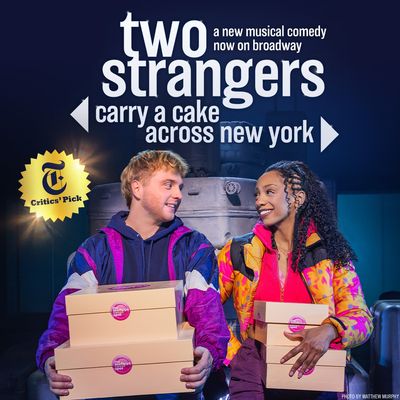
Kit Buchan and Jim Barne wrote the book, music, and lyrics for the New York Times Critic’s Pick musical Two Strangers (Carry a Cake Across New York), currently running on Broadway at the Longacre Theatre... Read More
From the show: When Lightning Strikes!
Featured Shows
About
Kit Buchan and Jim Barne wrote the book, music, and lyrics for the New York Times Critic’s Pick musical Two Strangers (Carry a Cake Across New York), currently running on Broadway at the Longacre Theatre. The longtime collaborators are known for their witty, contemporary storytelling and catchy, character-driven scores, that bring a fresh, modern voice to musical theater. Audiences will soon be able to experience their music beyond the theater when the show’s cast album is released on March 20. Two Strangers stars Sam Tutty and Christiani Pitts and is directed and choreographed by Tim Jackson.
This episode was recorded on March 17, 2026.
Transcript
This transcript was automatically generated and might contain errors.
[0:00] Jeryl Brunner: From Shakespeare to Schwartz, from Fosse to Alvin Ailey, from Sondheim to Borellis, from McNally to Fay, it happened to the greats, it still happens every day.
[0:10] Jeryl Brunner: When lightning strikes, it's the moment you know. When lightning strikes, where you're meant to go. You can stand and tell Eureka, do whatever you like. You'll never forget the moment when lightning strikes.
[0:25] Jeryl Brunner: This is Jeryl Brunner and you're listening to When Lightning Strikes!. Kit Buchan and Jim Barne wrote the book, music, and lyrics for the hit musical Two Strangers Carry a Cake Across New York, currently playing on Broadway at the Longacre Theatre.
[0:51] Jeryl Brunner: These longtime collaborators are known for their witty, contemporary storytelling and character-driven scores that bring a fresh, modern voice to musical theatre. Audiences will soon be able to experience the show's cast album, which will be released on March 20th. Welcome!
[1:15] Kit Buchan: Oh, Jeryl, that is without a doubt the most encouraging introduction we've ever heard.
[1:22] Jeryl Brunner: Well, it's all true. So, for people who might not have seen the show, can you tell us what it's about? Because I love just the plot of it all. It's a fish out of water from England and a diehard New Yorker.
[1:46] Jim Barne: And they meet for the first time.
[1:49] Kit Buchan: That's right. Yes. So I'm Kit, I should say. You can distinguish our voices. And the story, yes, as you say, is more or less about an Englishman in his mid to late twenties who comes to New York for the first time to attend his father's wedding.
[2:07] Kit Buchan: And it's also a story about the bride's younger sister, who is sort of dealing with some emotional baggage in New York and has landed with the unenviable task of having to look after this very excitable and optimistic, but also rather irritating Brit, who has a kind of misguided image of New York and of life in America in general.
[2:32] Kit Buchan: They are different from one another in almost every way. And they have to spend, well, it's between 36 and 48 hours together running errands in New York. One thing leads to another. And it becomes a story of two ships passing in the night and having a slight gravitational impact on one another's lives. I think that's the story. Jim, anything to add to that?
[2:58] Jim Barne: Sounds exactly like the story to me.
[3:02] Kit Buchan: And I love the juxtaposition of them. He's like a puppy dog, you know, full of passion and energy and excitement. And she's anything but that. She's been around. She's a little bit jaded. She's in an interesting place in her life, kind of a crossroads and how they come together.
[3:30] Kit Buchan: And I've heard it described also, I don't think anybody's ordinary, right? We're all extraordinary. But these two people who are not completely extraordinary having this connection and how their lives change and what they learn about each other, which is so beautiful.
[3:52] Jim Barne: Yeah, that was definitely the idea behind the piece. It was a wager, really, to see whether we could write a show that wasn't about people who were going to take over the world or win some very established competition or something.
[4:13] Jim Barne: They were just two ordinary people. And the sort of landscape, the emotional landscape of the plot was going to be very small, but hopefully was going to be profound for them, for those characters. And therefore, if we take the characters seriously and we take their emotional journeys seriously, then we'll find that moving as an audience.
[4:34] Jeryl Brunner: I've read that some of your influences like Before Sunrise and Before Sunset and how you were inspired by all these romantic comedies.
[4:46] Jim Barne: Yes, but in that particular matter, one of the inspirations, or rather, once we were already well underway writing it, but we were certainly not confident that it would work. And we went to see The Band's Visit. And I don't know if you know it, but that begins, there's a very short monologue that opens that musical, which is a few years, something along the lines of, I'll paraphrase, a few years ago, some Egyptian musicians went to Israel. You probably didn't hear about it. It wasn't very important.
[5:14] Jim Barne: And it's a brilliant way to open a show. And I think once we saw that, it was really encouraging, because it was like, this is a deeply, deeply moving story, where nothing really happens. And none of the people are likely to have a profound impact on world events, or indeed achieve anything individually magnificent.
[5:36] Jim Barne: But as you rightly said, Jeryl, everybody's extraordinary. And partly thanks to Sam and Christiane and everybody else involved, I think that comes through in the two characters. There is something unique about them, as well as there being ordinary people that you or I might meet on the subway.
[5:58] Jeryl Brunner: I'd love to know the origin story of the show. What inspired you to create this world, create these characters? When did that happen that you said, Oh, I have this idea?
[6:15] Kit Buchan: Yeah, I wonder. I mean, it was actually such a long time ago that we started writing the show, that we've kind of had to come up with a version of history, so we can tell people, because we can't remember. We can't even remember why we decided to write a musical.
[6:34] Kit Buchan: I remember seeing a writer give a talk once, a writer called Luke Brown, and he said that what novelists do is that they collect the favourite things that people have said about their book, and then they say that that was their intention all along. And I think, you know, maybe we're at risk of doing the same.
[6:52] Kit Buchan: Yeah, nobody, or anyway, certainly not us, sets out to think, well, we're going to write a Broadway show. We were amazed enough in 2019, when we put it on in Northampton and Ipswich, which are, you know, significant mid-sized towns in the English Midlands, or in the Midlands, the East of England, where the audiences are local people from those towns.
[7:18] Kit Buchan: And that to us was beyond anything we could have dreamt of when we began writing it. So I didn't know, neither of us knew that it had the potential reach that it has proven to have.
[7:34] Jim Barne: But I think it is true what you said, we're not fabricating our origin story when we say we wanted to write a musical about two ordinary people. And we also, I think, there was something else, we had some other ambition.
[7:51] Jim Barne: There was something vaguely political there, where we were like, we love rom-coms and Christmas movies and New York movies more than anything. But also, we wanted maybe to slightly question why those films tend to exclude certain people. Those films, certainly nowadays anyway, tended to be about people who are quite well off and for whom New York is kind of a playground.
[8:13] Jim Barne: And like, do those stories apply? Are they workable in real lives between people who, A, don't have the material resources and B, whose lives might be entangled in ways that are not very photogenic?
[8:31] Jim Barne: So I guess not to ruin the story for your listeners, but life intervenes in an ugly way, in a way that is maybe not very congruous with romantic comedy movies of the type that have also inspired the play.
[8:49] Jim Barne: So I guess maybe we wanted to experiment with that, like what happens when real life intervenes in quite an unphotogenic way and whether the sensation of romance and potential can survive that intervention.
[9:03] Kit Buchan: We absolutely love romantic comedies and we weren't trying to like do them down. We wanted it to feel like a romantic, like a movie as well. So we were trying to, this is, yeah, to coin a phrase, we wanted to have our cake and eat it in the sense that we wanted it to slightly pastiche the genre and question the genre and also belong in the genre.
[9:23] Jeryl Brunner: I see. I love that New York is a third character. And from what I understand, you were mostly tourists in New York when you were in the process of creating the show. So what was it about New York that so enchanted you?
[9:43] Kit Buchan: I think, yeah, it's everyone, in a way, I hope it doesn't sound, I hope it's okay to say this, but everyone sort of is invested in New York as an idea.
[9:53] Jim Barne: Yeah.
[9:54] Kit Buchan: Globally, because we've just seen so much culture centred around this place, so many stories that when you get there, the familiarity that you sort of, you feel when you're walking down the streets and you recognise it, or maybe you don't recognise it, you don't know where you recognise it from, but it's just familiar to you.
[10:17] Kit Buchan: And so I think that made it, whether or not it made it more realistic, it certainly made it easier for us to imagine the story taking place in New York, in that location.
[10:30] Jim Barne: Yeah. And like Jim says, it's a city that sort of belongs to everyone at that point. And also, I think, in a way, we were writing about what that city looks like to somebody who isn't from there, and only has a tourist, or in Dougal's case, less than a tourist understanding of New York.
[10:51] Kit Buchan: And in a way, the process of writing the show has been rather like Dougal's experience, where it's like, yes, as you say, previously, I think the longest I'd spent in New York before we wrote the show was probably 10 days.
[11:02] Kit Buchan: Now we've lived there, you know, and we, you know, we've, we've visited New York a great many times, but like, we, in a way, our increasing familiarity with the city kind of mirrored that of our character.
[11:17] Kit Buchan: And as it became clearer that we were going to bring the show to America, there was a great responsibility to make sure that the city of New York that we were representing, along with our brilliant director, Tim, and along with, in particular, Sutra Gilmore, a brilliant set and costume designer who has evoked New York in the set, and is something of an adoptive New Yorker herself, that we were offering New York as something that they would recognise.
[11:42] Kit Buchan: You can't pull the wool over New Yorkers' eyes. They're a very discerning audience. And we were, we felt like a really profound responsibility there. And I think it was only possible to do it. I mean, I think we were younger when we set out on this process and probably more confident than we would be now.
[12:01] Kit Buchan: But we were only able to do it probably because we had this huge bank of fascination towards the city, which I think I've learned now, possibly even people who live in New York feel. And I guess there are a lot of people in New York who've moved there from somewhere else. And even people who are from New York still experience a kind of, a kind of romantic fantasy about what it represents. It's a sort of mythical city.
[12:28] Jim Barne: And when we were worried about it, we remembered that, like, London has been committed to the stage in musicals a couple of times very successfully by Americans, in particular in Sweeney Todd and My Fair Lady, and in others. And it's like, I'm a Londoner. And it's true that I can forget that London exerts a magnetic power over people as well, not to the same extent as New York, but it's easy to forget that.
[12:52] Jim Barne: And I think I'm interested in seeing London represented in art, and in particular in theatre. And it pleases me. It makes us prouder than anything when we hear that New Yorkers feel that their city has been adequately reproduced or evoked in the show. It's a point of great pride and honour for us, I think, because we've really fallen for New York.
[13:16] Kit Buchan: I mean, we were already, we already love New York, and now we love it. And it feels like something that's really part of our lives.
[13:23] Jeryl Brunner: Yeah, I was wondering how the city changed for you after living here and doing the show in New York and really experiencing it.
[13:34] Kit Buchan: Yeah, we were there for, we were there for about two months. We've been back and forwards since.
[13:40] Jim Barne: Because we've been doing a cast album as well over Christmas.
[13:44] Kit Buchan: But yeah, we, what we typically say is just sort of being in one area for that length of time and sort of slowly having a local shop, having local restaurants, a local bar where you go, you know, just sort of starting to build a life there, a small life, was the most magical thing.
[14:06] Kit Buchan: And sort of New York is incredibly, each tiny little neighbourhood really has its own character, and it feels very alive.
[14:15] Jim Barne: You know, I think there are lots of places in big cities which kind of have lost their soul a bit, but New York somehow has managed to hold on to all these wonderful little communities. And yeah, we absolutely, we loved it. It was a real joy.
[14:31] Jim Barne: I totally agree. And it's something we miss in London. Some version of commodification or gentrification or like has afflicted a lot of neighbourhoods of London and they feel very alive.
[14:57] Kit Buchan: We have a theatre community in London, but it's not the same. In New York, it's like people really communicate and there's a whole industry that's kept alive and stays open so late at night, which is very romantic. And if you work in the theatre, it feels like that's a reputable trade and it's connected to the wider city. I cannot tell you how seductive that is. I don't want to do London down. It's a wonderful theatre in London, but that sense of like, we belong to the city. New York is really proud of musical theatre, and musical theatre is at the heart of its economy. I just love that. It's like I kind of never dreamed, we never dreamed, that we have the opportunity to inhabit a community like that and feel welcomed by it. It's really thrilling. And yeah, we can't get enough of it, basically. It's so good.
[16:17] Jeryl Brunner: Because it's your Broadway debut. So I'd love to hear your origin story of how you first collected, because you've been collaborators for years, right, since you were kids. I'll let you tell it.
[16:31] Jim Barne: Yeah, we have. Yeah. We met when we were, Kit was eight and I was just about to be nine, I think. Literally children. Nine, ten. One or the other. It was the late 90s.
[16:45] Kit Buchan: It was a great time, the late 90s. We were rollerblading.
[16:50] Jeryl Brunner: How did you meet?
[16:52] Jim Barne: We met at school. We were in the same year. And I was very small. I was about half his height. And I just thought he was the coolest guy I'd ever met, basically.
[17:09] Kit Buchan: Which is lucky for me. It was wrong to say that. I mean, we collaborated from the age of nine, but not as we collaborated on like playing Pokémon. And ultimately, in our team, we formed a band. And that was when we started writing songs together. And we did that for like, gosh, five, between five and ten years. And somewhere in that time, and neither of us can remember how or whose idea it was, it crossed our minds that the version of songwriting that we were doing might lend itself to musical theatre. I don't really know why that is, because neither of us comes from a musical theatre background. We didn't know anyone in the industry and didn't have anyone in our families in the industry, except for my brother, my older brother, who was a great theatre enthusiast and is an actor.
But God knows where he got it from, because we weren't a theatrical family. And my mother, you know, I didn't play a musical, my mother didn't play a musical instrument. And we were just, yeah, I mean, for me, it wouldn't have happened if it weren't for Jim, who's the musical one of the two of us.
[18:17] Jim Barne: I'm the musical and you're the theatre, I think.
[18:19] Kit Buchan: Right. Okay. That's clever. Yeah, that's good.
[18:22] Jeryl Brunner: Tell me about your early, your first band. What was it called? What were some of the songs?
[18:29] Jim Barne: We actually ripped off a song from our band, or I did, rather, in that we had a song that we wrote years ago about California and what California looks like to someone who's never been to California. And we nixed that idea, I think, for New York. And we're writing another show, and we found ourselves doing the same gag. We've written a song in L.A. and we've written a song doing the same gag. We've written a song in our next musical about these two teenagers who want to go to Alaska. And they particularly are planning to visit a city in Alaska called Juneau, the state capital of Alaska. And they haven't been there, and they don't really know anything about it. They just know that they really badly want to go there. And it's like this idea that we keep coming back to for some reason. Neither of us made very good... We were not very good on stage. Is that fair to say?
[19:32] Kit Buchan: Oh gosh, I certainly wasn't. It was like neither of us really wanted to be the singer. We both had sort of different varieties of stage fright. So I don't know if we were ever likely to make it big on the big stage, but it was a great time. And we were in a band, you know, by the end... I mean, the band has never disbanded, but we don't play much anymore. But there are seven of us in the band, and they're all our friends, Jim's brother and our best friend Margo. So we had some really good times. We learned probably a thing or two about audiences and certainly about pop songwriting. And also it was really an excuse to hang out, which bands... I think that's sort of what bands should be. It was a sort of excuse to just be together in a room playing the guitar.
And that's kind of... then I suppose what we've done, in a way, is a career. And it feels like we've slightly shoplifted it because we like each other's company so much. And the fact that that's working professionally feels a bit like we've cheated in some way.
[20:45] Jeryl Brunner: Not to embarrass either one of you, but do you mind sharing what you adore about the other? What the other gives you?
[20:51] Kit Buchan: Don't get me started. There's too much, really. To produce it. Where would I begin? I feel like the problem a lot of the time, Gerald. I feel like Jim is so patient with me. And he's also far more industrious and productive. And I am like really stressy and Jim manages to sort of keep me from floating off into outer space. But also more than that, I just think he's the most... I think you are the greatest songwriter who's ever lived. I really do think that.
[21:33] Jim Barne: Okay, well, you can tell Gerald's saying that. That is what I think. I feel so lucky. And sometimes it's like we sometimes have to schedule time to just... because there's always so much to do now. We sometimes have to schedule time where it's like, we're just going to go for a long walk and not talk about theatre. Because sometimes you can forget to be friends.
[21:52] Kit Buchan: To do nice things. Yeah, we did. We went for a walk along the canal, didn't we? Three days along the canal in Wiltshire. Just before we went to New York, actually. I think we were both a bit panicked by going to New York. I think we just thought, what if they laugh us out of town? Critics pick all the success later.
[22:16] Jeryl Brunner: When did you know that the show was a success? When did you know that it had legs?
[22:26] Jim Barne: I don't think that has ever happened. It's always just sort of like, the news generally seems to be sort of positive. So maybe we'll save them for another week. And I try not to look on the internet. It's the other thing. Jim reads the reviews and knows what's going on. But I don't because I'm too afraid. So I don't go on the internet. I just hope for the best, I guess. And I like to hear from other people what's going on. And I like to be in the audience and to see how they react. Yeah, I think all that we wanted was it not to be a disaster, I think. And that has happened, I guess, in that it hasn't died in the Longacre. And so the sense that there are people coming, and then, yes, that's kind of all we could have dreamed of.
Any more than this is too much to ask, I think. And what happens, happens. But one thing that thrills me is knowing that people are seeing Sam and Christiane every night. I sometimes am dazzled by the thought of how hard they're working. They are just the two most amazingly, mutually supportive, intelligent actors. And the thought of them doing it eight times a week. And obviously, you know, with help from the Amnesty International, who are also amazing. It just blows my mind. It's so easy being a writer compared with being an actor, and actually having to do it and be these people every night and live these people. And they really complete the world. It's so intimate, and yet so epic at the same time. And that set is so brilliant. I don't even want to give it away what you do with suitcases. It's so ingenious, the way they morph and transform.
[24:10] Jeryl Brunner: Can we talk about the cast album? It's coming out March 20th.
[24:20] Kit Buchan: It is. Yeah, it all happened quite quickly. It feels quite quickly to us anyway. I don't know. I know the Broadway albums are often done very quickly, because they're released, or they're recorded very soon after press night often. And then things just have to happen quite quickly. But it still felt very quick for us. And we are very excited for everyone to hear Sam and Christiane. We were just desperate to sort of, I guess, have a record of their performances because we're just so amazed by them.
[24:53] Jim Barne: The performances are so phenomenal. Their connection and how they grow before our eyes, you know, how you really believe that at the beginning, they're strangers and then how their relationship blossoms. It's so authentic and beautiful.
[25:11] Kit Buchan: That actually is authentic, as well. I mean, they are really special people. And they are deeply committed to one another as colleagues and as friends. And seeing their relationship in real life bloom into something really mature and really mutually supportive has been actually one of the joys. I remember you saying this, one of the joys of the process.
[25:37] Jim Barne: Yeah, so in a way, one of the lovely things about this cast recording is that the world gets to hear Christiane, because we rewrote all of Robin's solo numbers once we started rehearsing with her. And we just wanted to give her more material, basically, because we just so fell in love with her as a performer. And so I'm excited about people hearing those songs and their duets, which have also in many respects been rewritten for them. This cast recording is in a way testament to the two of them as performers, and it's a record of their chemistry. And it's also the result of amazing work from Jim and our orchestrator Lux Pyramid, who's a producer, and they've produced the album together with amazing attention to detail and at great speed, as you say.
[26:36] Kit Buchan: Yeah, well, Lux has been working away since January, I think, pretty much non-stop doing mixing and, you know, going through all the takes. And it's been amazing. We're so pleased with how it sounds. We also love, we're very excited about recording the band's performances. The musicians on Broadway have been absolutely phenomenal. There is nothing more dreamy than, you know, writing a song and then having some of the best musicians in the entire world play that song every night. It's so humbling. And every single one of them is just, you know, incredibly, a massive inspiration to us as well. So it's lovely to sort of have that, just for our own personal use, really. We can listen to the album in years to come and be, you know, just so dazzled by their playing.
And we got to do it at Power Station, which I didn't know about because I'm not a music head, but for Jim and Lux was like a huge deal. Like, you know, the Rolls-Royce of recording studios for something like this. And to go in there every day during the process, it felt like we were like kids in a candy shop getting to be in this really important studio where so much amazing stuff has been laid down. It was thrilling.
[27:46] Jeryl Brunner: Well, it's thrilling to have you both here. Would you ever have thought when you first met that here you'd be?
[27:53] Kit Buchan: I cannot shake my head more strenuously. Absolutely not. We probably thought we'd be Pokémon trainers.
[27:58] Jim Barne: Yes, exactly. We thought we'd be, yes, exactly. We'd be, what was the thing? Like sweets testers. That was always the thing, the best job in the world is when you taste chocolate for a living. We were really young, is what I'm saying, when we met. I also think, like, if we'd been successful at anything else, we wouldn't have done this. So I also kind of think, I often want to say to people, like, you know, maybe not doing very well professionally at first is okay, because you'll end up doing all right later on. Jim was a film composer, I was a journalist, and we, you know, we trundled away in those careers, but like, maybe never didn't make an absolute killing. And I think I feel so grateful for that now.
And I feel so grateful to have met Jim when I was a child. And everybody else that we've met, my God, Gerald, the fortune of it, you cannot exaggerate it. In particular, Timmy Jackson, who, I mean, we could never, he's just so immense, immensely, profoundly emotionally intelligent, caring, industrious, committed person who has become absolutely our third collaborator and is responsible for so much of why this show is good. And he had Broadway experience because he choreographed Merrily We Roll Along. And we're lucky to have him because he's going to go on to become, like, the director of musicals of his generation. And we're so lucky because his vision is so holistic and complete.
[29:28] Jeryl Brunner: Well, thank you so much. And have a great day.
[29:32] Kit Buchan and Jim Barne: Bye!
© Broadway Podcast Network, All Rights Reserved