

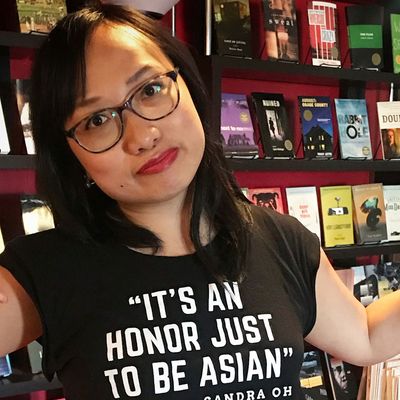
Diep Tran is the Chief Executive Editor of Playbill, an arts journalist and critic. In this-two part interview, we discuss cultural context in journalistic writing and why the framing of a subject can be problematic if the journalist lacks cultural context... Read More
From the show: You Can't Say That!
Guests
About
Diep Tran is the Chief Executive Editor of Playbill, an arts journalist and critic. In this-two part interview, we discuss cultural context in journalistic writing and why the framing of a subject can be problematic if the journalist lacks cultural context.
Connect with Tonya via her community phone number at +1 917-724-8998!
Produced by Dori Berinstein and Alan Seales, edited by Justin Payne, music by Cat Dail.
A proud member of the Broadway Podcast Network.
Transcript
This transcript was automatically generated and might contain errors.
[0:00] Tonya Pinkins: Hi, my name is Tonya Pinkins, and you are listening to You Can't SAY THAT on the Broadway Podcast Network.
[0:12] Tonya Pinkins: We gotta say one who's you can tell us real.
[0:28] Tonya Pinkins: It's been a while since I've done a podcast, but I am very excited to speak with my guests today.
[0:36] Tonya Pinkins: Uh they are an arts journalist, a critic, and newly chief executive editor of Playbill, which is the magazine of the American theater. So please welcome Diep Tran.
[0:50] Diep Tran: Hi, Tonya. Great to be here. Thank you for having me.
[0:54] Tonya Pinkins: Thank you. So Diep, I'm just a person who's always curious about ancestry. Tell me your ancestry.
[1:01] Diep Tran: Oh my goodness, that's a complicated question. Uh, because I can I can start with my grandmother who was who was married when she was 12 and had 10 kids, and that was just on one side, and my other grandmother had nine kids. So there's there's that, which I guess we don't have time for for that on the podcast. Um I guess my most immediate is my family came to America in 1990. Uh we were Vietnam War refugees because after the war, my dad was imprisoned in a communist reeducation camp for six years because he had fought during the Vietnam War with the Americans, and that was what happened to anyone who fought with the Americans on the Vietnamese side. Um, and so we came to the to America not only because of you know the promise of America that a lot of a lot of uh the immigrant literature talks about, but it was also it was also an issue of discrimination to be the children of South Vietnamese army veterans, like you were basically barred from going to college from certain jobs in society, and so we I feel very lucky to be in this position that I am in now, but I always think about like what Sherra Stra Strade said, like the ghost ship that didn't carry you, like that alternate person who what who would she have been and like what would she have had to do if she didn't have this life?
[2:54] Tonya Pinkins: Right. Where did they take your family when you when they arrived here? What state did they put them in?
[3:01] Diep Tran: Uh California. So we we had already had family here because my um my mother's side of her family, including my grandmother, they all escaped from Vietnam by boat in 1975. And so by the time we got here 15 years after that, they had already settled and you know, we got a house. And so it we were very lucky to have a support system.
[3:32] Diep Tran: But I remember um I I remember growing up, like I I never had my own room. I was always sleeping in the same bed with like my my three older sisters, and so what is privacy when you're in an immigrant family? I'm from Chicago and I grew up that way because my grandmother worked at the hospital, and a lot of Filipino and Caribbean immigrants were working at as you know at the hospital. And so my grandmother would bring them in, so we would have four and five people in bed as well. So that's also um a way that I grew up. So it was it would be always odd when I would travel with friends as I got older and they would like need to have their own room. I'd be like, why? Look at this big bed. We didn't have a king-sized bed, but I was like, okay.
[4:25] Diep Tran: Yeah, it's like it was so when I, yeah, when I was in college and sleeping in in the same dorm room with two other girls, I just thought, oh, and I'm I'm just it's just like home.
[4:35] Tonya Pinkins: Yeah, yeah, yeah. Very uh that's a very cultural thing to be comfortable sharing a room or a bed with other people, and it's not everybody's culture to do that. And some people find it even just uncomfortable to get naked in front of other people when like for other people it's like what else you're gonna do.
[4:55] Diep Tran: There's no other, there's no other place to go, you know, um, which is uh great because it's sort of what I wanted to talk to you about. My I feel like um a lot of I'm trying to be politic here. I I feel like a lot of the world history right now ends up being um with some unknown group of people at the top who managed to keep the people below them fighting with each other, you know. You know, let's you and him fight. I feel like that that happens a lot in the world.
[5:32] Diep Tran: And I want to not participate in that to my best ability when I see that happening. So I I I'm I'm gonna say that I had called you after you had interviewed me, I guess it's maybe a week or two ago, um, about an article that you had written for me uh about me in Playbill. So here's my backstory to that.
[5:57] Tonya Pinkins: Okay.
[5:59] Diep Tran: I um, because people don't know this, so I have to tell our sort of backstory. Uh, I was just in a play called A Raisin in the Sun at the public theater, and um I has signed a contract to a certain date, and uh as part of their that contract, there was an extension of a certain amount of time. And so I fully expected that I would be here till the end of the extension because that's just been my experience in almost 50 years in the theater. In pretty much anything I've ever done, the extension has been used. So it was uh an assumption that I made, but uh based on experience.
[6:40] Diep Tran: Um also one of the marketing things that it's been my experience that uh theaters do is they will only announce maybe the first week of a run, even though they contractually have to pay everybody for four weeks of a run so that as soon as you open, they can announce an extension. Um for us as actors, it isn't an extension because you've got to pay us anyway. That's the contract. You're going to, you're gonna stay open because you want to try to recoup the money that you have to pay out, but it gives ticket buyers a sense of like, oh, this must be a hot ticket. There's an extension.
[7:21] Diep Tran: So I think that that is one way in which there's there's this kind of two worlds that exist the world of the public and the world of the the people who are making the thing, like the story that they're told versus the story that we know to be true. And and certainly both of them are true in a certain sense. Both of them are true. And I'm I'm very fascinated always by the fact that, in a sense, every single human being is living in a different truthful real world that may be completely at odds with the person standing next to them's truthful real world, and that just fascinates me.
[8:04] Tonya Pinkins: And I feel like we the world would benefit if we all could realize that our world is only ours, and other people have another world that is as valid as ours.
[8:17] Diep Tran: Um our show was uh it was announced before that extension that we were gonna close. And uh I was like, oh, we must have gotten a bad review in the New York Times. And I I hadn't read any reviews because I knew we were doing a production that was going to polarize people. And so on the day that I found out that we were gonna close, I read the Times review, and I I really like and respect Jesse Green as a writer, but in reading the review, my little monkey mind just couldn't couldn't make peace with the the sort of to my mind in my world factual um discrepancies.
[9:02] Diep Tran: I was like, what wait, wait. You know, so many people have told me they dislike the play, but not for the reasons that you say they that you dislike the play. What did you see? Because I I don't even know where that could be. And so I was comp I felt compelled to write about it. And there was a piece in Playbill by Logan something. Um and I I read that that piece and I was like, okay, so you know, I'm getting thrown under the bus here.
[9:31] Diep Tran: And uh, and I was like, okay, so when I got the message about interviewing with you, I was like, okay, uh, I know what the publication is. I I was um, you know, reserved about um about doing the interview, but going the story is not going to be favorable to me. Nevertheless, I'm willing to participate, even though I'm running that risk.
[9:58] Tonya Pinkins: And so you did write a favorable um uh uh article, but I was um unhappy about the framing.
[10:08] Diep Tran: And I it my little monkey mind went round and round about that, and I, you know, did a little video about it, and then I thought, whoa, am I getting into let's you and him fight? She's a woman of color. I'm a woman of color. I don't want to just fight with a woman of color. Let me call her up and ask her why.
[10:26] Diep Tran: And and I wanted to have that conversation publicly because I feel like it is an opportunity um for the world to see how people can work things out. Uh and so that that was really why I wanted to to to speak with you. So can you tell me about like what is your mission job what do you have to do as a as a chief executive editor for Playbill?
[10:41] Diep Tran: Yeah um as editor in chief it's it's been a little bit more than a month since I've stepped into the role and I will be very frank and tell you what it wasn't a role I sought out they sought me out to do this and I was very hesitant initially to take this job because you know there's a lot of responsibility I manage a team of 11 and the articles we write everyone sees them in the theater industry and it was also very challenging for me to think about how I would marry the writer that I am as a as an individual to a to a brand because and for every and for anyone who doesn't know my work or who doesn't follow me on Twitter like I've I think my boss called me a provocateur because I speak very frankly about the issues I notice in the industry because I did not grow up doing theater.
[11:55] Diep Tran: I've never starred in a play I I come at it as a theater fan but also as someone who is very aware that people like me do are not represented but people like me do love musicals and do love storytelling and so we are a demographic who can get who can spend money on theater tickets so why are we not represented on the stages in any real authentic way outside of you know Miss Saigon.
[12:26] Diep Tran: So and so I've always been very frank about the issues around diversity the issues around pay inequity and the issues around workplace safety within the theater and I guess that's what's led me to being scouted for this job but it's for me I'm still trying to figure out like how I can take this publication which has been seen as being promotional for the theater and how can I marry that with my own advocacy tendencies.
[13:05] Tonya Pinkins: How's that going?
[13:07] Diep Tran: Well we're still working on it.
[13:09] Tonya Pinkins: Okay I would imagine that's going to be an ongoing uh process and it's gonna have its ups and downs.
[13:16] Diep Tran: I mean I would imagine you know people don't willingly change their ways so you're gonna I I you're gonna have to you're gonna have to struggle in that and to me that's I don't look at struggle as a bad thing.
[13:28] Diep Tran: I feel like so many times now I see on different social medias, you know if people don't make you feel good cut them out of your life and I'm like what if people say something bad about someone you know cut them out of your life I'm like what like everybody does bad things like at some point we all do.
[13:45] Diep Tran: Yeah and I think and I and and I think as you know a person of color coming into a position of power within the industry and just a side note I still have a lot of trouble thinking of myself in that way but I and I'm still having trouble accepting it because I don't know.
[13:45] Diep Tran: I don't know, I cannot see the effects of what it is that I'm doing. Because when you get to the into this position, everyone I I get the sense that everyone just talks about you and no one really talks to you because they think like you're untouchable or or they think they can like punch you now.
[14:28] Tonya Pinkins: I can totally see that. And why I reached out to you is because I wanted to have a conversation with you. I did not want to do those things. So I did I hear you say you don't see yourself as a person of color?
[14:39] Diep Tran: No, no, I do. I do okay. I'm as a person of color with power.
[14:44] Tonya Pinkins: Right, right, right, right, right, right. Because that's so rare to have, and there's very few models on how to wield that when you have a marginalized identity, because I think for us it's different because there are more things you have to be careful about. Oh, and I just wanted to add one more thing. And so what I wrote about you and the bar raising in the sun was me trying to figure out how I can write about these issues in Playbill without it being an incendiary headline of, you know, Tonya Pinkins writes an open letter to Jesse Green, which I will also say many of our readers were very supportive of you. And but I wanted to see if we can if we had the capacity to go deeper and if we have the capacity to ask the thorny questions about being blacklisted in the industry and what and how women are blacklisted in the industry, and about reinterpreting classics and who is quote unquote allowed to do that and about the broad relationships between critics and the people they cover. And so I thought, okay, I am three weeks into this job. Why not just try this out and see if I get in trouble for this?
[16:17] Tonya Pinkins: And did you get in trouble for it at your job?
[16:21] Diep Tran: No.
[16:22] Tonya Pinkins: And the article was received in what way for you as your first piece that you wrote?
[16:28] Diep Tran: It was received really positively. And it was received as like a piece of thoughtful journalism that judging from the Facebook comments that helped people see A Raisin in the Sun in a new way, which is what I wanted it to be.
[16:51] Tonya Pinkins: Okay, so I gotta go look at the Facebook comments now, but go ahead. Tell me more.
[16:59] Diep Tran: Yeah, and so yeah, and I think because I'm always telling my writers, you're allowed to ask people the questions, the uncomfortable questions, and they can choose whether or not to answer responsibly. With artists like you and other advocates in the field on how to really cover these subjects that people are thinking about and speaking more frankly about and how to do it fairly and how to do it in a way that isn't just going to, you know, lead to abuse being thrown at everyone from strangers on the internet, that's all the things I'm thinking about right now.
[18:01] Tonya Pinkins: Absolutely. So you mentioned framing, so for me, I didn't like the framing and I called you up to ask you about the framing. So you tell me about the framing and why you framed it that way.
[18:17] Diep Tran: Yeah, I mean writing an article for me, it's an art, not a science. And so for me when I'm writing, I'm always thinking if I was reading this as a casual fan, like what would be the thing that grabs me and keeps me reading? Because these days journalists aren't just, you know, competing with entertainment. I mean, journalists and theater artists, you know, you're not just competing with film and television, you're competing with social media and TikTok and people's very small attention spans. And so I'm trying to create an article that will have people reading from one section to the next. And so I went through the transcript and I was taking notes as we were talking and just the things that stood out to me was what I chose to include in the article.
And the things that interested me the most was what I chose to open the article with. And what that was in my mind was this notion that, you know, everyone was celebrating how you were coming back to New York theater finally. But you told me that you had essentially been blacklisted from New York theater since 2017. And so I thought, let's just get this truth out there. Not a lot of people will know that. And then we can go deeper into the play that she is starring in and why she chose to star in this play versus a standard Tonya Pinkins is doing A Raisin in the Sun and she is so happy to be back in New York. I feel like I'm not interested in false positivity.
[20:07] Tonya Pinkins: I'm with you. So would it be safe or fair to say that as a journalist, you do sort of follow that cliché that I've heard of if it bleeds, it leads?
[20:25] Diep Tran: And then not like someone is dying or, you know, being dragged, but what is the most interesting part of the story? And when I was going through the transcript, I came across the quote that you had said about what you expect in the rehearsal room. And so I thought, oh, this is so amazing, and I don't want it to be in the bottom because then it'll just get lost if no one ever gets there. And so, and I thought, okay, maybe I could tie this in with the fact that she was blacklisted. Why was she blacklisted? Because she is vocal. And this was an example of, and that quote was an example of you being vocal about what your limits are. Great. I love this. I'm so grateful to be having this conversation with you.
[21:14] Tonya Pinkins: So in general, I don't read any interviews that I do because the few times that I have, I find that like I may have spent an hour or two or three hours with someone, and what is left of that is like a sentence. Or whatever it, I'm never satisfied with the way in which I'm quoted. It doesn't ever feel like the amount of time and energy that I put into that interview. So that's just a kind of experience I have. I go, you've done the interview, it's now out of your hands, and you let it be, you let yourself be perceived in the world any way you're going to be perceived. This is part of the job description, and you know who you are, and those people closest to you know who you are, and you know, let people who read things build up whatever they want of you.
That's my normal way that I do things. I think because I had just written this essay and because of the previous Playbill article, and that I, you know, sort of was a little, what is the word, a little tense about going into the interview with you. I was like, no, actually it wasn't that. People kept writing me and going, great piece in Playbill. Congratulations on the great piece in Playbill. And I was like, well, let me go read the great piece in Playbill. And from the minute it opened up, I was like, what? What? And so for people who don't know, it opens with, it says something like, I don't remember it specifically. You'll have to read it to find out. The Tanya Pinkins doesn't stay in rooms where there's bullshit going on.
And I was just, I was like, horrified. Did I say that? I don't, I don't, I don't use that word. When do I, would I use that word? And so my monkey mind was just like, I was just horrified. So for me, I had to force myself to get through the whole article. And I was like, it's a really nice article. She's very kind to me. But that beginning, that beginning for me, I felt like that makes me sound like an inarticulate N-word. That was the feeling for me. And so what I'm gonna say is that as a black woman, oftentimes I'm in rooms and it feels like the people in there are trying to get a rise out of me. They want me to start telling them off or saying something like cursing them. And it has been my mission and principle to never ever let any of them hear me raise my voice or be reduced to swear words because I feel that to do so vindicates them in their ability to dismiss me and go, oh, you see, I knew she was that.
So I was carrying with it a whole historical story about how I feel I am perceived, or that's just black people are perceived, and that there's always looking for what excuse can I use to dismiss this person? So that's what I was bringing to it. And then as I sat with it, and you know, like you know, had to work it all out with my feeling, I was like, but you know what? Deep's from a different culture for me. It could be that in her mind or the way she looks at the world, that just made me sound really cool and badass. And she thought that's gonna bring people in. And I thought, so let me not assume the worst about her, and let me reach out to her and find out so that I can understand. And that's how we got to this conversation.
[25:13] Diep Tran: Oh, can I ask you something though?
[25:15] Tonya Pinkins: Sure.
[25:16] Diep Tran: So the initial news article that Playbill ran about your Medium post, like why did you feel it was throwing you under the bus?
[25:26] Tonya Pinkins: Um, there was a quality of this sort of innuendo. Oh, well, she alleges that this was that, and she thinks that she knows what Lorraine Hansberry is saying, and I was like, okay. That was why. I'm, you know, I know that, you know, for someone who went to law school, you're never supposed to infer, but I do infer all the time. So like one of my lobbyist friends says, whenever I see anything in print, I always go, who placed this and what is their point? And so I think the inferences I was making is that Playbill is the bastion of American theater. It is there to uphold American theater to audiences all across the world. And that in my attacking a critic, especially a black woman attacking a critic, I had violated the hierarchy.
Like, if I could violate a critic and get away with it, then anyone could violate a critic and get away with it. And what would that mean for the world if critics didn't hold the power to say what shows lived and died? Well, then it would definitely not be a capitalistic system, which would be helpful.
[26:44] Diep Tran: Right.
[26:45] Tonya Pinkins: Right. Right. Right. So I'm looking at it from capitalism's point of view. We cannot have artists destroying the people that we have said, you know, set the trends and the tastes. We can't not allow that, and we must nip that in the bud. So that was the point of view that I was bringing to reading it.
[27:05] Diep Tran: And got it, got it. Because I had also read the article before it had gone live, and we had me and Logan Cola Block, my writer, my edit, my news editor. We were discussing how we're going to frame this, and we had just settled on, you know, concentrating on what it is that you wrote and not trying to put our own interpretation of what you wrote onto it. And I'm sure the word alleges means it seems like you're making it up. But I do not know a better word for she said something and we cannot verify that what she said is true. But we cannot tell you it is true because that would be irresponsible journalistically.
[27:57] Tonya Pinkins: Right, right.
[27:58] Tonya Pinkins: Hi, this is Tonya Pinkins, and you're listening to You Can't SAY THAT on the Broadway Podcast Network. That was part one of my conversation with Chief Executive Editor of Playbill, Diep Tran. Return shortly for part two of our conversation about cultural context and the way artists and journalists perceive and project each other into the world. Thanks for listening to You Can't SAY THAT, the show where we can. I'm Tonya Pinkins, and You Can't SAY THAT is part of the Broadway Podcast Network, produced by Dori Berinstein and Alan Seales. With music by Cat Dail. If you like what you hear, don't forget to subscribe and rate this podcast highly wherever you stream.
© Broadway Podcast Network, All Rights Reserved