

In this episode, we are live from the Museum of Broadway at the Broadway Podcast Network POD FEST. This conversation features Anna K Jacobs (Teeth), and Kait Kerrigan & Nathan Tysen (The Great Gatsby) in a discussion about writing for the stage... Read More
From the show: Half Hour with Jeff & Richie (Post-Show Broadway Discussions and Interviews)
Guests
Featured Shows
About
In this episode, we are live from the Museum of Broadway at the Broadway Podcast Network POD FEST. This conversation features Anna K Jacobs (Teeth), and Kait Kerrigan & Nathan Tysen (The Great Gatsby) in a discussion about writing for the stage.
Follow and connect with all things @HalfHourPodcast on Instagram, and YouTube.
Transcript
This transcript was automatically generated and might contain errors.
[0:00] Jeff Malone: Welcome to Half Hour with Jeff and Richie, the podcast where we explore the latest shows we see, sharing our insights and opinions on the performances, storylines, and everything in between. In today's episode, we are live at the Museum of Broadway for the Broadway Podcast Network Podfest Day. Today, we're having a conversation on how to write for the stage with three accomplished Broadway and Off-Broadway writers. So please welcome to the conversation, Anna K Jacobs, Kait Kerrigan, and Nathan Tysen. Welcome along, Nathan. And just to let everyone know, Anna K Jacobs, in collaboration with Michael R. Jackson, has written the book, A Music to Teeth, playing Off-Broadway at Playwrights Horizons, and is based on the 2007 American comedy horror film written and directed by Mitchell Lichtenstein.
And Kait Kerrigan has written the book, and Nathan Tysen has written the lyrics to the new musical, The Great Gatsby, playing at the Broadway Theatre in collaboration with music writer Jason Howland. It is based on the 1925 novel by F. Scott Fitzgerald, as many of us already know. So welcome, everyone. To kick things off, could you all share a little bit about your origin story and how you got started in the theatre industry?
[1:16] Kait Kerrigan: I started out writing fiction, and as I was growing up, I was a violinist, and I did a lot of theatre. And when I was in college, I started directing a little bit. And then I reconnected with a friend of mine, Bree Loudermilk, who was writing musicals, and suggested that I try to write a musical with her. And I was 20, and when you're 20, you try things. And one of the things I tried was musical theatre writing, and it really stuck. And I loved all the collaboration in it. I loved working with other people from the beginning of the process. I loved working with actors. It's being able to write lyrics. I wrote lyrics and book, being able to go back and forth between those two things. Writing lyrics was really similar.
It connected to what I knew about music, and the way you bow is very much the way you breathe. There was something about all of it that felt like I'd been training for it my whole life without knowing that that's what I was doing. And once I had that first moment of an audience watching the thing I made, I was done for. And that led me, ever since then, to here.
[2:37] Nathan Tysen: I got bit by the performance bug pretty early because my father is a minister, and he treated our family a bit like the Von Trapps. He would take us to church and make us perform, and my dad would play guitar and my mom would play ukulele, and we'd do four-part harmony. People would clap, and they'd be like, “Oh, I like that feeling.” I grew up in a very small town in Kansas where there are not a lot of opportunities for theatre, but when there were, it was about performance. But it wasn't until I was 16 that I went to a theatre camp. They would hate that I call it a camp. It's called Lovewell Institute for the Creative Arts, and it's a three-week program. It still happens. They take 30 kids from all over the U.S., and in three weeks, you have to write and then perform a full-length musical.
So I went to it thinking, “Oh, I'm going to be the star of this show.” Then by the time we got to week two and we'd just been writing, I realized I didn't have a role, but I'd written a bunch of songs and ended up writing the finale of the show. Standing on stage with my peers, hearing them sing something was the most rewarding feeling I've ever felt. I feel like I've been chasing that since I was 16, and that's where I started writing and I've been writing ever since.
[3:50] Anna K Jacobs: I'm not American. I'm from Sydney, Australia. Growing up, I'm very extroverted, so I loved people and I loved music and I loved plays, but I didn't fully understand that those things could be synthesized into a career writing musicals. So I pursued a path as a classical composer, and I was writing lots of choral music and art songs. Eventually, I came over to the United States and started a master's in classical music at Indiana University, and I was working with the opera singers there. One of them was like, “Anna, clearly you want to be writing musicals.” I was like, “Clearly I do want to do that, but that's not a thing people do.” They were like, “No, it is. Also, I have this friend who goes to graduate school for writing musicals at NYU, which is where Nathan also went, and you should talk to them.”
So I talked to this friend and they told me about the program. I remember when they sent me the application package, and it was like, “Set this Edna St. Vincent Millay poem to music and choose a scene from your favorite play and write a song from that.” I was like, “This is so fun. This is what I've always wanted to do. I can't believe this is an application into graduate school.” So I ended up at that program, and I discovered right there and then that this was absolutely what I wanted to be doing. I wrote a musical for my thesis project called “Pop,” which was about Andy Warhol and the shooting of Warhol in the 60s, which got produced the year after I exited school at Yale Repertory Theater. Had that not happened, I may have just gotten back on an airplane and returned to Sydney, but that set me on the path that I'm on now.
[5:46] Jeff Malone: I love that. That's awesome. I love hearing the stories of the people and how they got to where they are today. I want to dive into my first question here. Just so you all know, we're talking about “Teeth” and “The Great Gatsby.” I don't know if there's two more opposite shows we could be talking about on the same panel. Let's talk about the mash-up. Let's write the mash-up. I want to go over to Kait here with my first question. You're talking about “The Great Gatsby,” this renowned work, this book that we haven't seen a commercial musical telling of this, for whatever reason. Now we're here and we have this first incarnation of it. My question for you is, how do you balance honoring the source material, but also what the fans expect of the book?
We just saw it last week, but from your perspective, are they getting the book through and through? Are they getting your own interpretation of a 2024 lens? Is it a hybrid of that? How do you take this epic book and make it for the present day, almost about 100 years later?
[6:47] Kait Kerrigan: The book has actually been put on stage. There was a production at the Public Theater called “Gats,” and the elevator repair service company did it. It was amazing. It was also eight hours. It takes about eight hours to put the book on stage. It's cool, but it's only for the select few people who would like to spend eight hours watching people tell you the story of the great Gatsby. I am one of those people. We knew from the beginning that we could never do everything. We knew that we wanted to make something that's accessible and that brings you to the great Gatsby, rather than definitely does everything by the letter. The way that we're adapting this is we're trying to deepen the characters and use the fact that we're in a musical to allow the characters to be more flesh and blood than they are in the book.
In the book, everything is told from the perspective of this character, Nick, who is important in our story, but he's not the only person that you're getting the perspective from. The fact that you're in these songs means that you have to dive into the inner psyche of these other characters. We took that as an opportunity to go into the female characters who Fitzgerald didn't spend as much time on. We're also diving into Gatsby as a human being, rather than Gatsby as a symbol. You have Nick's perspective and we're trying to make sure that we deliver on the things that people love about the book. I've had so many conversations where someone says, is this line in the book? Is that line in the book?
Try to make sure that you're delivering on those things that everybody loves, but then at the same time, trying to give them something that is next to the book, that's in conversation with the book, so that then you can go back to the novel and read that and see how those things are the same and how they're different. I think adaptation, you can probably speak to this too, you can't just try to do the thing. You have to deal with the medium that you're in.
[8:49] Kait Kerrigan: Do you have a favorite character that did develop more?
[8:53] Nathan Tysen: I mean, I think that the character who is the least developed in the book, and actually Fitzgerald admits to this, he thought that the reason that the book was not more successful in his lifetime, because it was not successful until after World War II, he thinks that the reason was because the character of Daisy was underdeveloped. I happen to agree. It was really exciting to go back into that character. She's got some of these really iconic lines and these really important statements in the book, but I found them to be a little confusing, but I wanted to make them make sense to me. We spent a lot of time trying to make something out of the iconic moments and lines that Daisy has and sort of weave those together and then create this sort of deeper psychological portrait of who she was, so that rather than seeing her as a bit of a villain, you come to understand where she came from.
You don't have to like her. There's a lot of unlikable characters in The Great Gatsby, but I hope that by the time you watch this musical, you come to understand where they're all coming from and that there's something about them that pulls you in. Definitely can feel the life given to Daisy.
[10:07] Jeff Malone: Now, Anna, what about this piece, Teeth, captured your interest to make a musical out of Teeth?
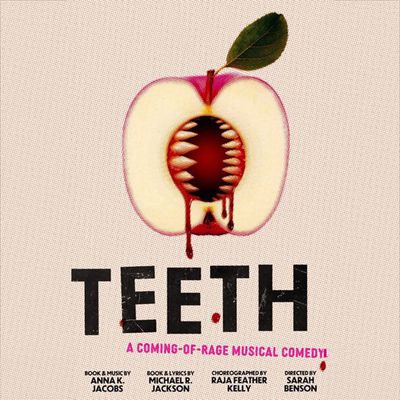
[10:17] Anna K Jacobs: Does a singing vagina not scream musical to you? It does to me! Yes, my collaborator on this piece is the brilliant Michael R. Jackson, and truth be told, it was Michael's idea initially. Michael had found this musical and I think the way that it intersected a lot of his own interests like horror and comedy and also the experience of growing up in a religious environment made him want to turn it into a musical and he really wanted to work on it with a collaborator, so he brought it to me. Michael and I had been friends for a while and I think we were both mutual admirers of each other's work. The first time I watched it, I was like, I'm not sure how to make this a musical, but I really wanted to work with Michael and I could see the version of the show that he had in his head and I was excited about that.
The more we worked on it, the more the adaptation presented itself to us. Before we went into production at Playwrights Horizons, we were working on it for 15 years, so it's been a long time in the making.
[11:30] Jeff Malone: Pretty amazing. It's also fascinating because, Nathan, I know you've worked on some other commercial projects as well with some other big titles, and I always find that there's so many movies and books being adapted for the Broadway stage. I always wonder from your perspective, is there a pressure of the audience expecting this, or the producer is expecting this, or the original fans of the book or music? From a commercial theater perspective, how is it writing when you say, I want to do all this, but are people saying, let's make it this, let's make it that? When it comes to the final product, how much of that are you feeling restricted by because of these commercial titles?
[12:05] Nathan Tysen: I think if you look at it as a restriction, I think you just won't write anything. I think the double-edged sword of doing a Gatsby or doing a Tuck Everlasting is there is a title, people love it, which means they might buy some tickets, but it means they also have opinions. I think what you need to do is you have to lean in on that.
[12:57] Nathan Tysen: Did we miss something? Was there something that you really wanted to see? In one of our big conversations, you can't do the Great Gatsby, at least we haven't been able to figure it out without cars. And cars on stage are rough, y'all, really rough. And also, it's the Great Gatsby. So in my mind, I don't want to do the Our Town version of Great Gatsby with a couple of ladders. You want to see the party on stage. And it's funny, we just kept kicking that can down the road as we were doing developmental steps of Gatsby, the can being the car. And finally, we found a car. And it does magical things. And it also was critical to the story that you need to tell, because people drive that car and things happen in that car, not to give anything away. Are they actually driving the car?
[13:42] Kait Kerrigan: They are actually driving the car.
[13:44] Nathan Tysen: I was going to say, it's pretty cool choreography on that stage, because there is a lot of movement. I'm like, oh, I hope they don't. Wow. That was a lot of tech. Learning to drive the car, making sure the car could make the turns, all the cars. Everything about the cars took a longer time than you think it's going to have to. But we got there.
[14:08] Nathan Tysen: We'll be right back.
[14:12] Kait Kerrigan: Welcome back. And now, Kate, what are some of the other bigger challenges you face when adapting existing works to the stage like Gatsby? And how do you overcome them while staying true to the original material?
[14:25] Kait Kerrigan: Yeah, I think in a lot of ways, you're trying to be true to the spirit of the material. You're trying to match the tone of the material and relate. Something like the Great Gatsby, there's so much of it that's about language. And there's so much of it that's about symbols. And I think that's one of the reasons it was so challenging to adapt into a film, which is very naturalistic. I think there's something more emotional and heightened about being in a musical that actually does relate more closely to what the text of that novel is. You're not in reality. You're always in this more heightened state. And so I think that that allows you to play in a way with the tone of the novel. We did everything we could to use text from the novel wherever we could.
But there's tons of things that were turned into dialogue that were little bits of more poetic language. And we shifted them slightly just to make them feel more like they could come out of someone's mouth. But that's one of the things we did. And then the other thing is just trying to take those moments that feel like they work in a musical. Anytime you're adapting, you have to think about what your genre does well and really play to what your genre does. And I think that that's one of the keys. You're not going to make the same thing. And you don't want to. I don't want to replace the Great Gatsby the novel. The greatest compliment is when someone comes in and they say, well, now I have to go back and read the novel or I haven't read the novel since high school and I can't wait to go back and read it.
So I think that you're always trying to honor the book enough that they want to go back and read it. And then when they go back and read it, it will be a rewarding and related experience, I think. And since you both collaborated on this, writing the book and the lyrics, how did you decide what was going to be book versus no, I want to write a song about that?
[16:28] Nathan Tysen: Oh, that's a great question. It always starts with just a lot of conversations. And of course, Jason Howland was part of that as well. When we first were commissioned to write the show, you know, it was a full week of just talking about the piece and trying, as I said, you know, finding like low hanging fruit. Beautiful Little Fool. What an amazing title. We should probably try and turn that into a song if we can. And then, of course, talking about like, where are the specific moments that feel active where a character starts one place, you know, this is textbook musical theater writing, but starts in one place, makes some sort of decision, feels different by the end of it. And, you know, after our first week, we had kind of a basic outline of and like some rough song titles of what could possibly be, you know, a first draft of a score.
And, you know, as a lyricist, like, and being able to work with fantastic playwrights, you know, one of my favorite things is would you just writing a little monologue about maybe how Daisy feels in this moment. And then I read the monologue and take all the good stuff and capitalize it in the script and make it rhyme. You know, that's it's kind of great. And playwrights, especially because Kate is also an amazing lyricist as well, kind of understand that that's it is kind of part of their part of their job. And but because Kate also writes lyrics, I'm very proud of the way that song and scene weave together. It never feels clunky as we're going in and out of songs. And usually that is a big conversation that I have to have with playwrights kind of asking for a stronger setup once we've found a song that really works.
[18:06] Anna K Jacobs: And in terms of adapting a movie with like with Teeth, I always find, you know, it's funny, because whenever I read a news article, it'll say, blank, blank is becoming a musical. I go watch the movie. I say, I wonder where could a song go there? Could I actually kind of like to do that's like my like, he knows like my hobby. I'll sit down with there's going to be a song there, because that's hello. Right. So for Teeth, which I mean, maybe the last thing most people are thinking is like, wow, this is going to be a musical live on stage with this epic film, right? What is your process with fleshing out some of these characters in these scenes and saying, with a film like this, like, oh, there's needs to go a song, a song needs to go there. There's needs to be some dancing here. This is a ballad or this is an uptempo. What's the process, especially for a movie like Teeth?
[19:48] Anna K Jacobs: It looks a lot the same as Kate and Nathan's process. Michael and I would do a lot of sitting down and talking about moments. I think our show leans very heavily into different musical genres. And so often, we get the sense that we knew of a moment that needed to be written if we had an impulse to bring a certain type of musical genre to it. The other thing about our show is that, and this is how it's similar to the movie as well, is that in its bones, it's like a superhero story. And so one of the things we needed to do without adaptation was like track that journey and using song moments to sort of highlight the different turning points for our protagonist Dawn was a big thing. And then amplifying all the characters around her through music.
So in our show, we have these principal characters of her stepbrother Brad, her boyfriend Toby, Ryan, her best friend, and then there's Steven Pasquale's character. He doubles as the pastor and Dr. Godfrey, the creepy gynecologist. But one thing that we did different than the movie was we also created a sort of a Greek chorus of what's called promise keeper girls. They're friends of Dawn's who are in a purity group with her at her church. And that was really instrumental to understanding musical moments as well, because anytime we wanted to sort of bring them out, like Kate said, what makes it possible to use music in a musical is heightenedness. And so anytime we had an impulse to bring them out onto stage, we're like, oh, it's probably going to be a song number there.
[20:35] Nathan Tysen: Just a side question kind of for all three of you. We were in the green room earlier talking about when a show is frozen, they freeze the show before opening night. In your processes on these shows, how many songs or scenes wound up on the cutting room floor from maybe two months ago, three months ago, four months ago, to all the way up to right before being frozen? Do you find that no, everything stays? Or do you find like, no, actually, there's five songs sitting there that didn't make it in? And when in the process are you finding that things are getting cut? Are they up to the very last minute before you've? I mean, maybe different answers for different shows. I mean, I can tell you exactly how many songs have been cut from Teeth because I counted. Thirty-four.
[21:10] Anna K Jacobs: Oh, my God. Wow. So we have multiple musicals worth of songs. But that was a 15-year process. And sometimes when you're writing fast, you don't cut so many songs. And I think that going into our production of Playwrights Horizons, we actually had all of our like, we changed songs, we didn't make any cuts, but we did write. We know that's a lot. We cut out finale. I think I like purposely blanked out on that. We had a completely different ending, like a whole scene and this big finale with this song called I Want to Choose. And it was in the show through previews, like for like a week or so. And then we're like, this doesn't feel right. We tried pulling the song and keeping the ending. That didn't feel right either.
And so I grabbed Michael after one preview. I was like, we got to figure this out. We went across the road to the West Bank and we like sat at the bar and we like tried to brainstorm how we could turn the penultimate song in the show into a finale. And we like pretty much figured it out right there at the bar. Wow. And it was in the show the next night. Wow. See, there we go.
[22:27] Nathan Tysen: And Gatsby, maybe a shorter process.
[22:27] Kait Kerrigan: Well, we got Paper Mill. Well, we did a lot of changes between Paper Mill and Broadway. We had, we finished, we closed Paper Mill in November and we found out that we were going to Broadway in early December. And I think we had our first meeting in preparation for Broadway, like with the possibility that maybe it would happen like November 20th, like it was like right after we closed. And then, and we rewrote basically the entire first 20 minutes of the show. And we also wrote, rewrote a huge, we rewrote a big production number in the second act. We actually moved a bunch of things around. And then when we were in rehearsal, restored most of them, but also kept all the changes. And then, and then we made a bunch of changes.
The majority of the changes that we made during the preview process were about just tightening. And it wasn't, we did, we cut one big scene and moved a couple things around. But for the most part, we, it was all about just like, what can we tighten? How can we handle the last 15 minutes of the show? There's always that last 15 minutes where you have to, you have to keep trying to make it as tight as possible because you have this feeling with the, like the horse is heading to the barn. You have this sense of like, okay, we're, everyone knows you're wrapping up. And so you can feel people getting a little jittery if you aren't going to the finale quickly enough and getting to the point. So, and I definitely feel that when I'm in the audience for other people's shows. So we've made a lot of little tiny trims and just little emotional adjustments and rewrote the finale a little bit.
[24:04] Nathan Tysen: Yeah. I would say, you know, usually rule of thumb, like you write about double the amount of songs for a show. But you learn that that is part of the process and it's very hard for young writers to understand that writing is rewriting. But once, once you can embrace that, it's kind of beautiful because I find that it's, it loosens you up on your first draft because you know, you're going to have to rewrite it. So you might as well just put something on the page so that you can hear it and learn from your other amazing collaborators and make it better.
[24:30] Kait Kerrigan: Yeah. And it's, it's so much worse trying to make a song that's wrong for a spot work than like doing a rough pass at the right song. So much easier.
[24:44] Nathan Tysen: Yeah, absolutely. And now with Gatsby being over 100 years old, how do you feel like you're bringing current social and current cultural issues into the writing?
[24:55] Kait Kerrigan: Just one funny story, as we got this gig during the pandemic, we started doing a lot of research and started finding these photographs of people outside in different random lines for things in New York all wearing masks, except back in the 20s, they would cut a little hole in their masks so they could still smoke their cigarettes. We don't have that in the show. We were saying in 100 years, what is our flapper dress that people are going to be looking at?
[26:50] Nathan Tysen: And getting ready to conclude here a little bit, but I kind of want to just ask this over. I'm always about musical theater history before what's happening now. What I hear from so many people today is, oh, everything's an adaptation of movie to stage or book to stage. And there's a lot that's now a Broadway musical. And we hear a lot of that. We also hear of really original works as well. I feel like right now on Broadway, there's this wonderful mix. You're seeing a little bit of both. Do you three like to also work on original concept ideas too? Do you see the future of Broadway being a mix of both as we move forward? Because I feel like we're in this very, some people will say, oh, this is a tourist trap show, or this is too small for Broadway, it should be downtown.
I always hear that, like, where should this show be? When you look at the future of Broadway moving forward as writers, do you see this continued mix of hybrid of like movies, adaptations, book adaptations, and original works?
[27:50] Anna K Jacobs: It's much easier to get something adapted and to get the job to adapt a show than it is to convince a producer to work on your original show. And so occasionally you have the incredible opportunity to work on an original piece and have it become a commercial production. But those are much less likely to happen just because of the way the pipeline of things works. But there's always going to be a combination of those things. There's always going to be incredible original ideas. You have something like A Strange Loop that happens and that sort of comes out of someone's brain. But that took, that has to take a very circuitous route to getting to Broadway. And then it takes a lot of, it takes a daring producer to take that to Broadway.
And those people exist and they do it and it's incredible. And it's so thrilling for people who do write original musicals. All of us have written original musicals. But it is much easier to get to Broadway with a producer who says, I want to adapt this book, help me do this.
[29:00] Kait Kerrigan: Because you're able to have a schedule that is, I love nothing more than a deadline. It is my favorite thing in the world is to be like, okay, what's the literal next date we can meet and let's do a reading then? What's the next date we can meet after that and do another reading? I love writing quickly. I think that you can get a lot done that way. You can keep the energy on a project. I also have many shows that have taken 15 plus years and that's, they're the thing that you, they're your mission and they're the thing that you love, but they're harder to make other people get on board with. It doesn't mean that they're not as good or not as worthwhile or not even as commercial. Sometimes they're incredibly commercial, but it's just harder to bring other people to you than to join a project.
[30:38] Nathan Tysen: Yeah, I would maybe add and say, for me, musical theater writing versus working in other forms of storytelling has so much to do with the how versus the what, because there are so many elements working together at the same time. So for me, musicals are so much about like dimension and depth and there's only so much story you can also like cram into a musical because you have music. And so I, as an audience member, I am equally compelled by adaptations and original concepts. And even when I'm working on original concepts with playwrights, we do tend to look to historical events or case studies or existing stories that may not give us the outline for our musical, but can still guide the storytelling. I feel like it's rare that an original concept comes from absolutely nowhere. I mean, The Strange Loop, which is such a great example, was partly inspired by Michael's life. That is the source material.
[31:48] Anna K Jacobs: I always find, I always remind people like, you know, when you look at Roger Hammerstein, you look at Steven Sondheim, a lot of that is based on books that existed, stories that exist of real people, Gypsy, like these real people, Funny Girl, these were real people. So I think it's always, you know, it's not like a real person. Not all, but a little orphan Annie in the comics, right? I mean, you know, like it's all based on something. But part of that too, is that because it's a collaborative medium, for the most part, and Michael R. Jackson is one of the exceptions, but a lot of times you're starting, you want to be able to bring your composer and your lyricist and your book writer onto an idea to begin with.
And so it's easier to do that to be say, like, read this book or watch this movie. I have an idea based on this thing, then to give somebody an outline and try to have that be the thing that is what you're starting from. So even then, you kind of, if you're the book writer, maybe you would like write the version of the book and be like, here, let's now basically adapt to this thing. You're kind of always adapting, because you're trying to communicate from the very jump, unless it's one person writing it.
[32:55] Nathan Tysen: And what advice would you give to young writers, people who are really in college or coming out of school and trying to get their show produced regionally, maybe on Broadway, off Broadway? What's the best advice you would give to a young writer today?
[33:03] Kait Kerrigan: Do not adapt a movie or a book unless you have the rights. It's going to break your heart.
[33:12] Nathan Tysen: Did you tell me that?
[33:14] Kait Kerrigan: No, no. So you have to make sure you have those rights before you.
[33:18] Anna K Jacobs: Oh my gosh, yeah. Or go into the public domain. There is 1925 or before. You can do whatever you want. You can do something crazy with it. You don't even have to follow any of it, but you can use it as a jumping off point if you're adapting something.
[33:31] Nathan Tysen: And I think the other thing is, especially if you're younger, if you're in college or if you're in high school, use the resources at your disposal. They have to give you space. They have to let you be. It's an educational thing. The law says if you're in high school, they have to let you have the space that you need to do the educational thing that you need to do. And so you can make the argument that the space that you need, you need their auditorium or you need their class, their chorus room to do a show because it's educational. But having access to space and people who are willing to work with you and free at that time is so valuable because the thing you need to do is you need to get it on its feet and put it in front of an audience and then you'll learn and then make another thing.
Then just keep iterating and keep trying because you learn so much from that experience rather than like being in your room alone. And I mean, that's great for being a novelist, but if you're trying to make a musical, it's about the audience. It's about the connection between all those people and learning how to collaborate.
[34:38] Kait Kerrigan: Yeah, I think I have two pieces of advice. One is that like networking is not a dirty word. And what networking is that at its root is being curious in other people and curious in their artistry and their humanity and like wanting to get to know them better. And nothing beats meeting a person face to face. But if it can't be face to face, do Zoom. Don't just text them. And like so I think so many of the most fruitful experiences I have have grown out of those sorts of encounters of like just falling in love with somebody's work and wanting to get to know them better. And then my other advice is if you're younger, like use that time to be explorative, like you can worry about like getting commissions and making money later, but like figure out like for composers, for example, play around with technology, if that takes your interest, play around with instruments you don't actually play, if that takes your interest.
But part of the reason Teeth came to be was because Michael and I were in our 20s and we're like, let's do something like really, really crazy. We'll get the rights first, but then let's just do it. And I think that's why we wrote something that's quite boundary pushing because I couldn't have done it now with my two children.
[35:52] Nathan Tysen: Amazing. Do any of you have any upcoming projects?
[35:56] Anna K Jacobs: Yeah, if you're allowed to speak in public. Anything upcoming?
[36:01] Kait Kerrigan: Teeth 2.
[36:04] Nathan Tysen: We're here to announce.
[36:07] Anna K Jacobs: Wow. Get ready. Or the Gatsby hybrid Teeth.
[36:14] Kait Kerrigan: Which cars? Well, cars on stage, we'll take a little bit. Teeth, Gatsby. I am writing the book for a stage adaptation of Moana that's going up on Disney Cruise Lines.
[36:23] Nathan Tysen: Amazing. Yes, that's wonderful.
[36:25] Anna K Jacobs: I'm really excited about it.
[36:27] Kait Kerrigan: Oh, I love that.
[36:28] Nathan Tysen: Do you get a cruise with that?
[36:29] Anna K Jacobs: Yes, I do.
[36:30] Kait Kerrigan: That's wonderful. Amazing.
[36:32] Nathan Tysen: That's so magical.
[36:33] Anna K Jacobs: The whole family will go.
[36:34] Kait Kerrigan: I love that.
[36:36] Nathan Tysen: Okay, good.
[36:37] Anna K Jacobs: And I'm writing a musical with the wonderful playwright Anna Ziegler called A House Without Windows. We're working with a commercial producer on that. We're really excited.
[36:47] Kait Kerrigan: Amazing. Good. And?
[36:50] Nathan Tysen: I have two new shows with my dear, dear collaborator, Chris Miller, who I met at NYU. We wrote two shows inside the pandemic. One is called Revival, which is based on a short story by Willa Cather. And then we also did a musical adaptation of Claudia Shearer's one-woman show, Blown Sideways Through Life. And that's been really exciting. And we worked with Claudia on Tuck Everlasting. So it was really fun to get the band back together on that.
[37:15] Kait Kerrigan: Love that.
[37:16] Nathan Tysen: I'm doing a summer workshop that is not yet announced. I have a new musical called The Heart. It's based on this beautiful French novel, and it takes place in a hospital in the 24 hours after a young man is in a car crash and his organs need to be donated. And it's this like 90-minute, fast-paced, crazy, beautiful story with Ian Eisendrath, who was the music supervisor on Come From Away, and his wife, Anne Eisendrath, directed by Chris Ashley.
[37:16] Nathan Tysen: Thank you.
[37:17] Kait Kerrigan: Yay.
[37:17] Anna K Jacobs: Thank you.
[37:17] Nathan Tysen: Thank you all so much. Thank you.
[37:48] Kait Kerrigan: Wow. You all heard it here first on the VPN.
[37:52] Nathan Tysen: But not where.
[37:53] Kait Kerrigan: Well, this wraps up our discussion today. We can't thank you all so much for being here. We thank you all and the Museum of Broadway, BPN, for hosting us here on this wonderful day. You could follow us on at half-hour podcast on Instagram and on TikTok and find out more. Go to BPN. There's so many amazing podcasts on the Broadway Podcast Network website. Check it out. Hopefully, we'll be chatting with you all again about your next projects soon to come.
© Broadway Podcast Network, All Rights Reserved