

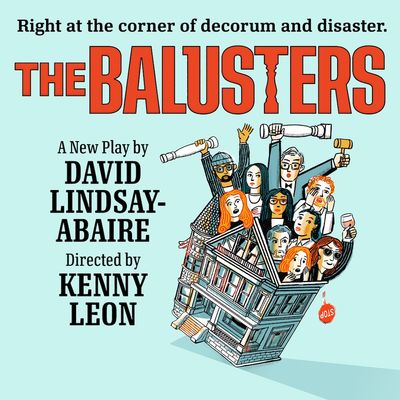
In this episode of Half Hour, we discuss the Broadway production of The Balusters, now playing at the Samuel J. Friedman Theatre. Written by David Lindsay-Abaire and directed by Kenny Leon, the play centers on a neighborhood association navigating questions of safety, preservation, and community identity... Read More
From the show: Half Hour with Jeff & Richie (Post-Show Broadway Discussions and Interviews)
Featured Shows
About
In this episode of Half Hour, we discuss the Broadway production of The Balusters, now playing at the Samuel J. Friedman Theatre. Written by David Lindsay-Abaire and directed by Kenny Leon, the play centers on a neighborhood association navigating questions of safety, preservation, and community identity. We take a deeper dive into the play’s structure, themes, and staging, breaking down how a seemingly local conflict reflects broader cultural tensions. We also discuss how the ensemble shapes the shifting dynamics within the story. From the symbolism of the balusters themselves to the play’s commentary on change and control, we unpack what’s working, what stands out, and how the production lands with a Broadway audience.
Follow and connect with all things @HalfHourPodcast on Instagram, TikTok, and YouTube. Share your thoughts on this production in the comments on Spotify, and let us know what you would like us to cover next. If you enjoy these post-show discussions, follow Half Hour and leave a rating and review so more theater lovers can find the podcast.
Transcript
This transcript was automatically generated and might contain errors.
[0:00] Jeff Malone: Welcome to Half Hour with Jeff & Richie, the podcast where we explore the latest shows we see, sharing our insights and opinions on the performances, storylines, and everything in between. In today's episode, we're discussing the 2026 Broadway production of The Balusters, playing at the Samuel J. Friedman Theatre. Whether you cannot catch the show in person, or you want to expand your thoughts after seeing it, this episode is for you. And as always, we want to inform you that this episode will contain spoilers. So if you're ready to dive into this production, stick around with us. I'm Jeff.
[0:28] Richie Grasso: And I'm Richie, and we're thrilled to be your hosts for this episode. But before we start the conversation about The Balusters, here are a few words from our advertisers. Welcome, everyone, to a new episode of Half Hour with Jeff & Richie. Today, we're discussing The Balusters.
[0:39] Jeff Malone: The Vernon Point Neighborhood Association is a passionate bunch, whether squabbling over historically inaccurate port railings or debating trash can protocol. Still, no one is prepared for the neighbor-versus-neighbor battle royale that ensues when a newcomer to the board suggests the unthinkable, installing a stop sign on the corner of the Enclave's prettiest block. Written by Pulitzer Prize and Tony winner Manhattan Theatre Club veteran and master of antics David Lindsay-Abaire, and directed by Tony winner Kenny Leon, The Balusters is a raucous wild ride through a small community with big feelings. All right, let's get into the overall thoughts on the plot and concept of The Balusters.
[1:16] Richie Grasso: So I find it interesting, you know, when I look at David Lindsay-Abaire, Rabbit Hole comes to mind as one of his big shows. He's also written the books and scripts for Kimberly Akimbo and Shrek the Musical, and he's worked on a lot of cool things in his career. But I feel like between Rabbit Hole being about suburban family life and now coming to this, it kind of feels like the first thing I would ask David Lindsay-Abaire is like, are you writing what you know? Because it seems like you do. Because I would love to know, does he live in these suburban areas? Does he understand that world? Because this really felt like he was writing about something he knew, which we always hear about when writers struggle with, and the biggest advice, right?
We learned that from the Jonathan Larson film about his life, and he was told, write what you know. And this is an example of what a niche thing, right? A community, an HOA, a board of people making decisions for a small community, and the impacts of that. And there's probably hundreds and hundreds of HOA boards all across America, probably thousands of people making decisions for condos and co-ops and neighborhoods and towns and communities, making decisions. And everyone has an opinion about those decisions. And I found that this was just something that was a rope that unraveled and unraveled and unraveled as the play went on. You had so many different characters all coming together, and it kind of creates this perfect pressure cooker of a show, where when you're writing a show, and I always wonder, well, what's the conflict you have to come up with, right?
It's like, well, why don't we put all these different people with different backgrounds and experience in a room together and present them with tasks and problems? Go. And that's all you needed, because it then organically flowed through this conversation, through extremely funny moments, through extremely sad moments. It just took you on this journey and you didn't need to overthink it. You let the dialogue run its course and you followed it. And I thought that was really, really impressive about this.
[3:19] Jeff Malone: Right. I agree. And I think, you know, when you look at what David wrote here, I kind of find, like, I kind of have the same question that you did, like saying like, oh, is this what you know? Or is he taking a topic like, you know, someone loving the past and trying to preserve the past and that being the topic and him then saying, hmm, how do I kind of turn that into a cool, creative play? Like, what's something that everyone kind of deals with in this world and in this country? And HOA boards are a big thing. It's like the one place that I kind of feel is like a volunteer, like almost political job within your little town. You get to make all the rules and laws for like your area. And it's like, and I find like that's what he did.
He's like saying, oh, OK, I see something that's going on constantly, a topic that's constantly happening where it's like, oh, the past. I loved the past. Let's go back to the simple times. And then like this roaring engine of change that comes to the board. And it's like that's where he kind of said like, oh, let's do this around an HOA board.
[4:36] Richie Grasso: Well, and I think that that was really fascinating because maybe not everyone can agree with or disagree with what HOA boards do and why not? I am on an HOA board for where we live in our Condo Co-op Association. And so I was watching this play and realizing, wow, wow, like, yeah, some of this is really everyone's got an opinion. Everyone has different things going on, but you get together and you work on things. And it's not just the people on the board. It's the people within the association too that all seem to have issues and problems. And your job is to help navigate that.
[5:05] Jeff Malone: Right. What I found most interesting about this is the what was presented overall. There were multiple things talked about throughout this association that they wanted to fix and do. But one major thing was a safety issue. And it boiled down to we have a safety problem. Someone is going to get hurt. And a lot of people were able to put that aside and say, you know, yeah, let's put aside that it's a beautiful block and then we can't have signs and it's going to take away from the view. And let's just put the sign. And then somebody like, no, that's our block. It's supposed to stay safe and but it's supposed to say beautified and we're not going to put these signs up or lights or whatever. Right.
And then when I actually, spoiler alert, becomes one of the board members that gets hurt in that intersection and still people don't want to put the sign up. It does boil down to a policy of ethics and just human morale. Because at what point do you say this is a safety issue? And I think that's what was so interesting about what David wrote here was it wasn't just about like, should we put pink flowers on the corner or blue flowers on the corner? It wasn't really about that at all. It was about a town not changing, but the people in the town were changing. The cars that were being flown down the street were changing. The people crossing through the neighborhood, that was an issue for some of them.
The things that were happening in the neighborhood. And then the can of worms that that's unopening. Why is that back gate left open all the time for the spouse who didn't know that the other spouse, right? There's why were the dog excrement bags put into the garbage and who was doing that? And it wound up being someone and those might feel like minor things. Some of them are major things, but it still can't kind of all boil down to this safety issue. And the fact that it came down to this one vote at the end, and it was the woman who was hurt in the incident, and it was down to her, it still wasn't a majority at that point for her to say, yeah, sorry, we're going to put the stop sign there.
And how that ruined the president of the board's life. And he had this whole breakdown. It was just so interesting to see the real stories behind people and who really stood behind who and who was out to get who it was pure theater, you know, in that way.
[7:15] Richie Grasso: I mean, it really was because you have a board president here. The board president is named Elliot and he comes and he's trying to preserve the history of this town. And when Kira comes in and she's the new member in the town, she was just sold the house and she joins the board because Melissa, a friend of hers now tells her to join. She's now trying to bring this safety issue to the topic here. And Elliot is here saying like, no, I've been here. I've become the president to kind of preserve this town and keep what it was and the special parts of it. The reason like why you even moved here, Kira. And like, she's looking at this and she's saying, yeah, but there's so much change that can also happen in this town.
Yes. I moved here for specific reasons, but that I also know that this is a safety issue now. And he's showing old photos of the town and she's saying like, listen, the people that are around are not these same people that are in these photos anymore. And we're given different character types on the board now for us to see that so much is actually changing within this board and in this town. So it's saying it's interesting for him to keep using, like, I'm trying to preserve the history. What is the history? And how does that change? And also there's this underlying theme of different ages of people, different races of people, different genders of people all coming together. And he's showing these photos from such a long time ago.
And everyone's like, and Kira's character says like, everybody here is white. Like this was so long ago. Look at how many things have changed and how we need to move with change. But it was almost like the board president wasn't trusting any new people to create safe, wonderful spaces for this community. There was no trust. And as a board president, or as a board member, listening to others and getting opinions and working through things is important instead of just saying no, or thinking that you're going to be open to it, but then saying, well, there's all these petitions that I'm signing behind your back. And it became really dramatic. And it was like, and here's people that are volunteering.
They're getting together. And then you're in this like domestic setting when you're in someone's living room. You're not in like an office or like a conference table. You're at someone's home where things actually broke at the end because he got so angry. And then there's Luce's character who's in and out listening. And where did she go from house to house and why? And you find that whole story out in that horrible moment where she has a great monologue, but the horrible feeling that she goes through about learning what her son was denied and all that. It was just fascinating unraveling as a playwright.
[9:56] Jeff Malone: Right. Because I find like when you have someone like Elliot here, who is the board president and you know, he is curating because he is also the realtor within this town deciding who gets to move in and is hand selecting them and wouldn't even let Luce's family come and live there and move there because they wanted to buy that house. Even when they had the financials to do so, he decided, no, I can't have my housekeeper come and live here. But everything Elliot was doing was beneficial to him. The traffic that was put on the one intersection was there to help his business. And he gets to make these decisions. And there's like a lot of indirect racism that's also happening within this dialogue that's happening there when he's using things like we have standards that we need to meet or the right kind of neighbors need to live here.
It's like they're not being racist, but they're indirectly being racist by using terms like that. And then there's this whole, and then you kind of wrap this whole thing up with the title being The Balusters. And they talk actually about balusters, which are posts that hold up a railing and that that symbolism, right, for the board holding up this town. And even the balusters that one neighbor was putting in, wasn't good enough for him and wasn't meeting protocol. Cause it just like the board wasn't agreeing with him. It didn't agree with the standard. What a symbolism, right? When I first heard the title of this play, I was like, okay, sure. And it just symbolizes what was happening. If you don't have a good support structure, right.
And also he didn't, then he didn't even like the support structures that the neighbor was putting in. He wasn't even liking all the board members on the board. So it was just fascinating in that way. I thought it was just such a really well-written play. One of the strongest of the season.
[11:42] Richie Grasso: Oh, definitely. All right. Well, let's take a quick break. When we get back, we're going to get into the direction, the actor performances and design of this production.
[11:52] Jeff Malone: Okay. And we're back. So let's get into the overall production here, starting off with the direction from Kenny Leon.
[11:56] Richie Grasso: Yeah. I find that Kenny Leon's direction on this was fine. I didn't think it was anything groundbreaking. I don't think it needed to be. I thought that the way people moved throughout the space was strong. I thought the center sitting around in the semicircle worked for the play that it was, you know, in the needs of this play. I wouldn't say that I a hundred percent liked the scene changes. And I think that's being really specific. I think like seeing them change from this, the furniture to make it feel like, okay, it's the next week now it's the next day now it's fine. But there was this like really abstract lighting with this really loud music. And I was like, okay, it just didn't seem to fit.
I actually think it would have been cool if every scene change was like maybe a different song of different styles and cultures of people to show that like all these different people lived there that could have been foreshadowing. Or maybe the lights were more night to day, day to night than like flashing disco kind of like in your face lights. I don't really know if I guess that's more of the designers too, but the director has to oversee a lot of that. And I found that the transitions were really jarring.
[13:03] Jeff Malone: And then we would be in the scene and the scenes weren't matching the scene transitions for me. If we were being nitpicky here, I think I would agree with you on this. Like the direction and the scenic design, while I thought the scenic design was probably more interesting than the direction that was happening here. And I agree with the scene changes as well. They kind of felt a little jarring at times. I feel like there was a slight missed opportunity to say like, why don't we have a spinning like scenic design happening here? Why are we not going into full
[14:05] Jeff Malone: Welcome back to Half Hour with Jeff and Richie. Today, we're diving into the Broadway production of *The Balusters*, which is currently playing at the Samuel J. Friedman Theatre.
[14:35] Richie Grasso: That's right, Jeff. Written by David Lindsay-Abaire and directed by Kenny Leon, this play really centers on a neighborhood association grappling with issues of safety, preservation, and community identity.
[15:05] Jeff Malone: Absolutely. It’s fascinating how a seemingly local conflict can reflect broader cultural tensions.
[15:35] Richie Grasso: And the structure of the play is quite compelling. The way it unfolds really highlights the shifting dynamics within the community.
[15:50] Jeff Malone: The ensemble cast does a fantastic job of bringing these characters to life, each representing different facets of the community.
[16:10] Richie Grasso: Right, and the symbolism of the balusters themselves is something we need to unpack. They represent not just physical barriers but also the emotional and social barriers that exist within the community.
[16:30] Jeff Malone: Exactly. The play’s commentary on change and control is particularly relevant today, as communities everywhere are facing similar dilemmas.
[16:50] Richie Grasso: And it’s interesting to see how the characters navigate these challenges. Some are resistant to change, while others embrace it, which creates a lot of tension.
[17:10] Jeff Malone: That tension is palpable throughout the production. It keeps the audience engaged and really makes you think about your own community.
[17:40] Richie Grasso: And the staging! The way the set is designed really enhances the storytelling. It feels like you’re right there in the neighborhood with them.
[18:00] Jeff Malone: Yes, the set design plays a crucial role in immersing the audience in the world of the play. It’s a character in its own right.
[18:20] Richie Grasso: I also appreciated how the pacing of the play allows for moments of reflection. It’s not just about the conflict; it’s about understanding the stakes involved.
[18:40] Jeff Malone: That’s a great point. The emotional depth of the characters adds layers to the narrative, making it more than just a simple story about a neighborhood dispute.
[19:00] Richie Grasso: And the performances! Each actor brings something unique to their role, which really enriches the overall experience.
[19:20] Jeff Malone: I couldn’t agree more. The chemistry among the cast is evident, and it really elevates the material.
[19:40] Richie Grasso: It’s a testament to Kenny Leon’s direction. He’s managed to create a cohesive vision that resonates with the audience.
[20:00] Jeff Malone: And the audience reaction has been quite positive. It seems like people are really connecting with the themes presented in the play.
[20:20] Richie Grasso: Definitely. It’s a conversation starter, and I think that’s what great theatre should do—spark dialogue.
[20:40] Jeff Malone: Speaking of dialogue, I’d love to hear what our listeners think about *The Balusters*. If you’ve seen it, share your thoughts in the comments on Spotify.
[21:00] Richie Grasso: Yes, please do! We want to know what stood out to you and how you interpreted the themes of the play.
[21:20] Jeff Malone: And if you have suggestions for what we should cover next, let us know! We’re always looking for new topics to explore.
[21:40] Richie Grasso: Don’t forget to follow us on Instagram, TikTok, and YouTube at @HalfHourPodcast for more Broadway discussions and insights.
[22:00] Jeff Malone: Thanks for joining us today as we unpacked *The Balusters*. It’s been a pleasure discussing this thought-provoking production with you, Richie.
[22:20] Richie Grasso: Likewise, Jeff! Until next time, keep celebrating the magic of Broadway.
[22:40] Jeff Malone: See you next time!
© Broadway Podcast Network, All Rights Reserved