

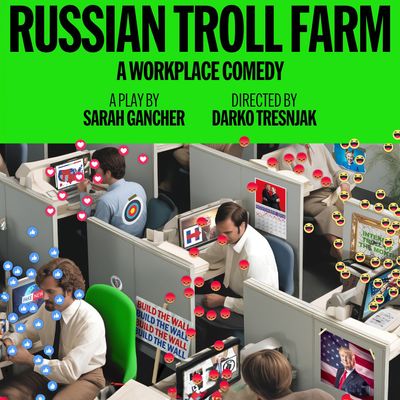
Join host, John Lavelle, backstage at Russian Troll Farm for a discussion with the trolls (AKA, the incredible cast). Christine Lahti, Renata Friedman, Haskell King, Hadi Tabbal, and John Lavelle discuss becoming trolls, important moments in the play, social media, fake news, and more!.. Read More
From the show: Russian Troll Farm, The Podcast
Guests




Featured Shows
About
Join host, John Lavelle, backstage at Russian Troll Farm for a discussion with the trolls (AKA, the incredible cast). Christine Lahti, Renata Friedman, Haskell King, Hadi Tabbal, and John Lavelle discuss becoming trolls, important moments in the play, social media, fake news, and more!
Hosted by show star John Lavelle, lose yourself to the world of Russian trolls on the Broadway Podcast Network.
Transcript
This transcript was automatically generated and might contain errors.
[0:18] John Lavelle: Hi, I'm John. John Lavelle. Welcome to the Russian Troll Farm Podcast. This podcast is inspired by Sarah Gancher's audaciously funny, deeply relevant, subversive play, Russian Troll Farm. Set in 2016 at the Internet Research Agency in Moscow, where Russian trolls show up to work to wreak havoc on the U.S. presidential election. Their job is to get Trump elected. I play Steve, a maniacal sociopath who believes deeply in the glory days of the Soviet Union. Typecasting. No. No, I'm just kidding. Seriously, just kidding. But it's not just about me. In addition to chatting with the amazing cast and creators of the play, Russian Troll Farm, we'll go beyond the stage to speak with cyber war experts regarding Russian's ongoing and very effective efforts to create chaos and division in the U.S. The play, Russian Troll Farm, is about the 2016 election.
The impact of Russian trolls today is massively greater. Today we're going to talk to my pals, the incredible cast of Russian Troll Farm. Christine Lahti, Haskell King, Renata Friedman, and Hadi Tabbal. Hello, everyone. Welcome. I'm John Lavelle. I play Steve in the Russian Troll Farm, the 4chan white supremacist, not to give too much away, but he's a Nazi. And I play him. And to make up for those sins, I'm part of this wonderful podcast and spreading real information and real conversation with open ears. So I'm with the cast of Russian Troll Farm right now because I'm a part of it. Some people might be like, oh my gosh, John, how do you have so much time to work with all these people and do a podcast? And it's simple. I have no life. So we're just gonna go around, introduce ourselves and the characters we play. And to my left is...
[2:10] Christine Lahti: Hi, I'm Christine Lahti, and I play Luba, and I'm their boss. I'm not a troll. Luba is a fascinating, complex woman whose journey in this play is so spectacular. I've never quite played a journey that goes from A to Z. And in this case, it really does. So I'm thrilled, and I love working with all these people here. And to my left is one of my faves. Go Renata.
[2:37] Renata Friedman: Hi, I'm Renata Friedman. I play Masha. Masha is a disillusioned former journalist living in St. Petersburg, Russian, who takes a job at the real-life Internet Research Agency because she just needs some quick cash to leave the country. While she's there, she finds herself embroiled in an office romance. And through the task of trolling, and through the task of telling these stories to the American public, she finds her love of story and love of language sort of reinvigorated. And then it all comes crashing down.
[3:21] Haskell King: Hi, I'm Haskell King. Thank you, Renata. I play Igor. Igor is a troll, and Igor is a bit of a loner and is very specific about the community that he trolls and goes a bit off guidelines to do so. But I've heard, and I take umbrage at this description, but I know it's kind of like an easy way to kind of get at who he is externally. People keep telling me that he's robotic. And I keep telling people that's just me. But Igor is trolling a specific community and attempting to undermine American democracy in the elections while creating a connection with that community. And that is actually the main source of human connection that my character has. So that in itself creates a conflict of its own for him, and then ultimately for this particular office as the play goes on.
[4:26] Hadi Tabbal: Hi, I'm Hadi Tabbal, and I play Nikolai, who is a troll and a supervisor in this department working under Luba, played by Christine. Nikolai is married to the daughter of an oligarch, and he's pretty unhappy in his marriage, and he's a frustrated artist and screenwriter. And I guess when someone gets hired at this company, he is able to carve out in his work a way to be creative, but that comes at a high cost. I don't want to spoil the play. And so, yeah, I think I play someone who can't be who they are in this environment, which is very much a theme of a lot of what this play is about, and that's super exciting.
[5:18] John Lavelle: Awesome. So now you know who we are. So we're just gonna have a conversation, and some of us have worked together for a pretty long time. I've known Renata for like 25 years, and others of us just came on this project and got to know each other. But we, as cast members, could ask each other questions or pose questions to the group, and we can all get into discussion about that. And Hadi, I love your question. Can you ask it first?
[5:39] Hadi Tabbal: Oh, yes, sure. Thanks for loving my question, John.
[5:43] John Lavelle: I really do though.
[5:45] Hadi Tabbal: No, I know you do. I don't even think you can ever tell when you're serious or not.
[5:48] John Lavelle: I know you're being honest.
[5:49] Hadi Tabbal: Right now, I what I asked, I think is there a moment or a line or an event in the play that just has always stuck with you or has always kind of stood out. It kind of either gives you goosebumps or makes you think about something, or it rings in your ear or in your heart, and you kind of can't really forget it or shake it off. It's that one thing that sticks. It happens to us in a lot of plays we read or we watch. And so that was my question.
[6:16] Christine Lahti: Okay. Hi. I guess I'm right sitting right next to you. So I think this is the line that I always that always sticks with me. And every time it comes up, it hits me. And I'm not gonna get word for word, but anyway. We've been doing this play for a year.
[6:31] Haskell King: No one hasn't. He's been doing this play for like five years and still doesn't know if I've heard.
[6:36] Christine Lahti: Okay, so it is I'm moving to London. Let's see if I can get I'm moving to London. I'm gonna do yoga and heal this shit out of myself. Close, right?
[6:45] Haskell King: It's not a lot of things.
[6:46] Christine Lahti: I was 99 point. What did I miss? There's a jest in there.
[6:50] Haskell King: Yeah.
[6:51] Christine Lahti: Okay. I'm gonna move to London. I'm moving to London. I'm just gonna do yoga. I'm just gonna do yoga. I'm gonna do yoga. Yoga just healed the shit out of myself. I guess Sarah really is a writer.
[7:03] Haskell King: What about that line?
[7:04] Christine Lahti: Yeah. Oh, I love that line because it tells us where Masha is right now, her emotional state, where her life is. It tells us what she's thinking about and what she's really aspiring to. It's such a sad line. And it's so relatable. Like I hear that, I'm like, oh, I know what you're saying. It's so sad because you say something like that when you're at a point you don't, you're at a desperate point because you think that is going to solve what you see as a problem in your life. And this is my interpretation, obviously. But this is how I feel from the lines. And you know that if that's what you think is going to solve the issues with your life, then it is not going to work. And you have a lot of other problems that you're not willing to deal with.
And we see, and we know she's never going to get to that point. And we know that we've seen her rushing headlong in the opposite direction. And look at where she's like taking a job at and who she's taking up with, Nikolai. And so I just that line just does so much for me.
[8:08] Haskell King: Yeah. It's very touching. It's also a really funny line.
[8:10] Christine Lahti: I mean, it's a super funny line.
[8:13] Haskell King: I was gonna say that it's one of those in the math of the show and in the math of the comedy of the show. You know how you have many different audiences who respond in a variety of ways. And some of your lines you just don't know from night to night whether or not it's gonna get a response. But that's one of my consistent lines. And so it's sort of an anchor for me on the show. I mean, I hope I'm not jinxing myself right now.
[8:38] John Lavelle: Wait for tonight. It's like Saturday night. It's gonna be fine.
[8:40] Haskell King: Even if it's a trickier house or a trickier audience, I can always count on that. That's why I like it.
[8:45] Christine Lahti: Yeah, because it is so honest and is so relatable. I think it's very relatable.
[8:50] Haskell King: Did he laugh that hard night we had at it?
[8:52] Christine Lahti: Yeah, even then there was some yes. I wanted to talk about for a second a line that means a lot to me, which is your mental illness is well suited to your job.
[9:02] Haskell King: Yeah.
[9:03] Christine Lahti: I think that's one of my favorite lines. And the reason is I think last night was very moving to me. We had they had one line responses at our talk back, one word responses, and somebody said, I feel impotent. And I thought, yeah, okay, so we got we can't, we gotta get past impotence. We have to get to some kind of action. And understanding that these people have a mental illness. I mean, they're broken, they're all broken in some ways. They have some mental issues. Luba in particular. But the people that, you know, I don't know, MAGA, can I say MAGA people? Yeah, that they're not, we can't demonize them. There, there's some hurt and anger that we need to identify with and have empathy for, and then talk to them about why they're voting against their own interests.
And we have to get people to, you know, registered to vote. But talking to not to demonize people with certain, you know, mental issues or whatever, hurting that are supporting MAGA and want Donald Trump again. But to really try to have conversations with them. And I think that will help people not feel so impotent after seeing this play, because I think this play is so powerful. And obviously, after Navalny's murder, it is even more terrifying. And I think that anyway, that line always reminds me of how we need to have empathy for people like Steve.
[10:36] Haskell King: I want to piggyback on that because it's so true what you're saying, in a way, for me, how I understand what you're saying, Christine also is what's really interesting about this play, right, is that you have this insight into these trolls, right?
[10:48] Christine Lahti: Like who these people are. And you know, you get to, you know, as actors, we can't judge them. And as audience members, we're hoping that we're inviting them to see their humanity somewhere. And I think what Sarah Gancher, our writer, did, which is so brilliant in a way, is that, you know, it's set in Russian, but it actually feels like you're watching it inside the United States, a bit like what Shakespeare used to do, kind of set things away from England. I mean, he did it for other reasons. Sarah didn't do that because she's afraid that she's gonna be censored here. I hope not. But you know, obviously Shakespeare was doing it because you couldn't really set things in the court and the royal court there.
But there is this thing where, like, you know, Russian looking at the US, US looking at Russian, but at the end of the day, we are these people who are doing these horrible things and who are broken in a lot of ways and who really want to be seen somehow, which is actually one of the lines that Nikolai says in the play. And I think that is also very profound about this piece, which is, you know, you have these people who want to be seen in some way, even the white supremacist horrifying character who happens to be our funniest character, is looking to be seen. He even says it. He says, you know, I used to do things just to get a reaction, but actually I'm on board too. He has jumped on board of something to be seen.
And I think that is really powerful. That ties into my answer to your question, which is the moment in the play that always stands out to me. It's sort of more of a section without giving too much away in the later part of the play. Luba and Masha have a moment of connection where there is a friendship that begins to grow. And I love that section of the play because it allows two desperately lonely people to connect. And I think that all of our characters are horrifically lonely, and we're preying on lonely people in America. But that is one of my favorite sections that always resonates when I do it.
[12:48] John Lavelle: Well said, Renata. We're gonna take a quick break. Stay tuned for more Russian Troll Farm.
[12:55] John Lavelle: And we're back. We're talking with the cast of Russian Troll Farm. Along with this kind of empathy, it's actually in Luba's ghost from a glorious future that never came. For like a lot of reasons. Like the fact that Sarah wrote that, it's such a beautiful visceral. I see it, I hear it, I feel it. It's like one of those lines that all my senses are like just triggered when I hear it. And in context about someone living their life so hard and doing everything they can and overcoming so much, and then sitting at the precipice, they climb this mountain and looking down and saying, This wasn't worth it. What have I done? What have I done with my life? I dedicated myself to something that didn't happen, never will happen.
And it gets me so sad every time I hear it. So I try not to listen to it. I try to like move on at that point. But I sometimes hear that moment, I kind of get a little like, oh my gosh. And yeah, it's like one of my fears as a person. Like, like, what have I doing? What am I dedicating myself to this? And a lot of actors, I'm sure, feel this way. Like what is this a noble pursuit? Is my life a noble thing? Is my night life even worth living? Yeah. That whole section just hits me in such a way. And especially, you know, we said the play changed a few days ago with Alexi's murder. It's just like I think about that. And I was like, well, that that's a life worth living. Like that is, you know, that that is dedication, and that is something profound. But yeah, no, it really strikes me. Ooh, I got a little emotional talking about it.
[14:29] Renata Friedman: My favorite line in the play is when Luba says we this was not a spoiler because we all know how the elections ended up in 2016, right? Like it's cool for me to say that. She says, We won. And there's something so horrifying about watching someone celebrate that they won the election of another country. It is so vile. No matter who is where, you know, it always gets me. Always, every night, I'm like, it enrages me. And actually, it's a moment of celebration on stage, which I think is great. You know, that kind of duality. Fantastic. Renata, what's your question for all of us?
[15:08] Renata Friedman: I've been thinking a lot just about our job as trolls up there. And I've been reading about this theory that humans have a cynicism bias, that as we have evolved, it has been safer for us to always assume something is a threat rather than assume something as a friend. So if you encounter a dog alone on the road, you're much more likely to survive if you assume they're dangerous rather than friendly. And the way this ties into online propaganda, I have encountered this in my willingness to jump on board and believe something awful that I read. And sometimes I'm sure I have been manipulated in those scenarios. And I So my question, is that something that rings true for you guys? Do you feel that you are when you are online, you are more inclined to absorb and believe something that is tragic or inflammatory before you question whether or not that is true?
[16:04] Haskell King: It's such a good question, Renata. I'm I have like a conscious bias for cynicism. I'm not really like a good buyer. If the minute I see an ad, my first thought is, oh, someone's trying to get me to buy something that I don't need, you know? Whereas there's a lot of what do you call them, early adopters. They just like, you know, the people who line up for an iPhone, you know, like overnight. I'm like, what is wrong with you? But anyway, I think I usually tend to be cynical about what I see, but here's the dangerous thing, which I think happens to me, is when you already have a belief in something and you see something that aligns with it, but what aligns with it is actually an exaggerated nuance or not a true event.
Yes. That's when it's really hard. You know what I mean? Because then you're like, you want the uh what do you call it? Like you want the not the approval, what's the other word I'm looking for? The affirmation. Affirmation that what you believe in is true. It's true. And I think for the most vigilant of us, it's really hard to resist that, you know? So I'm trying to be aware of that. Maybe this isn't the answer to that question, but it's something what you it's like talking about what you say. It's like it's the idea that things can't be so simple sometimes, where you see a dog on the street, the simplicity of him just being outside of his house is too hard to fathom. And I think this leads to like conspiracy theory, right? Two towers go down and downtown New York. It can't be as simple as a bunch of people flying planes into them. People dying over here. It's not so it's not so simple.
[16:53] Haskell King: No, no, it's really hard to figure out. No, it's a really nuanced thing that's happening right now. It's like, no, people are dying. People should not be dying. People should not be getting hurt. So I think cynicism also with the idea is like the need for stuff that's so horrible, or it's so hard to accept simplicity. I sometimes think, where it's like you see that ad, you're like, they're just trying to get me. Yeah. So my microphones listening to me. These people, but they want my money. No, it's simple. Like, you know, maybe I would probably like this product. Someone's walking up to me on the street and they're like, Can I have a dollar? And it's like, they're gonna buy meth and I give them this meth.
And if and they're gonna have meth, and I was like, they're gonna commit a crime. It's like, no, maybe they want a dollar because they're hungry, right? But you're I'll believe you know, believe that other thing. So you withhold your humanity sometimes because it can't just be so simple just to be humane to another person. Like that's what I kind of think about that. But uh yeah, I tend to create stories for people and things, and I tried, I really am really working towards seeing like the hopeful good of it all. But online, I can't read any story right now because I just don't believe anything right now.
[18:33] Hadi Tabbal: I think I'm a complete sucker for everything I see online. This play has helped me to be a little more discerning. But certainly, if there's something bad, I go, oh my god, and I'm just engaged. And I don't know if it's the drama queen in me or the the need, this fucked up need to watch other people suffering so you don't feel so bad about your own life, right? And that's part of it, the attraction to it, I think. It's all really sick, but I think that it I will scroll, find myself scrolling through shit, and 20 minutes has gone by, and I want to kill myself. And then you know, you get the screen time how much time you've been spending on your this pops up. I really want to kill myself then.
[19:20] John Lavelle: What are you on apps? Are you on Instagram, Twitter, Instagram, Instagram, Instagram, Twitter. What are some more? Tell me some more that I've got. Snapchat, TikTok. TikTok is a black hole. It's a black hole. And I just literally have to put the phone away. But I'm just some there's something in my psyche that is I'm real susceptible to that kind of thing. I don't know.
[19:45] Haskell King: We all are, but it's designed that way. It's literally, it's not a it's not an accident. It is designed to be addictive. Yeah. These are it's engineered to be addictive. Even the amount of time this the reels take is to make you addicted to the next one or the next one. But they must know my algorithm. They must know that I'm a you know a pretty radical feminist and activist, and so I'm getting all this stuff about women empowerment and and women's stories about violence and rape and I'd be horrible. I'm getting so much stuff. And then one time I liked someone's plastic surgery, and now I'm getting all these plastic surgery TikToks. Like, oh my god, no, I don't want to see this. I've deleted like all the apps on my phone. I can't have TikTok, I don't have Twitter, I barely have Instagram. So it was really nice talking to y'all. Thanks, John.
[20:35] John Lavelle: Thanks. All right. And for moderating this lovely conversation with a great cast. So glad you joined us for episode two of Russian Troll Farm. Big thanks to the incredible cast, Christine Lahti, Haskell King, Renata Friedman, Hadi Tabbal, and me, John Lavelle. Join us for the next episode of Russian Troll Farm. Coming soon. Thanks to Sarah Goodman, our sound engineer and editor, and to Kim Garris, BPN's head of production, Alan Sayles, BPN's co-founder, the amazing BPN social media team, and our producer, Dory Berenstein. I'm John Lavelle, host. You can find Russian Troll Farm on the Broadway Podcast Network or wherever you listen to podcasts.
© Broadway Podcast Network, All Rights Reserved