

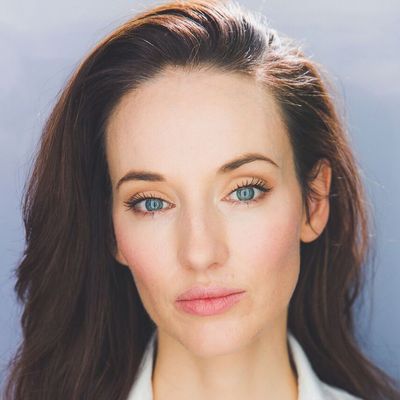
Elizabeth A. Davis is currently gracing the Broadway stage as Thomas Jefferson in “1776”, where she has the unique opportunity to showcase her actual violin skills at the same time... Read More
From the show: The Theatre Podcast with Alan Seales
Guests
Featured Shows
About
Elizabeth A. Davis is currently gracing the Broadway stage as Thomas Jefferson in “1776”, where she has the unique opportunity to showcase her actual violin skills at the same time. She talks about what it's like performing eight shows a week while pregnant, and the financial and societal expectations that come with it. Elizabeth's love for music started at a very early age, sharing that she started playing an instrument with a butter box with a ruler in it when she was three years old. She reflects on how music was an important part of her family's life, and why she played not because she had an inkling it would be her trajectory but for the discipline of it. Playing as Thomas Jefferson, she shares that the pieces that she's playing on stage were pieces that Jefferson himself played, how she auditioned and how they were particular about casting actors who can play instruments very well, and why she considers "1776" a true musical theatre. She admits that singing on stage still terrifies her, and while she thought she wasn't a good enough violinist or a vocalist to major in them, she knew that she was a storyteller and got her degrees in classical theatre performance instead. As a storyteller, Elizabeth reflects on why the act of acting is a total defiance of death, why she aims to live her life as a thank you, and why failure is your friend and something that is not to be feared.
Elizabeth A. Davis is a multi-talented, multi-hyphenate actress who received a Tony Award nomination for originating the role of Reza in the Broadway production of "Once". She has over 30 Off-Broadway credits, including "The Resistible Rise of Arturo Ui", "Women on Fire: Stories from the Frontlines", "Zorba", "Rain", "Allegro", "The Caucasian Chalk Circle", and "The 39 Steps". She's appeared in several TV shows such as "Fringe", "Blue Bloods", “The Jim Gaffigan Show”, and "Law & Order: Special Victims Unit". She has also written original musicals and short plays, and sung on Ben Platt's album, "Sing to Me Instead". Elizabeth is playing Thomas Jefferson in Broadway's "1776", where she sings and plays the violin on stage.
Connect with Elizabeth:
- Website: www.elizabethadavis.com
- Instagram: @elizabetadavis
- Twitter: @ElizabetADavis
- Facebook: @officialelizabethadavis
Connect with The Theatre Podcast:
- Support us on Patreon: Patreon.com/TheTheatrePodcast
- Twitter & Instagram: @theatre_podcast
- TikTok: @thetheatrepodcast
- Facebook.com/OfficialTheatrePodcast
- TheTheatrePodcast.com
- Alan's personal Instagram: @alanseales
- Email me at feedback@thetheatrepodcast.com. I want to know what you think.
Transcript
This transcript was automatically generated and might contain errors.
[0:00] Alan Seales: Welcome to The Theatre Podcast, intimate personal conversations with the industry's biggest names.
[0:11] Alan Seales: I'm your host, Alan Seales, and our guest today is Thomas Jefferson in "1776" on Broadway, none other than Elizabeth A. Davis. Yes, of course, she plays Thomas Jefferson in the show right now, which is, of course, all over the headlines for many, many good reasons.
[0:27] Alan Seales: You can take the lady out of the small town, but you can't take the small town out of the lady. She's a Texan that still performs to this day to pay homage to her grandparents and great-grandparents, who, as she tells the story, paved the way for her and her family today. Speaking of family, I am so proud to see that she's performing eight times a week now at being seven months pregnant. The show is scheduled to close right around her due date, and often we've heard on this podcast that women have a hard time making a choice between starting a family or even continuing their family and continuing to perform, and the producers of "1776" never batted an eye. They were like, great, you're pregnant, keep on going, doesn't affect the story.
So, kudos there where kudos are due. Find me online on Instagram and Twitter and TikTok and Facebook and the web, you know, I'm all over the place. Leave a rating and review wherever you're listening. Now, if you can, and everybody, please enjoy this episode with Elizabeth A. Davis.
[1:35] Alan Seales: Today's guest received a Tony Award nomination for originating the role of Reza in the Broadway production of "Once." Aside from her over 30 off-Broadway credits, she's a multi-talented multi-hyphenate who's ironically now had two back-to-back Broadway credits where her character both sings and plays the violin on stage. She's written original musicals, short plays, sung on Ben Platt's album "Sing to Me Instead," and even has TV credits that include "Blue Bloods," "The Jim Gaffigan Show," "Fringe," and "Law & Order: SVU." She can now be seen playing Thomas Jefferson in the reimagined revival of "1776." Elizabeth A. Davis, welcome to The Theatre Podcast.
[2:16] Elizabeth A. Davis: Hey, thanks for having me. So happy to be here.
[2:23] Alan Seales: How are you feeling? I guess the baby elephant in the room is that you are many months pregnant.
[2:32] Elizabeth A. Davis: Yeah, I had my eight-month appointment this morning after I dropped my five-year-old off.
[2:39] Alan Seales: Wow, eight months and you're on stage performing eight shows a week while being eight months pregnant?
[2:45] Elizabeth A. Davis: Yeah, I just have this image of me having a cigar dangling out of one side of my mouth and wearing a muumuu and just walking and be like, mama's here kids, let's do another show. Yeah, I'm just going to keep showing up till my body says no. That's it. That's going to be a really cool story one day for your child if you're like, mama's water broke in the middle of a Sunday matinee.
[3:08] Alan Seales: Do you all have a contingency plan for this? Because you're going to be running through your due date, I suspect.
[3:13] Elizabeth A. Davis: Yes, I'm due January 1st. The show is set to close January 9th and I was a week late with my son. Yeah. It's a hoot. It's really a hoot. The metaphor does not escape me. It has never escaped me. I just didn't think I would be living the metaphor that I knew would be profound, but here we are. So yeah, it's not easy. I didn't really know definitively. I thought I had an ulcer. I think I went to the doctor July 5th. I found out definitively on July 21st in Boston. We closed July 24th. So I did the entirety of my first trimester and into my second trimester rehearsals and performance at ART just thinking I was getting a little tight in the pants and that I had an ulcer.
[4:08] Elizabeth A. Davis: Wow. I take none of this for granted for real because there's so many layers and levels. There's the financial component. There is the human component. There is the component of how we expect pregnancy to look. There's just so many landmines around the whole thing. But at the end of the day, what I'm finding is that I was hired to do a job and I'm showing up to do my job. And I just happened to be amongst a wonderful company and creatives and designers and stage management and all of that that have supported me unequivocally. So all I can say is thank you. It's just a wild story.
[4:52] Elizabeth A. Davis: I was so happy and I guess overjoyed is not the right word. I was just pleasantly surprised when I saw the show a couple of weeks ago to see you on stage, full Jefferson outfit. You're all playing men up there. But the part of the point of the gender blind casting, we'll call it and color blind, is that you're up there representing the voices of the nation that still went unrepresented during the whole process of declaring independence and whatnot. So twofold, like you're literally up there representing motherhood and mothers and while birthing a nation, while cooking your own egg and all of these roundabout metaphors. Hey, roundabout, see what I did there? Didn't mean to do that, unintentional pun.
So yeah, you've got all of this up there, all these voices, these unsung voices that you're representing. And while at the same time, as Elizabeth, you're representing actual actors, actual mothers who typically can't find work while they're pregnant or don't want to work while they're pregnant or afterwards, because it's just freaking hard to maintain eight shows a week and breastfeed and miss your little elementary school everythings, right?
[6:31] Elizabeth A. Davis: Yeah. It's a really impossible line to walk. And look, I'm not going to say that it's hard. It's hard. It will be hard. This is a very extraordinarily unique situation that was born out of, no pun intended, but born out of a lot of pain. And it happens to just be in a production that happens to be cast in such a way that allows my body to look how my body looks right now. And that is not the case very often. And so, I acknowledge that while I do want it to be representative of what I think can change and be different in the industry, I also understand that there is a superlative quality about it. There is a uniqueness to time and place and specific show and specific type of casting, etc. But there's also like, there's no maternity leave because I was in two different states doing the show and New York State doesn't... So should there be maternity?
I don't know. So there's like the financial component. There's all of these very real logistical threads that are going around this whole scenario for me. But at the center, in the yolk of the egg of it is the beauty that I get to be in this body and be telling the story and feeling the profundity of these metaphors upon metaphors. And it's the most profound, creative moment of my life, I would like to say. Yeah.
[8:13] Alan Seales: Well, in addition to carrying around another living being inside of you, you're also carrying around a violin. And of course, you played the violin in "Once" as well. When did you start playing? I guess, is violin the only instrument you play? And when did you start playing that as a child?
[8:27] Elizabeth A. Davis: As a child, I guess. I assume everybody who's good as an adult had to start as a child. I started on a butter box with a ruler in it at three. And a dowel rod for the bow with like an eraser at the end as the frog. I did start as a child. And I was in the... I grew up in the panhandle of Texas where we had... Our population is 362, I think, on our population signs still to this day. My parents still live in the house I grew up in. My brother and his family live about an hour away. It was a discipline. It was a very important part of all of my family's life. Music was interwoven into pretty much everything. And so I played not because I had any inkling that this would be my trajectory, but I played for the love of it eventually.
And I played for the discipline of it. And so to find myself first in "Once" with all of the things that I love to do coming together in such a way. Yeah, that was the first moment of real synthesis, creative synthesis, where I thought, I think that I'm in the middle of a genre creation. I say that, but John Doyle, who I have to shout out, is like... I call him a creative father. I did "Allegro" with him and played the violin in "Allegro" after I did "Once." And John Doyle, I have to say, created in our modern understanding of it, actor musicianship. Margaret Thatcher cut arts funding when he was working in Scotland, the European Union. Or was it then at that time? I don't know. Don't put me on my head governmental structural understanding.
But John said, how am I going to continue to do my work without arts funding that Margaret Thatcher just cut? And hence, I think we got "Sweeney Todd." Was that first? Was that his first production that he brought over? Or was it... I have no clue.
[10:54] Elizabeth A. Davis: My point being, shout out to John Doyle. And then shout out to John Tiffany and the producers that made that possible. So that was "Once." It was extraordinary and so singular. But this show is different in that I'm not the orchestra. There is a pit violinist who's fantastic and I love her. Our orchestra is amazing. Ryan Cantwell, our MD, amazing. David Chase, the whole nine yards, the whole gang, love them. But this is woven into the narrative. Jefferson historically played the violin very well. And the pieces that I'm playing on stage were pieces that Jefferson himself played. So, wow. Yeah, it's pretty crazy. And then Martha has the whole song, he plays the violin, obviously, originated by Betty Buckley, who also has my heart, played currently by McElroy.
So, yeah, it's a different type of... it's not diegetic, as we say. It is true musical theater, even though people are considering the show a play with music. But I digress. So the casting, the original casting of the show when they were, I guess...
[12:07] Elizabeth A. Davis: Well, yeah. So the character description for Jefferson, it calls for an actor who can play the violin. And then I guess going back to "Once" as well, was that cast looking for musicians who can sing or singer-actors who can also play instruments?
[12:25] Elizabeth A. Davis: I'll answer the "Once" question first. John Tiffany was very specific that he wanted actors first who also played instruments very well. And I think that was a huge part of what made that cast so unique and specific is that you had a bunch of actors who just happened to be... who started playing a butterbox at three. And that was all of us. So John wanted actors who played. In this scenario, I don't think Jefferson doesn't have to play the violin at all. That's certainly not part of the description of the role. I just think Diane and Jeffrey knew that I played and thought, oh, that would be a bonus. And indeed, I personally find it a bonus. I find it a fun bonus that I get to do that every night.
It's a beautiful violin, too. It's absolutely... Before I could see it, just the lights and the color. And it's a deep, very, very pretty violin. I played for a year in third grade. I couldn't play a lick right now, but I can at least appreciate a good instrument when I see one. So I'm like, oh, wow, that's really pretty.
[13:31] Elizabeth A. Davis: It's an instrument they found that can be acoustic and electric because I use it acoustically in act one and then electrically in act two.
[13:39] Alan Seales: That's cool. I love technology, especially when it merges with the arts. That's a lot of fun. We're going to take a short break. Stay tuned for more of the episode.
[14:01] Elizabeth A. Davis: I started with The Butterbox when I was like three. So where did it grow from there? Because you're in the middle of this tiny town in Texas playing instruments. Did singing come next? Did acting come next? And then progressing up through there, what was your moment where you said, I have to do this for my life? This needs to be who I am, or this is who I am. I've just discovered me. Well, I have to always pay homage to my parents because my dad was a vocal performance major. My parents met in a singing group. My mom and my dad both play the piano somewhat, and they also directed the high school theater production. When you come from a tiny town, you're on the cross country team, you run track, you do poetry interpretation, you do the one-act play, and you also barrel race.
So that was just normal life that everyone did everything in order to create teams. And because we're in Texas, everything was a competition. Not because we're in Texas, but Texas has very competitive extracurricular activities. So everything just overlapped. It was a constant overlapping of like, oh, I'm five and I'm sitting on the steps of this tiny theater in our school where my parents are directing Steel Magnolias. And then on Thursday, I'm going to go to violin lessons. And then daddy is singing for church. And we're all like, so all of the components that I'm bringing, I guess, to my work now were always part of the ingredients of our family soup. Then when it came time to figure out how to make anything out of that, to make a sustenance of a life, I pursued theater because I wasn't good enough.
In my mind, I wasn't a good enough violinist or a vocalist to major in those. But looking back, I knew that I was a storyteller. And so I got both of my degrees in classical theater performance. I got my bachelor's and my master's. I never thought I would do a musical theater production ever. Singing still terrifies me on stage. But I love to sing and I write music, I record music, all of this. I found my way into feeling comfortable in singing when I, well, once allowed a voice to be what it was. One said, Glenn Hansard is going to get up and scrouch and let the pure just rawness of the human voice ring out. And we're going to say yes to that. And so there's such freedom in saying, yes, there is something gorgeous about perfection in the singing voice.
But why do we love Dylan? Why do we love Springsteen? Why do we love Glenn Hansard? Why do we love Bonnie Raitt? Because their heart comes out of their voice. We don't listen to them for technical perfection. We listen to them because they are telling the story of life when they open their mouth to sing. And discovering my version of that is what lets me sing and feel confident in that. And saying, oh, I'm going to screw up. I don't care. That means it's live. That means you're hearing the real me. Oh, well. Embrace what makes you different. We say it all the time.
[18:02] Alan Seales: Yeah, exactly. And people come to the theater to see something real and different and alive. They, of course, come to the theater also to see extraordinary skill and brilliance. And we have plenty of that on our stage as well. But I guess to just go back and answer your question about tying everything together, that's when the vocal piece really came into play.
[18:14] Elizabeth A. Davis: That's really cool. That's really cool. And I think it's refreshing a little bit to realize too that you have people at the top of their game. I say this all the time in these episodes is that Broadway performers are the Olympians of theater. They're the top of the game. You've reached the ultimate of competition, the ultimate pinnacle of the performance. And it's refreshing to know that people still get stressed. These people doing shows eight times a week, they still get nervous about auditions. They get stressed about singing. They go up on their lines after doing it for a year and a half. All of this stuff, everyone is human and everyone is unique in their humanity, which I think, again, it speaks to why I love this production of 1776 so much.
Because the cast is so diverse and different. And we're all representing one nation. We're all representing one movement. You, not we. I'm not a part of the cast. You are all representing, of course, this movement, the individual people. But it's really cool to me to see the choices that were made to put you and all the rest of the phenomenal cast together to represent this one particular moment in time. I don't have a question there. I was just making an observation. But my question then would be, did you know about the production before you auditioned for it and before you really started getting involved?
[19:39] Elizabeth A. Davis: I auditioned for this old school style through my agent. I found out, I think the first full day that I knew I was cast was January 1st of 2020. Which, by the way, it's so interesting. My child is due on January 1st of 2023. So I didn't know much. I knew that... I didn't know much. That's the real answer. I had never seen a production of 1776. My father apparently was in a production in college in 1776, which seems to be... I'm finding all these people that I peripherally know and they're like, Oh, I did a production of that. Oh, yeah, I did that. The first time I listened... I watched the movie and I listened to the score. And I was struck by how funny it was. And I was struck by how the creatives, the writers were dealing... They use comedy so deftly to kind of take the air out or to release the pressure valve on major, major contention and sticking points. So I respected that a lot. And I got excited about being in the middle of walking that line.
[20:59] Elizabeth A. Davis: I guess looking at all of the original founding fathers, fathers being the key word there being men, right? Were there any of these characters, of these real life people that you were drawn to initially of like, that's a really interesting story? Or I didn't... There's so much I didn't know about these particular people because just your character arc in general, the Jefferson story alone is phenomenal. And then the conflict over the clause about abolishing slavery that Rutledge wanted to or had successfully removed from the final draft or from the final version. All of this just fascinated me because I didn't know any of it. It was in my North Carolina public school upbringing. It was, you know, there's like some tea that got thrown in the ocean.
And then we said, screw you, England, we're out. A couple of people fought some battles and that was it. And then I really got to know the real history. I put in air quotes because of Hamilton, because Hamilton then teaches you everything. But that's like, right. And so that's like years before and years after. But I love 1776. I love this because this show is like the months leading up to July 4th, 1776. And just the drama and the drive, the need for these kids. I'm a day older than you. So you and I can call them kids. A lot of them were kids. Especially Jefferson, who was what, 27? 28? What was he? 33 at least. I mean, I say that only because there's a line in the show, for a man of only 33 years old, you possess a, whatever John Adams line is, it calls me 33.
And I always, every night I get a kick out of it. I'm like, yeah, that's right. Of course I'm 33. I look like a young lover. It's so funny. And I'm standing up there again with a cigar hanging out my mouth being like, you kids, blah, blah, blah. The history is unbelievable. And it's like, you and I are, people can't see obviously, but you and I both holding our voting stickers right now because we've both voted today. And after reading extensively about, well, let's just go straight to the 1800 presidential election between Jefferson and Adams, where partisanship was actually introduced into the political zeitgeist. Jefferson was like, you know, no, if you come in second, you can't, no, I don't want you as my, I don't want you as my vice president.
The contention between Jefferson's and Adams is considered one of the most heated presidential elections ever. They didn't speak for years after that. And I always take being inside the show, being inside the history, being inside Jefferson's track as encouragement to say, it's always been insane. And also reading Thomas Paine's Common Sense. That's what I'm reading on stage during scene three. I sit there and I read and reread over and over Common Sense by Thomas Paine, which is considered the inciting document that gave the colonies the courage to say, okay, we're actually ready to do this. And I just find, I find so much courage. And I also, again, people can't see, but I have these two notebooks that I filled during the Boston production, sitting in scene three, writing about congressional madness.
And I have a document that I do. I have a document called the Congressional Chronicles, where I wrote about what I was witnessing as Jefferson in scene three, but obviously it's also Elizabeth writing about what she's experiencing in 2022 America. And so I hesitate to take any time to just find this, but I was so tickled getting to put these together. I wrote this on stage and I believe this applies right now as much as it did then. The sun shines with earnest work ethic. The moon waxes with precocious swoon. And the men in this congressional sweat box foghorn with volume so as to convert the citizens of planet Mars. And just, you know, the ideas such as that of like, nothing has changed. Like we're, we're watching people foghorn in our congressional sweat boxes as to convert literally along with Elon, the citizens of planet Mars.
So there was great courage to be had in that humanity does not change. The circumstances around humanity just does. And that may cause people to be cynical. It may depress them. I find it encouraging because it means that the trajectory of growth and learning can be pretty tried and true. If people are willing to commit to it. And this is a very long winded way of saying Jefferson, despite all of his inconsistencies and all of his inabilities to see his mistakes, or I'll regret that his inability to change his mistakes. I think he was quite aware of them. I think he knew that slavery was wrong. He, he, he, I read the clause every night, calling it an excreble commerce. Yeah, he knew. But his, his daughter knew that he knew it was at least a generation or two away from him being able to, for us to abolish it truly.
[27:20] Alan Seales: How much of this history did you already know? And how much did you learn, I guess, joining the cast? Were you all given the real history lessons? Or did you take it upon yourself to learn all of this? I'm always curious how much the production team requires their cast to really like dig into the past of these real characters sometimes.
[27:36] Elizabeth A. Davis: It was both. I mean, we as we were in the middle of the pandemic, knowing that we were cast as these roles. So we had the freedom of time to do an extraordinary amount of research if we so chose. But we also were gifted kind of the arsenal of Harvard's.
[28:02] Elizabeth A. Davis: We had these guests that would just either zoom in or physically show up who are Pulitzer Prize winners in their field. We had Pulitzer Prize winner Annette Gordon Reed, who is a scholar of Thomas Jefferson. Like that is her life's work is Jefferson and uncovering a lot of the Sally Hemings history. So I'm listening to this woman talk like I still like I think about Alan Rickman and Annette Gordon Reed the same way. They both like give me chills. So there was a lot made available to us and there was a lot that was put on the emphasis of the true understanding of the history and an emphasis on saying we're not interested in deifying or demonizing. We're interested as art does creating characterizations of people and making them imperfect and making them human.
And that's what I hope people see when they come to watch the show. I hope that they don't know our aim is not to preach. Our aim is simply to hold a mirror and I think the production does a good job of that.
[29:39] Alan Seales: It's a country founded on conflict. I mean we rose out of conflict to overcome conflict to then establish a system that perpetuates conflict and here we are, you know, but all in all like you said shining up a mirror. That's all that's the best thing. I think that we that you can do in any situation 'cause it's all it's self-improvement and exactly what you're saying about Jefferson. He knew he wasn't perfect, but he worked to improve himself and I think you know it could be the modern day or now the modern version is like you know you're going to therapy and you realize that you have work to do and you're not perfect and you've got blind spots in your way of thinking your unconscious biases because of societal influence because of generational blah blah blah blah blah like you can trace it all the way back and this is why part of why I love Broadway and love theater and love the arts so damn much because it allows you to just open up.
It opens up your mind as an audience member and then even like you and your cast as performers how much better of a person how much more I guess aware of things are you now as a person as Elizabeth than you were previously and now you can take that into your next roles and teach your children and teach and you know go pay this forward in a way that you wouldn't have otherwise. I think it's a fascinating cycle.
[31:08] Elizabeth A. Davis: Oh, that's so well said and I absolutely agree. I'm a significantly better citizen than I was two and a half some years ago. I'm a better citizen. I hope I'm a better artist and to your point, I hope that I'm a better mother. There is something profound about being able to put yourself on a continuum being able to imagine your children on a continuum as opposed to fixed points and yeah, I don't know how to exactly say, but there's a I think children thrive and do better when, well, obviously when there's a growth mindset when there's a sense that they are not the center of the universe, it's unhealthy for a child for a human. That's hard. It's hard to get them to see that right exactly but exposure to history and exposure to similar struggles at different time points and in different countries like any of that exposure allows a child I think to feel strengthened, but also keenly aware of the fact that they are a part of they are a small part of human history.
Well, everybody is, everybody is whether they want to be or not and that's something too that you know people have asked before they're like what do you hope that you leave behind and it's just legacy and and that's why gosh. I mean look at look at it again. I take Hamilton and 1776 and in every show about a period piece historical moment. Everyone at the crux of it wants to leave their legacy.
[33:03] Alan Seales: What do you why do you think that is now that I brought that up like why is that? Why do you think as a species we just wanna you know we're afraid to be forgotten out of 7 billion people? Of course, some people are not gonna rise to the top. It's kind of a **** thing to say, but it's the truth.
[33:16] Elizabeth A. Davis: No, I think we are. I think we are all created to desire higher meaning. We're all in search of saying I intrinsically feel or understand that I'm more than myself. How do I reach that? How do I surpass my own humanity? Yeah. I mean look, I'm a person of faith and I've been able to take my art and my understanding of my purpose on planet Earth and through the continuum of time and soul and spirit and say I do believe that we are created for more than just the end of our lives that there is legacy built into our DNA. There's a desire for I call it continuum. I wrote this play called Home and Tropic and Entropy meaning you know everything falls toward chaos and how if left to our own broken we've we fall toward entropy and the fight of redemption defies that and so for me, that's the legacy and the meaning that I long to leave to say my human is not the end of what I aimed to portray or said differently, which that was deeply convoluted.
There is continuance in every role I play. What acting is is incarnational meaning we take something that is without flesh and we put spirit and flesh into something that's simply on the page. We incarnate it. And so for me, the act of acting is a total defiance of death. It is an absolute defiance of entropy to be able to step into something and to breathe life into something and to allow it to be alive in your face for however long and so there's purpose and drive and meaning in that, which is why you know I'm exhausted. I'm 8 months pregnant. I'm exhausted. I've and still purpose and continuance and meaning calls to me and so I keep showing up. I keep showing up community calls to me, you know being a part of being part of a whole calls to me. Anyway, please please stop me from my pontification.
[36:05] Alan Seales: No, I absolutely resonate with what you just said about the act of acting incarnates and I think you said transcends death or cheats death. I don't I forget what you said exactly, but that that puts so much of people's need to perform and express themselves and leave that legacy that I think just puts a pin in that so well in a way that I never actually considered before. So thank you for that little tidbit. I'm gonna go to bed tonight thinking about that, but I would love to wrap up the episode here with three closing questions. I ask everybody to end the episodes and you may have just answered the first one already, but the first one just is very simply what motivates you.
[37:00] Elizabeth A. Davis: My grandparents worked on a farm for 50 years of their life and saved enough money to send me to college. I stand on their shoulders. I stand on the shoulders of my great grandfather who was a doctor in Scotland crossed through Ellis Island. There have been so many people in my history who have sacrificed and I want I bring the same ethic drive and passion to my job as an actor that my grandfather did when he was farming untilled dirt in the panhandle of Texas and my grandmother who cooked three meals a day for cowboys as they were trying to provide food for the United States of America. This is not just a hope and a wing and a prayer or whatever the phrase is. This is a thank you. I aim to live my life as a thank you.
[38:00] Alan Seales: Wow. I love that. Alright next question. Then what advice would you give to your younger self and younger people listening now starting out down a similar path?
[38:04] Elizabeth A. Davis: The biggest job I had at 30 years old was understudying off Broadway. I was 30 years old. I recently listened to Leslie Jordan on SNL talking about Oprah got fired at twenty-five or something and the best thing that could have ever happened to Oprah at twenty-five is to be fired because it's what made her Oprah. Yeah. And so I would tell young people that failure is your friend and that is not to be feared. It is to be welcomed as the teacher you must have to go to the next place. You are not a failure. If you refuse failure, you refuse growth and we must uncouple identity self-worth from work. We must uncouple them. They are not the same. If you allow them to be the same, you will be crushed by your work.
[39:07] Alan Seales: That is again another beautiful answer. Beautiful. I almost said beautiful. I don't say beautiful, but I almost did that time. Alright, the last question and this one is the hardest. If you can only see one show for the rest of your life, but you can see it as many times as you want, what would you see show musical play movie like what are the parameters here? I leave it very open.
[39:26] Elizabeth A. Davis: Oh my gosh. The Boys Next Door, the Hallmark special with Nathan Lane.
[39:30] Alan Seales: That's not even like you can't even find it. I don't even know where to find it. I haven't even been able to find it on VHS.
[39:34] Elizabeth A. Davis: It's like who else was in that? It's called The Boys Next Door. It was about a man who was helping a home of people who had a variety of I think the correct term is disability, but his learning to live without them and their ability to live without him and it just. I don't I don't have words. It makes me feel all the things I have no idea where people can find it. Good luck. If you find it, let me know, but I live high on the memory of it daily.
[40:25] Alan Seales: Okay. Well, where can we find you online? It's a great transition to social media. Where can people send you all the info about where to find the missing mysterious movie?
[40:31] Elizabeth A. Davis: Yeah. So my professional name is Elizabeth A. Davis, but Elizabeth A. Davis was already taken on Twitter and Instagram and the places so it's just Elizabeth A. Davis without the H, so it looks like Elizabeth Davis. So Betty Buckley for a long time, I thought my name is Elizabeth. So don't let that but I mean Betty can call me whatever she wants. She's Betty Buckley. She can call you.
[41:02] Alan Seales: Hey you.
[41:02] Elizabeth A. Davis: Exactly. Find me there. My website is deeply out of date, but Elizabeth A. Davis and I don't I don't know where else I mean my dream is to escape myself completely from the internet or to remove myself from the internet, but in the meantime, I'm still on socials. So there you go 'cause we have to be that's the game we play.
[41:26] Alan Seales: Alright, you can get more of me at thetheaterpodcast.com. I'm on Instagram, Twitter, Facebook, YouTube. Leave a rating, leave a review, leave a comment wherever you're listening, watching, doing anything. This has been edited by Well Rounded Production. Our music that you're hearing now came from Jukebox the Ghost and our conversation, of course, came from Elizabeth A. Davis.
[41:48] Elizabeth A. Davis: Thank you.
[41:52] Alan Seales: Thank you. Thank you.
[41:58] Elizabeth A. Davis: Take a deep breath, make the world a little colorful.
© Broadway Podcast Network, All Rights Reserved