

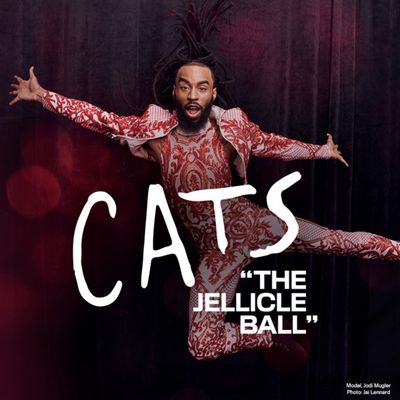
From The Vault: Originally released on May 10, 2024, this was a bonus episode with CATS: The Jellicle Ball Creative Team ft. Zhailon Levingston, Bill Rauch, & William Waldrop. CATS: The Jellicle Ball will be transferring to Broadway in March of 2026!.. Read More
From the show: The Wrong Cat Died
Guests


Featured Shows
About
From The Vault: Originally released on May 10, 2024, this was a bonus episode with CATS: The Jellicle Ball Creative Team ft. Zhailon Levingston, Bill Rauch, & William Waldrop. CATS: The Jellicle Ball will be transferring to Broadway in March of 2026!
"What overtly having categories does dramaturgy of CATS itself is that there is a particular outcome of winner or loser that happens at the end of every song." This bonus episode features the creative team of the Perelman Performing Arts Center reimagined production of CATS set in a ballroom which is appropriately titled: "CATS: The Jellicle Ball". Like me, many of you have been obsessing over this new production. I originally spoke with one of the directors Bill Rauch in July of 2022 when I first got wind of this potential new production which was just a reading at the time and the PAC wasn’t even open yet. Nearly 2 years later, I'm joined by directors Zhailon Levingston and Bill Rauch as well as music supervisor William Waldrop to discuss what you can expect from this new production. We recorded this episode two days before the team started rehearsals and discussed how this incredible production is being brought to life. This is an episode you won't want to miss.
- Check out Zhailon on Instagram: @zhailon
- Check out PAC on Instagram: @pac_nyc
- Check out PAC's website: pacnyc.org
Produced by:
Alan Seales & Broadway Podcast Network
Social Media: @TheWrongCatDied
Transcript
This transcript was automatically generated and might contain errors.
[0:00] Mike Abrams: Welcome to The Wrong Cat Died, the podcast breakdown of the CATS Ashrafi. I'm your host, Mike Abrams, and we are going back to The Vault. I was very fortunate last year in 2024 to be able to record a bunch of episodes with the creative team and the cast from the Perlman Performing Arts Center's production, CATS The Jellicle Ball, and I am thrilled that this production is going to be transferring to Broadway, and I'm very excited for what they're going to do at the Broadhurst Theater this upcoming March. So for the holiday season, for Thanksgiving and Christmas, I decided to release a couple of the episodes that we did during last year's run.
[0:40] Mike Abrams: Up first, we have the creative team that I recorded with Zhailon Levingston and Bill Rauch, who were the directors, and then William Waldrop, who was the musical director, and this was recorded actually before I'd even seen the show. This was very much a teaser about a lot of the conversations we had, and it was released on May 10th of 2024. So this was a bonus episode at the time, but I wanted to re-release it so you can hear a little bit about how the original thought for CATS The Jellicle Ball was created for PAC. Enjoy the show.
[1:12] Mike Abrams: There's a cat over here. There's a cat over there. And the wrong one died. And the wrong one died.
[1:28] Mike Abrams: Welcome to The Wrong Cat Died, the podcast breakdown of CATS Astrophe. I'm your host, Mike Abrams. Today we have three amazing guests. I cannot express how excited I am for today's episode. Like me, many of you have been obsessing over the upcoming reimagined production of CATS at the Perlman Performing Arts Center. I originally spoke with Bill Rauch in July of 2022 when I first got wind of this potential new production, which at the time was just a reading and the PAC wasn't even open yet. Fast forward to the official announcement when more of the creative team was introduced, and I knew that we had to have an episode with him. There are so many amazing people involved with this show, and I'm excited that we have a few of them here today.
I'm joined by directors Zhailon Levingston and Bill Rauch, as well as music supervisor William Waldrop. This incredible new production is opening at the PAC on June 13th and running through July 14th. I have been ready for this conversation for over two years, and I'm excited to bring it to you today.
[2:27] Mike Abrams: We are finally here to talk about CATS The Jellicle Ball, the reimagined ballroom production of this incredible musical. So welcome, William, Zhailon, and Bill, and thank you for joining me. I appreciate you guys all coming on today, so thank you all for taking the time to chat with me. I know the excitement around this production is incredible. So I want to start at the beginning for you all, and I want to hear, what was the inception of this idea? How did this begin to come to life?
[2:55] Bill Rauch: This is Bill, and I began to think about CATS in the context of a queer community. I began to think about, in fact, the song "Memory" being sung by an older gay man in a gay bar. And I knew CATS, but I didn't know it really well. And as I dug into the material, I realized, it's not a bar, it's a ball. It's literally the whole show is a competitive ball. And then a bunch of people smarter than me started to work on it, including our gender consultant and dramaturg, Josie Carnes, and one of our co-choreographers, Omari Wiles. And then Zhailon entered the picture as co-director, and everything then went through the roof because of Zhailon's creativity.
[3:47] Bill Rauch: So Zhailon, take us to that moment when you first heard the idea and you said, all right, I'm in.
[3:54] Zhailon Levingston: Oh, yeah. It just was one of those gut feeling things. I didn't know what it looked like, what it was supposed to exactly be, but it was just one of those things where you look at something or you feel something, you go, that's a right thing. That's the right next direction. And the problem was, I had nothing to do with it so far. So I had to figure out, how do I get a meeting with Bill to let him know that I have this overwhelming sense that I'm supposed to be making this with you? And so I was able to get a Zoom meeting with Bill. And one of the things that I talked about was just how I grew up on the 1998 recording of CATS, and I didn't even know what it was, what I was looking at, but it was just like starting to work on me in some way.
And I watched that from second grade to fourth grade, like every day of my life. And I was as excited about the way we could adapt to the material to fit within the ballroom context as I was about what it would mean for me artistically to engage with the youngest memories of myself and its relationship to this material in terms of me being, you know, falling in love with theater, me being a queer kid, me being someone who had to relate to this material on VHS because of the distance between here and Broadway, you know, just all the things. Yeah, so yeah, it was a couple of different things coming together to create just an intuitive feeling of yes. I have to say, I'm an impulsive person sometimes, but literally the first Zoom that Zhailon and I had, we agreed that he should co-direct by the end of the conversation. New right away. Wild.
[5:49] Mike Abrams: I want to ask some questions about the music. You know, William, you are on here as the music supervisor and kind of bringing this music that's been around for a long time and taking this music that a lot of people know, people know "Memory," people know a lot of the songs and transforming it into a different culture and setting and everything that comes with it. How do you start to tackle a problem like that? How do you think about that?
[6:09] William Waldrop: Well, it is a huge challenge, but I guess first, what helps for me is that I've been involved with the show for a long time and been involved with Andrew Lloyd Webber Productions. And CATS, for me, has a special place because it was my first professional job. And I remember listening to the first recording or one of the recordings of the original Broadway cast. And so I come from that world of sort of like doing those shows. And the challenge is how do we bridge this iconic score and fuse it with this incredible ballroom influence and ballroom music and all that goes around that and the history of ballroom and the decades of what it means for that community and all of that. And so I've been lucky enough to be brought on to the team to help.
But I have an incredible team of my own that's helping to put all this together. We have Trevor Holder, who's the beats arranger. He's an incredible arranger who's helping us design and execute the actual insertions of different kinds of beats that we're putting into the songs. And then we have Capital Chaos, who is from the ballroom world, a brilliant DJ and knows about all the specific elements of ballroom and the flourishes and everything that makes the music crucial and how the people on the runway react to the music. He's so intrinsic to that. And then we have several other people helping us develop these and produce these tracks. So it's a delicate balance of keeping the score intact and keeping Andrew's music a place where everyone remembers and is familiar with it, but also being authentic to the ballroom world and having those moments in the show where you least expect it almost for the ballroom to just burst out of the song. And that's where we've found the sweet spot of making this entire concept work.
[8:15] William Waldrop: Yeah, there's definitely moments that everyone's going to know. I mean, there's music in this that people immediately know, like the Arbiter and "Memory" and definitely a couple of the songs, but being able to transform it into a different view. What would you like? This is going to go out before the show is even out. So this is before anybody goes, people will be able to hear this. What would you tell an audience to expect from it musically?
[8:38] William Waldrop: I would first say, you know, I have to honor Andrew first. I would say first expect the iconic moments that you know and love of CATS, those moments when the jellicle ball starts and that sound that we all know from the 80s that always will be there. However, it's the surprises for me that I want everyone to be ready for. So when the beat drops, that's where we try to really make these sort of just dynamic and exciting moments that help us tell the story that, you know, when I came on, I couldn't believe how perfect this story works and how moving it is. And so that's what's special about it. Hopefully, this doesn't give away too much. But I would say that a lot of what we thought about in relation to ballroom beats is when we're actually in a moment of competition on the runway. And that is often where the beats come in in terms of Andrew's music.
[9:39] Mike Abrams: I want to talk about competition. I'm glad you brought that up. Because as everyone who's listened to the show knows, I had always thought this show is the X Factor on drugs. And we talked a lot about how that was a big part of my view of the show. And so you're bringing some of that to life. So how are you, I mean, what can you tell us about how you're doing without giving too much away? How can you tell us about how you're bringing that competition piece to it? Because I think it's a part a lot of us think about of like, which characters most worthy in this competition. And you're actually taking that as a central theme of how you're telling the story.
[10:12] William Waldrop: I will say one of the most creative, and fun and sometimes maddening, but then, again, fun when we find the solutions has been trying to find the match between character and category, the songs and the categories. And some of them, like the very first thing that was put out there, that's still what we're doing. And then some of them went through multiple, I will just say that the one that probably changed the most was Macavity. Okay, that we really, really struggled with Macavity before we hit on what we're using. But others like Rum Tum Tugger, we knew right away.
[11:01] Bill Rauch: Yeah, I mean, what I would add to that is just like, I think what overtly having categories does to just the dramaturgy of CATS itself, just the way the story moves, is that you know that there is a particular outcome of winner or loser that happens or should happen at the end of every song. Yet you don't necessarily know who was going to win or lose at the end of every song, just because a song may be about a certain character or not about a certain character. It doesn't necessarily mean that's the one who gets their chance. And so it adds this other layer of suspense and tension to the event that I think is going to be really satisfying for people.
[11:45] Zhailon Levingston: Let's talk about the categories, because I'm not sure everyone who listens to this knows ballroom culture well to know what that even means. And you put up some really good videos about it. And I've seen and I've read up more about this as well. But how does that, I mean, that's different than what the current CATS story is that people are used to. So talk a little bit about that experience that people will get.
[12:05] Zhailon Levingston: Yeah, I mean, the categories really represent.
[12:09] Zhailon Levingston: The world that best fits each CATS song. And so there was a kind of like, to Bill's point, some categories that existed from the very beginning that we were like, yes, that is always going to be Tag Team Vogue performance. That's always going to be that. And then there's certain categories that evolved based on our understanding of how we were reinterpretating the characters and how the adaptation went along. i.e. McCavity, who in this version walks a category called Labels. And all these categories kind of represent some fantasy that these CATS believe that they are aspiring to. And that is the parallel between it and ballroom culture, right? Ballroom saying we are coming from an underground perspective, but we are just as worthy and valuable as anything you may see in the mainstream.
The other thing that I want to say that really moves me about the ballroom setting is, you know, there's so many shadows of mortality, and, you know, real kind of spiritual depth in TS Eliot's words, and Andrew's score. And I mean, the name of your podcast, right? There's a depth at the end, depending on how you interpret what it means to go to the Heaviside Lair, that I feel like the context of ballroom, because in its current incarnation, ballrooms really existed for over 50 years now. And there are multiple generations of people, and there are people we've lost, who were ballroom founders and ballroom icons. And, of course, so much of the early ballroom days also overlapped with the AIDS epidemic.
So there's, I think, real poignance in all the songs that touch on memories of younger days, on the responsibility of passing on the baton to the next generation, like all of those themes, and our very multi-generational cast. You know, which character is a virgin voguer who's voguing on the runway for the very first time, and who has been in this world, you know, and seen multiple generations come and go. And I think that that is a real gift of TS Eliot's words, Andrew's music, and the authenticity of ballroom. Like, those things meeting, I think they shed a lot of light on each other in really surprising ways.
[14:52] Bill Rauch: Yeah. I think what it creates is this opportunity for there to be a certain kind of event that's always happening on the runway, but there's another kind of poetry and pathos that's going on around the runway as well, that doesn't make the show just about the event of competition, that it is also about the entire human experience in some way.
[15:17] Zhailon Levingston: Yeah. I love what you're saying, too. There's the whole community and family, and that's kind of what the Jellicles feel like. It's this group that are coming together for their night. Yes, they're going to have the competition, but there are these multiple generations, and one cat's telling stories from time past, and another is brand new and getting their first experience at the ball. And you're able to bring that in against a slightly different tweak, but a similar culture that has that exact same type of world brought to it. So, I love the idea of this and the way that you're going to bring it to life just fits so perfectly with it.
[15:54] Mike Abrams: I want to ask, though, a little bit about the story when you think about that, though, because Cats is always... One of the criticisms of Cats is the story is pretty loose. And you have a little bit more of what this competition and with the setting, a little bit more of a way to tell a truer story, in a sense. How do you all think about that when you are directing this to bring that to life? Is it a, I want to tell, not a beginning, middle, and conflict resolution type of thing, but a here's what to expect from when you sit down to when you leave?
[16:31] Bill Rauch: I mean, I guess one way I would begin to take on the question, because it's a big one, would be just that I actually do think that Cats is mostly story. What Cats is not is a lot of plot. And I think that the relationship between story and plot is usually, in other musicals, has a much closer relationship. And one of the things that makes, obviously, Cats feel distinctive is that it actually is only about the change that happens over this one night. And if story is about how people change over time, that's why we feel emotionally satisfied at that event. And so I think much like actually the original, our story anchor points are how we are interpreting Grizabella, who is the character whose transformation has the biggest impact on the night, right, who is our protagonist.
And if we contextualize Cats as a mega musical, a spectacle musical, one of the first musicals to do that, I think the way our show is in conversation with that idea is that in our show, the spectacle is humanity. The spectacle is the multitude of human stories that are now going to be in relationship to this poetry and these things that emerge in the poetry. And I think that that's going to be really, really, really fun and interesting and something that helps to keep the show alive, even after it's open, is that it isn't just one story, it's this multitude of stories. And that's the thing that justifies the event itself.
[18:22] Zhailon Levingston: Yeah, you're totally right with the plot versus story. And I would love to ask you, from that perspective, I've spent most of this podcast digging into backstories of the Cats, some that's very clearly stated and some that's lore and everything in between. And there's some very clear stuff and stuff that's not. And we're a couple of days recording this from you going into rehearsals. How much of that are you going to be bringing into, all right, I got to tell Skimbleshanks about this, I've got to tell Macavity about this, versus letting some of that come naturally with the overarching theme?
[19:53] Bill Rauch: Well, I will say we've done five developmental workshops, two with full cast, two that focused on dance and one that focused just on music. So we've had a lot of input from a lot of extraordinary musical theater artists and ballroom artists, some of them who are still part of this full production and some of whom were able to jump in and be part of a workshop. And that was their contribution. So we've had so many voices. So we've had a lot of our kind of directors and choreographers and dramaturge wrestling with it all. But we've also had input from a lot of performers. I will say that an important part of ballroom culture is houses of ballroom with a house parent, with a house mother or a house father and the children that are in that house.
And so trying to find the meeting place with our relatively small cast and house culture, that's like finding the meeting place between characters and categories. Finding the meeting place between houses and the story has also been really significant. I don't know, Jalen, if you want to give away anything about one or two of the houses that we have, or if you think we should keep it secret.
[20:27] Zhailon Levingston: Don't be houses, and maybe you'll recognize some of their names. I was going to say, let's tease it out here, get people ready to go.
[20:32] Mike Abrams: So along those lines, how much research does someone who knows little about ballroom culture need to have? What's the baseline that you would tell anybody coming to see this that they should maybe read up on or enjoy it? I'm sure they're going to enjoy it either way, but is there this a little bit that they should know?
[20:54] Bill Rauch: I mean, I think like any hopefully good art, the more you bring yourself to it, the more you engage with the material, the more you are independently curious about the context, the more thrilling the experience is going to be for you. I think our gig is to make something that can catch people at every level, and so I do think if you know nothing about ballroom culture other than people are going to be competing against other people tonight, then you're going to get, I think, a really thrilling competition show, and you're going to see some relationships that are surprisingly poignant or hilarious or scary or whatever, and I think the more you know, then the more you know, and like a good book, you just want to read it over and over and over again, and so I think anyone coming in blank is going to have a thrilling time, and hopefully we're shooting to reach and impact the ones who are coming in with as much context as we have having been immersed in this material for the past few years on either side, ballroom or cats.
[22:02] Zhailon Levingston: That's exactly what I was going to say, that I think is true for cats virgins and for ballroom virgins, is that hopefully we're telling the story in a clear way. There have been people who have come up to me and they were like, I've never seen cats, so yours is going to be the first one. What do I do? And I just thought, just come see it, you know, you'll interpret it, and you'll see it.
[22:25] Bill Rauch: Yeah, I've always thought cats was a good show for anybody because of how you don't need to know much. It's just, they're cats. At the end of the day, they're just cats, and you're going to see something beautiful on stage, so I think it's exciting.
[22:37] Zhailon Levingston: At the end of the day, isn't that true of humanity?
[22:39] Bill Rauch: Completely.
[22:41] Zhailon Levingston: Right, like as complex and different and messy and all the things that we are, we are actually all all those things, so you'll connect on that level.
[22:51] Mike Abrams: We're going to take a quick break, and then we'll be back for more of The Wrong Cat Died.
[22:56] Mike Abrams: I really liked in one of the videos I saw that you all put out was that like cats, the ballroom culture comes from the streets, but also the cat is the alter ego or the ego of the performer and not being in cat. Because you are doing it, it's going to be a human interaction. So I want to hear a little bit about costumes and the design and what we're going to see there, because this is a show that's so iconic for cosplay and everyone who does come up in full cat, and there's the full entity of that, and you're bringing this in the human version of this. So how did you decide a little bit about how you maybe keep some of that junkyard ish feel and some of the cat feel, but also bring it into the ballroom culture?
[23:38] Bill Rauch: For starters, our costume designer, Queen Jean is a genius and is somebody who really knows the ballroom world and who is a very accomplished theater costume designer. And so Queen has just brought idea after idea after idea. And one of the kind of polishing the gems of these designs that Jaylen and Queen and I have done in the last couple of days has been looking at where the feline touches exist in the clothes. And a lot of that was already in the design, and we've been adding.
[24:18] Zhailon Levingston: A few more Easter eggs, uh, or grace notes, um, in terms of the feline touches, for sure. And there's tons of Easter eggs. So it's like, you know, back to the more you know, the more you know part is just like, if you know a lot about cats, there's actually a lot this adaptation has to say about everything you already know, um, but in extremely different presentations. I would say the other thing that's really distinctive from the costume world is just like, you may see a cat in three or four different costumes in the night, which is, I think, very different than the way the show usually is with, you know, your one iconic look. In this show, it's really what is your iconic personas? And how do we dress that up? And how do we find that continuity, um, between those looks themselves? Um, and so just costumes as its own kind of spectacle in this show, it feels like a kind of new take on the material.
[25:14] Bill Rauch: Yeah, because the ballroom categories demand transformation, and some of the categories demand an authenticity in terms of what the look is in that category. So as Zhailon is saying, we've, there's a great tension between wanting the ballroom competitor to have their own arc in terms of clothing, but also that they are deliberately transforming themselves if they're walking X category versus when they're walking Y category.
[25:45] Zhailon Levingston: You've talked about this a lot with the paying homage to the source material. In the similar sense, I'd love to hear just quickly on the choreography, because there's, you know, Gillian Lynne, Andy Blankenbuehler, there's these brilliant choreographers who have done this production, um, you know, over years, there's plenty of others, but you're bringing a different version of it. So how do you in the same realm kind of honor a little bit of what people come to know and love about the choreography, but also bring your own new interpretation to it?
[26:13] William Waldrop: We're working with two amazing choreographers from the ballroom community, Omari Oricci and Arturo Lyons, who are legends in ballroom, and who also have experience in multiple styles as well. And I think, you know, one of the things that is important for team choreography that I've heard them talk about is just the breadth of urban street styles that they want to be able to showcase in this production. And just the range of genres that they want to engage with. And I know that, you know, when people hear about cats and ballroom, you're going to automatically think about voguing, and that is a very distinctive choreographic language that will be a big part of this production, but also not the only part of the production.
I think that's important for people to know as well. And I would say that its relationship to the iconic choreography of the past is not so much in how it looks, but the spirit in which it comes from, which is how do we put these bodies in relationship to each other in a way that we've never really taken in in a musical like this before? And I think in the same way, we're probably using more of that vogue language vocabulary in a kind of dramaturgical context in a musical. I don't know many musicals that have done that past a number or two, right? So what does it mean to really take the form as seriously as it can be taken and stretching it as far as it can be stretched?
[27:59] Zhailon Levingston: Everything you're saying, I think the whole Cats community and a lot of the theater community is thrilled and excited for this. So I cannot wait for y'all to start your journey, bringing this to life and for everyone to come see it and come to New York and to the PAC and the beautiful theater. Before we get into it, of course, I got to ask you the million-dollar question, but before I do that, what's your parting... This is going out before people can go see it. So this is before anyone's seen the show. What's the, like, hey, come see it. Here's what you're going to expect. Here's what we want to bring to you. Here's my, like, little elevator pitch on why you're going to love it.
[28:27] William Waldrop: Well, I will just say, get tickets sooner than later because the presale of Cats tickets has been by far the most robust. We've had a lot of amazing projects in our inaugural season at PAC NYC, but Cats, the tickets are going out the door faster than anything we've done all year. And so that's my pedestrian comment is get your tickets by now. Yes. But yeah, I would just say, yeah, come and prepare to have fun, but also prepare to feel everything, you know, all the emotions, all the colors. And the show needs you. Like, it actually needs you to be there in order for it to justify itself. And so bring yourself, bring a group, bring some girlfriends, bring some boyfriends, you know, make it an event. And I think it will meet you on that level. Audience dressing up is welcome.
[29:35] Zhailon Levingston: I did see that. I love the advice to come in your best fashion, which is always fun. As a Midwesterner, that's, that's not very high bar for me, but you know, well, I'll do my best to do my best when I come.
[29:47] William Waldrop: We're going to be watching. We're going to be watching what you were wearing.
[29:51] Zhailon Levingston: I'll be there. Okay. So I got to ask you all the million-dollar question and, and I have at length argued that I don't think Grizabella is the right Jellicle choice. So I want to hear from you all. If you are picking your Jellicle choice, not in your production, just in general, in the Cats world over the 45 years, who are you picking and why?
[30:12] Zhailon Levingston: I will go and I will say, of course, it's absolutely Grizabella for me. Of course, because I believe in the way the story unspools. But I will say in a sequel to Cats and son of Cats, daughter of Cats, ballroom daughter of Cats. Um, for me, it's the character that we call Sillabub.
[30:37] William Waldrop: Sillabub. Okay. Absolutely. Love it. Hands down. No question. Cats too.
[30:46] Bill Rauch: I love that in, in the third installment of Cats called Cats Again. Um, I would have to say probably, I fear that this is probably cliche and gets said all the time, but he was as magical as he was in the show. He actually felt that way to me as a child. So I have to say, uh, Mr. Mistoffelees.
[31:07] Zhailon Levingston: Um, I have to say this sounds crazy, but I have to say Skimbleshanks because I love simple things. And I think that in our production, uh, Skimbleshanks played by a female identifying, um, actor and, and especially because I think that whole role of sort of, you know, the precision and keeping everyone together and all that it takes, it's, it's a really special thing. And I think I would say Skimbleshanks.
[31:41] William Waldrop: Okay. Musically, that is a very wild beat in general. Um, it's very different. I love it. So we've got, uh, Mr. Mistoffelees, Grizabella, and Skimbleshanks as our three votes. That helps me. And Sillabub. And Sillabub. Okay. Sillabub. Yeah. Um, that helps my, my numbers. We're bringing Grizabella's, uh, she's about half down. So we're, this is, this is beneficial to this, which is great. Um, this has been, uh, incredible. I appreciate y'all coming on and sharing. Um, I will link everything. How can people stay in touch with you? Uh, separately, aside from I'll link the show and the, how to get tickets in the description of this episode.
[32:23] Zhailon Levingston: Yeah. I mean, you can just follow me on Instagram at Zhai, Z-H-A-I, um, and yeah.
[32:30] William Waldrop: I love it. You're going to get, you're going to get some, some theories probably sent your way.
[32:35] Zhailon Levingston: What are some of the funnier things that you've heard people message?
[32:40] William Waldrop: So I, people are extremely excited because again, this show, people have very strong opinions about the show one way or the other, whether it's about the choreography, about a certain character story, an arc, me making that I don't want Grizabella to be the choice. Like there is always these very deep interpretations of it and that you are taking it and putting it into a different setting is there's just so much people are excited about from that. And I love everything we've talked about with the themes and how it relates and all this stuff, but just this re-imagining of it into something that a lot of people hold, you know, very true to their hearts. Like they very much love this show. You're going to get a different version of it.
And I think that it might scare some people in a way, just cause they're, you know, they're so used to the 1998 movie or whatever it is, but there's a lot of people that have been like, I got to get tickets. When are we going? How are we getting there? Like not even in New York. And I just think the energy behind it is huge. So I cannot wait for people to get to experience it.
[33:41] Zhailon Levingston: I do want to say one last thing, if I can. We've talked a lot about what we're trying to do with this new production and, you know, our vision and the way it's come into being, but I just want to give a moment of respect to Andrew Lloyd Webber and all his colleagues at The Really Useful Group, because, you know, they're really, really committed to this iconic musical having a long life, and they're willing to let us take this risk of trying something that is different than has ever been tried with Cats. And so their, like, belief in us trying this and their support of that and the way in which they've been active collaborators with us in terms of, you know, really being engaged, like caring about the choices we're making and why we're making them and how we're making them has been really beautiful. And so part of what's on stage is not just our response to what was created 40-some years ago, but also an active dialogue with The Really Useful Group.
[34:56] Bill Rauch: Yeah. I've always said they build a world, and with that world, you can do a lot with it. And I love that they're open into this and that they're working with you and they're doing it. It also selfishly gives me hope because I want an audience voting style of Cats. And so I know if they're willing to do this, that maybe they're willing to let, not me, I have zero abilities that you both do to direct or have any say in it, but the idea that I want, I have hope that they are, yeah, maybe they'll be open to it. So it's so great to hear too. And, you know, it's something that's been so successful for so long that sometimes you would fear that they wouldn't want to make those changes or those risks. And I love hearing that they're open to it and supporting it and encouraging it and working with you all, because it's going to only make it better.
[35:40] Zhailon Levingston: Hear, hear.
[35:42] Bill Rauch: Well, I appreciate y'all taking the time. I cannot wait to be at the PAC probably multiple times in June and July and see what you all put together. So thank you all for coming on and for sharing what we can expect here in the next couple of weeks.
[35:58] Zhailon Levingston: Thanks for inviting us.
[36:00] Mike Abrams: Thanks for listening to this episode of The Wrong Cat Died, the podcast breakdown of the catastrophe. To follow along, you can subscribe on Apple podcasts, Spotify, or anywhere else to listen to podcasts. Follow us on Twitter, Instagram, TikTok, and threads at TheWrongCatDied or check out our website, TheWrongCatDied.com.
© Broadway Podcast Network, All Rights Reserved