

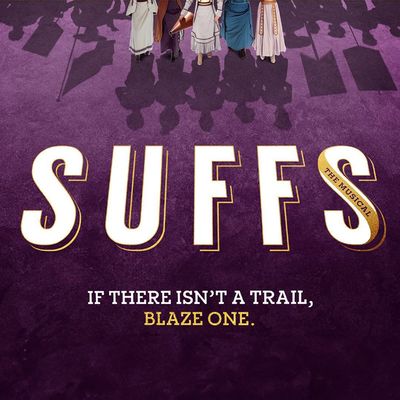
Join us for another wonderful episode of "Theatre in the D" where we talk about Shaina Taub's acclaimed musical "Suffs" currently playing at the Fisher theater! Get your Tickets to Suffs now!.. Read More
From the show: The Dear Friends Podcast
Featured Shows
About
Join us for another wonderful episode of "Theatre in the D" where we talk about Shaina Taub's acclaimed musical "Suffs" currently playing at the Fisher theater!
Transcript
This transcript was automatically generated and might contain errors.
[0:21] Miranda Moffat: Hello and welcome to another extra-special episode of Theatre in the D!
[0:24] Jesse “Jess” McAnally: I am joined as always by my partner in all things Miranda Moffat.
[0:28] Miranda Moffat: Hello, everyone.
[0:30] Jesse “Jess” McAnally: And this week, thanks to ATG in Detroit, we were able to see Shaina Taub's wonderful musical, Suffs. Miranda, tell us a little bit about Suffs and what's going on there.
[0:41] Miranda Moffat: So, Suffs, the book, music, and lyrics are all by Shaina Taub, and this musical in particular is covering the suffragette or suffragist movement for women in the United States, starting in around the mid-1910s to the ratification of the 19th Amendment, which guaranteed the right to vote for women. That was passed in, I believe, 1920, all the way up to more present-day activist movements, but focusing in on that specific time period. So it's basically Hamilton, but for the early 1900s and women. I think that sums it up, and if you had described that to me just on general premise, I think I would have cringed a bit, but my god, this show, this show was something. I don't think I've been this positive about a musical I've seen in a very long time, especially a new musical.
This is a mastercraft of someone that has known their structure and put in the time to learn musical theater and how it works, and how to use songs to tell a story that you're passionate about. Shaina Taub is an auteur in that way, in the same way that Dave Molloy is, in the same way that Anais Mitchell is, and in the same way that Lin-Manuel Miranda is. She is one in a million, and we are lucky to have her and give her a thousand Disney films and a thousand musicals because she does this so well. I loved it, and I had a blast.
[2:20] Jesse “Jess” McAnally: Yeah, that is my overall opinion, but Miranda, what do you think?
[2:25] Miranda Moffat: I think I'm of a similar opinion. I think if I'm just taking it at face value as a musical, as a piece of art, I agree with you. I think it is perfectly structured. I really enjoyed the songs. I enjoyed the complexity of the music, the different harmonies that they had going on in all the pieces. And this is also kind of a rare thing for me to say, is that these are songs that I think I would return to. Typically if I see a musical, I tend to enjoy it as a piece or in small pieces for things that I really like, but I don't tend to go back to it unless I really, really liked it. I think for this, there were songs that I really, really enjoyed and I will return to. I think if I'm thinking about it as something representing history, it feels a little bit more complicated to me as, like I said, somebody who is pretty interested in the history.
I think it does a pretty good job at representing that progress in a movement like suffrage isn't always perfect. I think any time that you look back at progress that has been made, it was always made by imperfect people in their specific context. I think it does a really good job of acknowledging the contributions of Black suffragettes like Ida B. Wells and recognizing that they were also fighting for their own movement, but still largely iced out of what the prominent suffragettes were doing in their day. I think there could have been maybe a little bit more on the contributions of those women in my own opinion. If I had to have some critique, I would say there are some times where it does feel slightly pandering to me in particular as a white woman, but I think overall, I appreciate it for what it is.
I think in the same way as Hamilton or Evita, you have to sometimes oversimplify things or make things convenient to tell a cohesive story. The truth is, if you're being very faithful to actual history, that will never be the case because history is always super complicated and inconvenient. I think with all of that in mind, I did really enjoy it. I think something that we've talked about that I really appreciated is the overall message at the end, which is there is still always so much more work to do, and there is always the next thing, and there is always injustice, which is so, so, so true. So, so, so relevant today. So yeah, that's my general opinion.
[5:07] Jesse “Jess” McAnally: Understandable, and I get what you mean about the pandering. I've coined these as now every musical wants to have seven immigrants, we get the job done moments where we stop and let the audience applaud us because we're all progressives. It didn't take me out of it too, too much. I take it you really didn't know who Shaina Taub was before this?
[5:27] Miranda Moffat: No, no, I did not.
[5:28] Jesse “Jess” McAnally: Shaina Taub is someone that has been in this industry in the background and really kind of, I don't want to say taking her pains, but it felt that way. One of the first things I remember clocking her in, there was a vaudeville show with Bill Irwin and his partner, and you know Bill Irwin as the clown from Mr. Noodle from Elmo. He was the dad in The Grinch, and he does clowning, and he would just go on stage, do a bit, and then we'd have Shaina Taub on the piano, and she'd sing a goofy little song, and then they'd do more bits, and then she'd sing a goofy little song, and then she moved up to doing Shakespeare adaptations funded by the Public Theater. She did As You Like It and Twelfth Night, but two versions of Twelfth Night.
I have been a big fan of her Twelfth Night. I have been a defender of it. I think it is wonderful, goofy, funny, and all the things that she brings. She's so good at the bouncy stuff. And then she had an unfortunate collaboration with Elton John where she did the lyrics for the Devil Wears Prada musical in London that was reviled by critics. Elton John has not had good luck on Broadway unless it's The Lion King. And then this is kind of like her big step into the big leagues, and she had to bring her A-game. And I think it kind of goes to show that as far as women in this industry, they have to be exceptional enough to both write every word, every note, and then star in it, which is rare enough for any individual.
Correct me if I'm wrong. I don't know of any other female writers that I know. We have Lin-Manuel Miranda and Dave Molloy's of the world. Sara Bareilles. Her and Sara Bareilles are in the same world. And I just am completely and utterly impressed. I was talking to Miranda briefly about it, like how on the surface, if you actually kind of listen to the songs and just feel what it is, very ra-ra, yeah, we did it, way to go, girls. But if you actually pay attention to the themes, it is one of the most depressing and kind of daunting, realistic and horrific messages I've ever left a musical feeling. Basically, it's like, yeah, we did a thing, but even when I die, it will not be enough. The message is, it will never be enough.
But we keep marching, I guess, because we have to. And it truly left me with this gut punch of like, it was not this thrilling success story. It was really this, it will never be enough. I will eventually be replaced. And I will fall into the same mistakes that my elders fell into before me. And this is a repeating pattern forever. And it is horrific to think about. And I really appreciate a show that in theory is supposed to be a fun, goofy romp about history in the same way Hamilton is. And it has such a weirdly myopic ending.
[8:27] Miranda Moffat: It does. And I agree with you. I could not tell you whether or not that historical relationship between Alice Paul, who is the protagonist of the show, and I can't remember who the older lady's name was. Let me see if I can find it. I think it was Carrie. Let's see. Yes, Carrie Chapman Catt, who is basically the representation of the old guard of the movement who is trying to lead things a certain way that worked for them and trying to do things steady and slow. Whereas Alice Paul is coming in as a figure who is speaking from a younger generation who has a lot of vitality and wants to get this done now. They're tired of waiting. And that is like the push and pull that always exists in human rights movements and equality movements in general.
There's both the feeling of like, you can't get everything done all at once. And also, like, we've waited long enough. Like, if not now, then when? If not me, then who? So I think like it does show the push and pull. And then, as Jesse said, kind of at the end where you see Alice Paul being confronted by like, I think it's set in probably the 60s or 70s, whenever Nixon was banging about and seeing that she has now become what was the word they use the old crony or buddy, daddy.
[9:44] Christi Esterle: Something, some kind of fun turn of phrase. I could not tell you whether or not that is an actual historical relationship that exists between Alice Paul and Carrie Chapman Catt. But I think, like I said, for the purposes of this, you kind of have to simplify history to make everything make sense together. I think, for me in particular, I also appreciated the fact that it's exploring the inherent fear that women have. Also, like those two, the sort of, again, the dichotomy between Alice and Carrie, and those characters' views on how those movements should go and move, where there's still that underlying fear of being perceived as dangerous, or a shrew, or unfeminine, or too much, or too complex.
And I think that idea is pretty well represented in having to make a choice between having the things that are traditionally there for you, like getting married and having a family, or dedicating your life to a cause that really means something to you. And it's like the same thing women are facing today between marriage and family, or career, and can you have it all? I think that that is well played out, and I think that that's pretty interesting. I also love that it's an all-woman cast. It's very Shakespearean in that the women are playing men. I thought that that was very interesting. I really appreciated that. Also, I could not verify the historical accuracy of some things that I really enjoyed, like Carrie basically having a relationship with her friend.
I don't know that that's historically accurate. I'm going to tell you the facts, and you can tell me whether or not it is. So, Carrie lived with her husband. Her husband died, and then Molly Hay moved in with her, and they had a special relationship. And when Carrie died, she was chosen to be buried next to Molly, opposed to her husband. Read between the lines there, kiddos!
[11:46] Christi Esterle: Um, as far as the historical aspects, I kind of give this the same leeway that I give most historical musicals. Musicals are very hard to kind of get fact-accurate, because there is the element of heightened aspect. There is an argument that, you know, since this is such an upbeat musical, that the more horrific elements like the force-feeding and the hunger strike do kind of come off a little darker because of it, which I kind of appreciate. I kind of like the tonal jump, especially because there's an expectation of that in the second act of a musical, and it happens right away. So, I can imagine other people might have that issue, but I did not feel that, personally. I also want to highlight—what was her name?
Inés Mahaland, who I believe was played by Brandy—or, Monica Tulia Ramirez. My god, what a performance! And for one act, basically an act and a half kind of character, she stole the entire show. She was such a showstopper, and anytime she was on stage, she was bringing the A-game. Truly, probably my—her and the young lady that played Woodrow Wilson—my top two MVPs of the night. Everyone did a great job, but those are the ones that really, really struck it out of the park for me.
[13:11] Emily Clark: I would agree. One of the things I do remember from history is that image of Inés Mahaland on the horse during the march, which I think was in 1913, if I'm not mistaken. That was particularly moving. That whole sequence, and also the sequences at the end, as we talked about, that sort of wrap up the idea of, there is always still more work to do. I also loved—I cannot remember what her name was that played the Polish. I guess it was Ruza. I think Ruza was the name of the character, played by, it looks like, Joyce. I also loved her character, and I loved that there were those slight fourth wall breaks when the actors were telling you, this is actually what happened. There's a couple moments where, for example, Ruza's character—I'm pretty sure that's her character—basically is like, I'm going to go off.
I was a factory worker and an immigrant, and I've been in the suffragette movement, and now I'm going to go be an actor on the Broadway stage. The actor's like, and that's actually what she historically did next. She died at 44. She was a young woman when she died. That's ridiculous.
[14:25] Christi Esterle: That is ridiculous. I didn't know that. There was a couple moments where the actors will call out, like, hey, this is actually what this person said. Isn't that ridiculous? Which, isn't it ridiculous? I think also, one of the sequences that I particularly loved was Woodrow Wilson's chief of staff. I can't remember what the character's name was. It was, oh, Dudley Malone. Dudley Malone and then the other young lady who, like, fall in love in the process of that whole thing. That, like, if we were married sequence, when they're talking, when she's basically doing a fun, it's very Hamilton that way, where you're telling really horrific things in a really fun and upbeat, jaunty way, where she's talking about, like, yeah, it's beautiful.
If we were married, we'd love each other forever. Also, I'd technically be your property and could never have money of my own, and all my kids would be considered your property as well. I think that mixing of the incredibly serious and heinous parts of history with something kind of upbeat in almost a satirical way was another aspect that I really enjoyed.
[15:33] Christi Esterle: And that is all historically true. Dudley Field Malone did marry Doris Stevens, and Doris Stevens was the person that wrote all the books about why we know these stories. She did keep the record. This is accurate. Her book was also adapted into a film I had to watch in APUS History called Iron Jawed Angels that tells this same story. It stars Hilary Swank so much worse. Shaina Taub had the decency to know that we did not need a scene of Alice Paul masturbating in a bathtub to imply heterosexuality. I really appreciated how this was such through a female eyes and telling the story in such an economic, effective, always fun, always audience first, but always with history in mind. I could not sing enough praises of this show. Go see it, guys.
[16:32] Emily Clark: I agree. I think if you like musicals in general or if you're a history buff like myself, like I said, Jesse's over here doing some on-demand research to check the historical accuracy, but there's always going to be things that are a little tampered with in adaptations. But so far, it seems like a lot of it is correct, which I really love. I appreciate the specificity, and I like history, so I like that it's accurate. I also really enjoyed it. I was really moved by it. I had really complicated feelings about it, which I think is always a testament to the complexity and the well-doneness of something is having a lot of thoughts about it. So, I would agree. Go see it.
[17:16] Christi Esterle: And what is your cheese rating, Miranda? What kind of cheese can encapsulate the suffering and triumph of the early suffrage movement in the United States? What a great question. I don't know. What's yours?
[17:33] Emily Clark: I'm going to give it cheddar or muenster because that was what Susan B. Anthony allegedly despised the most, according to the movie Iron Jawed Angels.
[17:42] Christi Esterle: Good lord. Yeah, Susan B. Anthony. God, that's another really contested historical figure. Let's see. What would be like a classic cheese, a classic Americana cheese? Velveeta.
[17:59] Emily Clark: Velveeta. I wonder if Velveeta existed at that point. That feels like a very 1950s thing, like canned cheese. I don't know, man. I'll have to get back to you on that. I'll agree with your muenster.
[18:11] Christi Esterle: You can take muenster and I can take the other one. Yeah, we'll mutually agree on cheddar and muenster cheeses for this. If you can, go check out Suffs at the Fisher Theatre. It is a true blue Broadway musical. I cannot tell you how grateful I was that there wasn't just random guitar moaning. With respect to people that love those rock ballads, I was just so glad that I got proper show tunes, proper show tunes on a Broadway show. I've missed you so much.
[18:41] Emily Clark: And our next show that we will be seeing is the one, the only Hamilton, which will be playing at the Fisher Theatre from April 29th to May 17th. If you want to hear our thoughts on that, oh my god, it's playing for nearly a month. Yeah, you have a lot of opportunities to see Hamilton, so go take that opportunity. But first, see Suffs. Go see Suffs like five times.
[19:04] Christi Esterle: Thank you very much, Miranda, for joining us. I hope you had a good time.
[19:07] Emily Clark: I did too. I had a great time. And if you go see Suffs, I think you will too.
[19:11] Christi Esterle: All right, and we will see you next time on Theatre in the D.
© Broadway Podcast Network, All Rights Reserved